

Fomena: Anti-Asiamah NPP protesters rebrand party office NDC
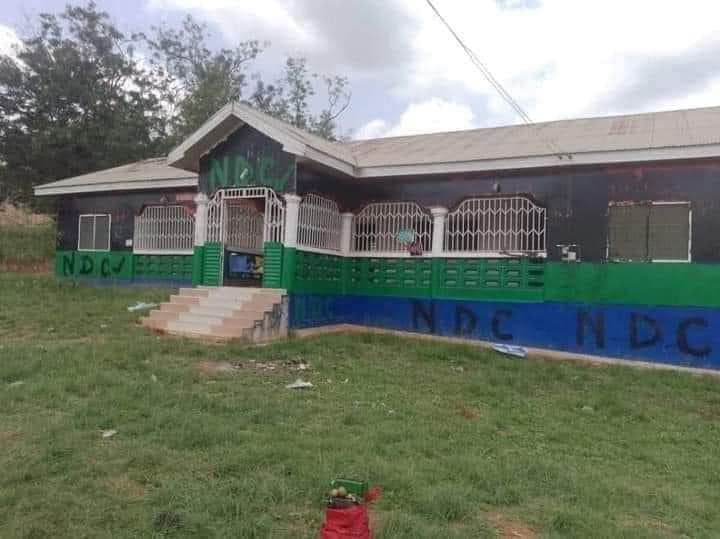
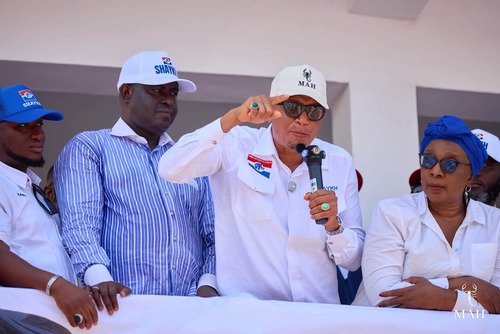
The Fomena constituency office of the governing New Patriotic Party in the Ashanti region has been rebranded NDC by some disgruntled supporters of the NPP. The party members are accusing their leaders of deploying illegitimate means to impose the Fomena constituency member of parliament on them ahead of the party’s polling stations election. The allege the party’s national elections committee is aware that Mr. Andrews Amoako Asiamah who was sacked from the party during the 2020 elections for contesting as independent candidate in line with the party’s constitution is returning to contest election 2024 on the ticket of the party. The said the national executives of the party have given the MP who is not a member of the party the opportunity to form a team of five each for every polling station in the constituency contrary to the party’s constitution. The aggrieved party members believe both regional and national executives of the party are behind this move. “We will not vote for the NPP in the next elections. We will vote for John Mahama because at least, he has built a modern hospital for us,” one of the angry supporters said. The leadership of the party in the constituency is to comment on the development. —Starrfm Please contact Apexnewsgh.com on email apexnewsgh@gmail.com for your credible news publications. Contact: 05555568093
We must wind down the hubris, the arrogance, and the show of impunity that the people see–Prof. Kwesi Botchwey

Professor Kwesi Botchwey, a former Finance Minister, has advised the Akufo-Addo government to accept the fact that the economy is in a crisis and tell the people the truth. He said: “Our current travails can be overcome provided we level with the people. The solution to a problem begins with recognizing that there is one. It must start with the recognition that it is a crisis and level with the people. We must wind down the hubris, the arrogance, and the show of impunity that the people see”, The lecture was on the theme: “On the state of the nation’s economy and politics, 65 years after independence, the path to sustainable development and democratic consolidation.” Prof Botchwey said at the 65th Independence Day Lecture held at the Economics Department of the University of Ghana, Legon, on Monday, March 7, 2022. A day after President Nana Akufo-Addo asked Ghanaians for help in getting the economy back on track. According to President Akufo-Addo at Ghana’s 65th Independence Day anniversary, he will not renege on his pledge to help create progressive and prosperous Ghana” but he, however, cannot do it alone. “I need the backing of each and every one of you, if we are to bounce back together and build a Ghana beyond aid”, he pleaded at Cape Coast, Central Region on Sunday, 6 March 2022. The anniversary theme: ‘Working together; bouncing back together’, “imposes a duty on all of us” as far as what it means to be a Ghanaian and loving one’s country, is concerned. Borrowing a leaf from history, the President recounted how “our forebears worked together with the belief that Ghana, once free and independent, could make her own unique contribution to the growth of world civilization and be able to generate wealth and prosperity for the masses of her people”. “They forebears put away ethnic, political and religious affiliations and came together to work for the liberation of the Gold Coast from colonial and imperial domination”, he pointed. “Each one of them”, Mr. Akufo-Addo explained, “contributed their quota toward a free, independent Ghana in which we now live”. “All of us gathered here and millions out there – inside our borders and outside – share this love for the place we call home”, President said. According to him, “When we make wrong choices, we must act to set things right” and “when those put in charge of running affairs get it wrong, we must have the courage to say so”. “That is our patriotic duty and calling. But, we must not, at any given opportunity, run down our nation simply because we can, all to achieve a narrow, political can partisan interest”, President condemned. Ghana’s democratic system of governance, he noted, “acknowledges that we’ll have differences of opinion on the way forward for our nation. We must, however, recognize that the expression of those diverse views should not undermine the fundamental unity we need to forge to advance the cause of our nation”, President added. The Ghanaian leader said despite the harm done to the economy by the COVID-19 pandemic, his government will soldier on to fix things. “Fellow Ghanaians, for the last two years, we’ve seen, as a result of the COVID-19 pandemic, the disruption of the global supply chain, and the global financial system; the opening up of a huge funding gap in virtually all countries, the widening of the fiscal deficit and increased public debt level. Simply put, there are difficulties everywhere in the world. We are seeing increasing global freight rates, rising crude oil prices – which means rising fuel prices; rising cost of items on the market, as a result of inflationary pressures and the depreciation of currencies”. “Inasmuch as these are all happening in all countries around the world, the government of Nana Addo Dankwa Akufo-Addo has not thrown up its hands in despair. We’re not looking for the easy way out”, he clarified. He said: “We’re determined to become even more self-reliant and, in the process, find Ghanaian solutions to Ghanaian problems, as, already, we have made considerable progress toward this end”. He noted that, for example, Ghana, today, “is a net exporter of foodstuffs thanks to the success of the programme for Planting for Food and Jobs” while pointing out: “Free Senior High School is ensuring money, or the lack of it, is no longer a barrier toward the attainment of a minimum of senior high school education for every Ghanaian child – an important tool for the development of our nation”. “We’re processing more of our cocoa in Ghana than at any other time in our history”, adding: “The ‘One District-One Factory’ initiative, which has seen the ongoing construction of 278 factories cross the country – 106 completed – is part of the foundation, on which we are building a comprehensive industrialization programme by the development of strategic anchor industries and the coordinated exploitation of our bauxite and iron ore resources”. Also, the President noted: “We have opened up this country through the construction of roads, more than any other government has in the history of the fourth republic”. Further, he said: “Our efforts at digitization are improving transparency, accountability and efficiency in the public sector and helping to accelerate the growth of our economy”. “Fellow Ghanaians, these and more are what we have used tax revenues for over the last five years. In all your communities, villages, towns, constituencies and regions, you’re seeing your taxes at work – whether it is the construction of a classroom block, clinic, small-town water facility, factory or road and we will continue down this path”, he stressed. Apexnewsgh.com/Ghana
UER: RCC and MMDCE’s Contributes Ghc105,000 Towards National Cathedral Project
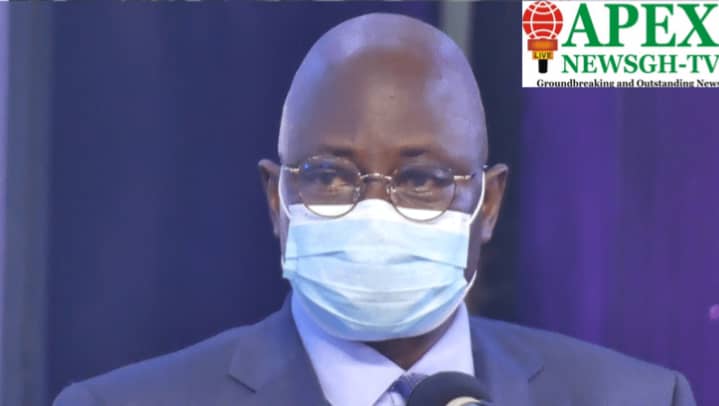
”The building of the National Cathedral required the physical and spiritual support of all Ghanaians for its establishment”. The above remark by the Upper East Regional Minister Stephen Yakubu was a backup message after the Upper East Regional Coordinating Council (RCC) made a donation of GHC105,000 towards the construction of the National Cathedral. “On behalf of RCC and my lieutenants, the MDAs, our contribution is hundred and five thousand Ghana Cedis”, he said. The Regional Minister commended President Nana Addo Dankwa Akufo-Addo and his administration for the wonderful initiative to put up a place of worship “Cathedral”. Adding that, it is prudent to give proper protection to the soul while engaging in activities for material wealth. The total amount of One Hundred and five Thousand Ghana Cedis Ghc105.000 was handed over to the team in charge of the Cathedral project. The event took place at the Fountain Gate Chapel International Bolgatanga with some MMDCE’s present. Apexnewsgh.com/Ghana Please contact Apexnewsgh.com on email apexnewsgh@gmail.com for your credible news publications. Contact: 05555568093
Cedi’ll hit GHS10: $1-mark before 2022 ends – Nii Moi

An Economist Dr. Nii Moi Thompson has predicted that unless there is a drastic interventions to arrest the fall of the cedi to the dollar, the struggling Ghanaian currency, which is currently above GHS7 to a dollar, will hit the GHS10 to $1 before the end of this year. Read Dr Nii Moi Thompson’s full article below: On 4th March 2022, the Bank of Ghana reported that the cedi had reached 7.00 to the dollar. Compared to the rate of GHc4.2 at the end of December 2016, this meant the cedi had depreciated by 40.02% against the dollar since January 2017, when the government took office amidst flamboyant promises to usher the cedi into a golden age of stability. In mid-2017, the vice president, Dr. Mahamudu Bawumia, who now chairs the economic management team and had been hailed as the ultimate saviour of the long-suffering cedi, proudly declared that he had “arrested the cedi” (or its “rate of depreciation”?), locked it up, and given the key to the IGP. There appears to have been a jailbreak since then, and the IGP must answer some questions. As to be expected, the rates at forex bureaus were higher than the BoG’s rate, with one bureau quoting US$/GHc7.6 on the same day; it was likely higher still at Cow Lane, the engine room of the underground currency market in Accra. Clearly, unless drastic action is taken – and soon – the cedi may well reach the 10:1 mark before year’s end, dragging with it the already-struggling economy. We can’t afford that. How did things go so horribly wrong between 2017 and now? What happened to those flamboyant promises and the vice president’s smoke-and-mirrors lectures on the cedi, complete with insults for anyone who dared disagree with him? And how do we get the cedi out of this quicksand and back on firm ground to prevent the imminent implosion of the economy? To answer these questions, we need first to revisit an article that the vice president wrote on his Facebook page in 2018 when the cedi started wobbling; briefly look at the cedi’s beleaguered history; and then review the key recommendations of the 40-Year Development Plan (2018-2057) to stabilise the cedi that the government ignored in favour of a special committee in 2020 to “investigate the depreciation of the cedi”. That committee almost immediately faded into oblivion and left the cedi to its fate. The vice president began his article with his trademark insults, noting that former President Mahama, who as vice president before becoming president once chaired the economic management team, had been talking about exchange rate depreciation, but “sadly demonstrate[d] his lack of understanding on (sic) key aspects of our economy”. He then promised “to try to simplify the explanation for him”. Rather condescending. What followed was a potent mix of crass propaganda, grammatical blunders, and a shocking inability of the vice president to calculate the depreciation of the cedi, or, worse still, distinguish between currency depreciation and appreciation. He was, of course, once the deputy governor of the Bank of Ghana, which is responsible for managing the stability of the cedi. The propaganda had begun in the months leading to the 2016 elections. He and the entire campaign team behind him proclaimed, erroneously, repeatedly, that the cedi had depreciated by 247% under “NDC’s Mills-Mahama (8 years)”, from GH¢1.2 to GH¢4.2, compared to what he claimed to be a depreciation of 72% under “NPP’s Kufour-Aliu (sic) (8 years)”. These claims were reproduced in his Facebook article. Since nothing can lose all its value and remain in existence, it is impossible for a currency too to lose 100% or more of its value without ceasing to exist. Even if the cedi were to exchange for a million to the dollar, so long as it can buy something, it can’t be said to have lost 100% of its value. This is basic financial economics. What the vice president presented as the depreciation rates of the cedi against the dollar under the two governments, therefore, were in fact the appreciation rates of the dollar against the cedi (something, after all, can be worth several times its value). The correct depreciation under the Kufuor-Aliu Mahama government was thus 41.7%, and not 72%, which was actually the appreciation of the dollar against the cedi. And the Mills-Mahama depreciation rate was 71.4%, still unacceptably high, but certainly not 247%, which was the dollar’s appreciation against the cedi (the exact figure is 250%, allowing for the decimal places that he omitted). He concluded: “Although it is early days, there is much optimism for a more stronger (sic) currency under the leadership of Nana Addo Dankwa Akufo-Addo”, continuing with his habit of brown-nosing. What he didn’t say was the role of Eurobond proceeds in the relative stability of the cedi under his watch up to that point. The Bank of Ghana had reported in May 2018 that “the recently issued Eurobonds raised the levels of international reserves to US$8.1 billion (4.4 months cover for imports) as at 17th May 2018, providing enough cushion against any potential external vulnerability” – that is, cedi deprecation, in layman’s language. It was when the Eurobond proceeds ran out and the cedi started tumbling that the former president spoke and incurred the wrath of the vice president. He had been exposed over his famous claim that the exchange rate would always expose weak economic fundamentals. Clearly, he didn’t like that. Between 2018 and 2021, the government borrowed an eye-popping US$11 billion through Eurobonds, compared to US$4.5 billion under Mills and Mahama; the US$11 billion represented 71% of all Eurobonds since President Kufuor. By early 2022, investors had seen through the government’s Ponzi scheme and pulled the brakes on further lending. The scheme collapsed and the cedi has been disintegrating since then. The vice president has been in hiding. Or at least quiet about the cedi. Now, to the demons that have plagued the cedi for decades. Busia was overthrown in 1972 for devaluing