




3 Ghanaian citizens petition parliament following Serwaa Broni saga

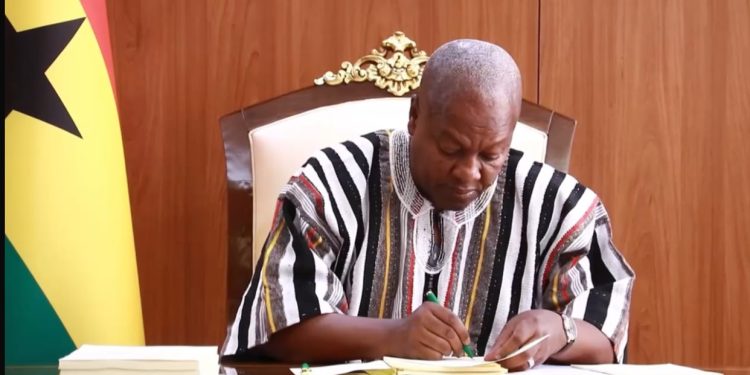
Some Ghanaian numbering three, Issifu Seidu Kudus Gbeadese, Elikem Kotoko and Stephen Kwabena Attuh have petitioned Parliament to commence impeachment proceedings against President Akufo-Addo over the allegations of Serwaa Broni. According to the three, the allegations, if proven to be true, would amount to “human rights abuse, abuse of office, exposing the security of Ghana to external threat…” as well as “…dragging the name of the high office of President into disrepute”. Read the petition below: Petition for President Akufo-Addo’s impeachment Apexnewsgh.com/Ghana Please contact Apexnewsgh.com on email apexnewsgh@gmail.com for your credible news publications. Contact: 05555568093
Hear ‘only important cases’, don’t call frivolous ones in open court; dismiss them ‘in chambers’ – AG to SC

Attorney General Godfred Dame has told the Supreme Court that it has to start dismissing, in chambers, all frivolous cases while giving attention to only important cases as part of measures to reduce the caseload. “The time has come for the Supreme Court to reduce its caseload by prioritising the kinds of cases it actually hears”, Mr Dame suggested and proposed that cases without merit not be called at all in open court but dismissed in chambers. The Minister of Justice was speaking at the opening of this year’s Bench, Bar, and Faculty Conference in Accra on Thursday. In his view, “only important cases with the potential of resulting in a change of the law or with an immense public interest, should be heard by the Supreme Court.” He proposed that the rules of the court be revised to make room for his suggestion so as to make the courts more productive and effective. Mr Dame also suggested that some innovations made to the court system as a result of the COVID-19 pandemic be made permanent features of the judicial process. “Virtual hearing of cases should become a regular feature of our court system”, he said. —Classfm
Upper East and Upper West Assemblies to appear before PAC
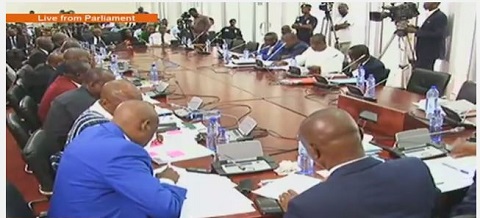
All Assemblies in the Upper East and Upper West regions cited in the 2018 Auditor-General’s Report have officially been invited to the Public Accounts Committee (PAC) to respond to various violations. Apexnewsgh.com report During the start of the second day of the PAC public hearing which took place in Tamale, the Northern Regional Capital, these Assemblies were asked to clarify why they misused certain funds allocated for some specific projects as captured in the report. Members of PAC, are expected to consider the report of the Auditor-General on the Management and Utilization of District Assemblies Common Fund and Other Statutory Funds for the year ended 31 December 2018 and Accounts of District Assemblies (IGF) for the year ended 31st December 2018. Bolgatanga, Nabdam, Jirapa, Kassena Nankana West, Builsa North, Wa Municipal and Nandom, Includes Assemblies that appeared earlier before the committee. Apexnewsgh.com/Ghana Please contact Apexnewsgh.com on email apexnewsgh@gmail.com for your credible news publications. Contact: 05555568093
NPP welcomes EIU report, described it as “constructive analysis”
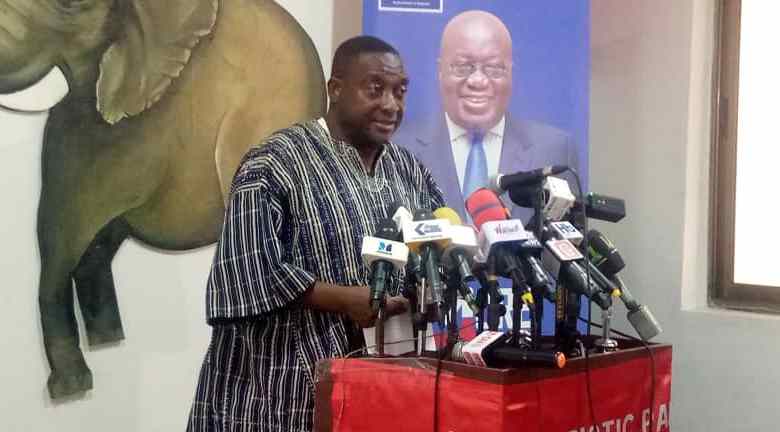
The governing New Patriotic Party (NPP) has officially applauded the recent political and economic report by the Economic Intelligence Unit (EIU), as they described it as a “constructive analysis” According to a statement signed by the Party National Communication Director Yaw Buaben Asamoa: “This is because objective analysis extends the democratic tenet of free speech, and provides perspectives capable of informing policy reform”. The NPP however, acknowledges that the EIU has a record of reviewing Ghana’s governance systems, especially potential political outcomes. “To buttress its prediction of the National Democratic Congress (NDC) winning the presidential election and the parliamentary elections by a slim margin in 2024, the EIU touts its record of successful predictions over the years.” “If NDC wins, it will not be news. But if the NPP wins, it would be a remarkable achievement that would demonstrate the coming of age of electoral politics in Ghana,”. Yaw Buaben Asamoa said. Meanwhile, the NPP victory in 2024, is targeted on, “Breaking the Eight (8)” would be a more uncommon occurrence than an NDC victory, based on the history of elections in the Fourth Republic. The NPP noted, however, that EIU introduced a “new and significant double-edged factor” into the eight-year cycle, and said this is “the quality of leadership.” The “EIU implies that former President Mahama’s record of leadership is so poor that if he becomes the candidate, the NDC’s predicted win goes up in smoke,”. Pointing that, “this is a huge boost to the NPP’s effort of ‘Breaking the Eight (8) since we are confident that the NPP candidate will have a better governance record based on the cumulative achievements of the NPP in the Fourth Republic.” “But more importantly, NDC has not demonstrated any policy capacity capable of turning out better and faster outcomes in the areas listed. Indeed, the tendency is for the NDC to set the country back in respect of these factors whenever the eight-year cycle kicks in. The NPP builds and the NDC destroys. “Political stability is also a product of the NPP’s quiet yet hard work on the security front. Notwithstanding increased threats of regional instability spilling over into Ghana, piracy in the Gulf of Guinea, and sometimes very extremist talk from anarchic elements, the EIU predicts without hesitation that there will be political stability over the next five years. A plus for free, fair, and violence-free elections,” Yaw Buaben Asamoa said. Apexnewsgh.com/Ghana Please contact Apexnewsgh.com on email apexnewsgh@gmail.com for your credible news publications. Contact: 05555568093
Gov’t swiftly releases GHS 67m to Colleges Of Education for trainees’ feeding

The Minister of Education, Dr. Yaw Osei Adutwum has disclosed that government has released over GHS67 million to public Colleges of Education across the country to cater for trainees food supply. Apexnewsgh.com report The step was taking immediately after the Principals of the various Colleges of Education announced that students would be fed twice instead of the three square meals a day due to the delay in the payment of six-month feeding arrears by the government. Meanwhile, the Principals had also pointed that trainees were going to start feeding themselves from May 8, 2022, if the government failed to release funds for feeding. Confirming the release of fund, Dr. Yaw Osei Adutwum said, the government through the Finance Ministry has acted swiftly by releasing GHC67,942,662 to principals of the various Public Colleges of Education to salvage the situation. Earlier on in a statement, PRINCOF said, “suppliers have backed their threats of not supplying any food items to Colleges with concrete action by not supplying Colleges with any food items until they have been paid monies owed them.” Apexnewsgh.com/Ghana Please contact Apexnewsgh.com on email apexnewsgh@gmail.com for your credible news publications. Contact: 05555568093
World Bank to address “multiple overlapping crises” with $170bn fund

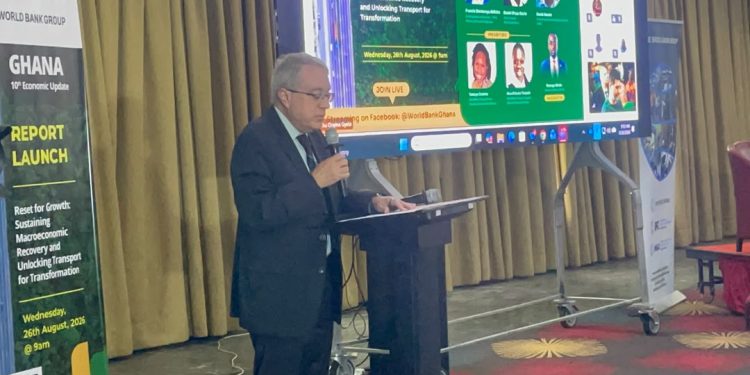
World Bank Group President David Malpass has said over the next few weeks, “I expect to discuss with our board a new 15-month crisis response envelope of around $170 billion to cover April 2022 through June 2023” for member countries. “We expect to commit around $50 billion of this amount in the next three months”, Mr Malpass said in his opening remarks at the Spring Meetings 2022 Roundtable. “This is a continued, massive crisis response given the continuation of the crisis. Helping this effort was the front-loading of IDA19. IDA has been a key part of what has been a record scale-up. We’ll be starting IDA20 on July 1, making $93 billion available to IDA countries, the poorest”, he said. Read the full speech of Mr David Malpass below: Spring Meetings 2022 Media Roundtable Opening Remarks by World Bank Group President David Malpass Thank you. It will be a busy week. Lots to get through today. Good morning, everybody. Thank you for joining. We begin the Spring Meetings facing severe overlapping crises. There’s COVID-19, inflation, and Russia’s invasion of Ukraine. I’m deeply concerned about developing countries. They’re facing sudden price increases for energy, fertiliser, and food, and the likelihood of interest rate increases. Each one hits them hard. These, plus the war in Ukraine and China’s COVID-related shutdowns, are pushing global growth rates even lower and poverty rates higher. We’ve lowered our 2022 growth rate to 3.2% from 4.1% before. People are facing reversals in development for education, health, and gender equality. They’re facing reduced commercial activity and trade. Also, the debt crises and currency depreciations have a burden that falls heavily on the poor. Many discussions this week will focus on these topics. For Ukraine, we’ve mobilised nearly $1 billion in emergency financing, and we’ve announced another $1.5 billion to support essential government services. I made that announcement in Poland last week. I want to spend a few minutes on the issue of food insecurity. I was recently at the World Water Forum in Senegal, and then I visited Morocco. Both countries are being affected by the price spike in the energy and fertiliser that are used to make food. This is an intense problem. Food crises are bad for everyone, but they’re devastating for the poorest and most vulnerable. There are two reasons. First, the world’s poorest countries tend to be food-importing countries. Second, food accounts for, at least, half of total expenditures in household budgets in low-income countries, so it hits them hardest. I joined Kristalina (Georgieva, IMF Managing Director), Ngozi (Okonjo-Iweala, WTO Director-General), and David Beasley (UN World Food Program Executive Director) in a joint statement last week on food insecurity. We wanted to highlight the issue and help coordination. Countries must be taking action now to encourage the production of food, energy, and fertiliser. The production chain needs all three. It’s vital for countries, both advanced and developing, to reduce their trade barriers. Global trade is still facing quotas, high import tariffs, high export tariffs, expensive food price subsidies, and even export bans on food products. These should stop. The international community needs to immediately step up emergency assistance for food insecurity and help bolster social safety nets. From the World Bank’s standpoint, we are providing roughly $17 billion per year to strengthen food security – a big part of the global effort. I’ll turn briefly to the COVID-19 response, which is still underway. The World Bank Group expanded our financing rapidly, reaching $157 billion in the 15 months ending June 2021. Vaccines were a big part of this effort. We now expect to have committed $11 billion to purchase and deploy vaccines in our current fiscal year ending June 30, benefiting 81 countries. This has been a massive effort by our country teams around the world and has brought hundreds of millions of shots to arms. Over the next few weeks, I expect to discuss with our board a new 15-month crisis response envelope of around $170 billion to cover April 2022 through June 2023. We expect to commit around $50 billion of this amount in the next three months. This is a continued, massive crisis response given the continuation of the crisis. Helping this effort was the front-loading of IDA19. IDA has been a key part of what has been a record scale-up. We’ll be starting IDA20 on July 1, making $93 billion available to IDA countries, the poorest. As part of our scale-up, we’ve increased our climate financing and technical support to over $26 billion in fiscal 2021 alone. That’s our highest level ever. Electrical grid and baseload were key topics in my visits to Poland and Romania last week. I note that Ukraine synchronised its electrical grid with Western Europe in recent weeks, which is a step toward improving the electrical grid for Western Europe. I want to say a few words on debt and inflation. These are two big problems facing global growth. Due to high debt and deficit levels, countries are under severe financial stress. Sixty per cent of low-income countries are already in debt distress or at high risk of it. I participated virtually in our April 13 conference on debt transparency and sustainability and suggested steps to improve the implementation of the Common Framework. These included: Establishing a timeline for forming creditors’ committees. Suspension of debt service payments and penalty interest. Expanding eligibility. A simple rule so that comparability of treatment can be evaluated and enforced. Engaging commercial creditors at the beginning of the process. We expect the debt crisis to continue to worsen in 2022. I want to turn now to the inflation problem, which is causing immense strain. Policies need to be adjusted to enhance supply, not just increasing demand. Markets are forward-looking so it’s vital for governments and private sectors to state that supply will increase and that their policies will foster currency stability to bring down inflation and increase growth rates. This is especially important as global supply chains shift away from