


MITDS Council Chairman Celebrates 10th Anniversary and 6th Graduation Ceremony
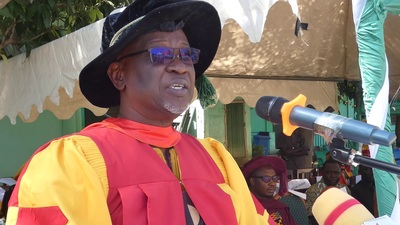
Naa Ganglaar Bog-Belagr Tater V, MITDS Council Chairman, delivered an inspiring speech at the institution’s 10th anniversary and 6th graduation ceremony. The event marked a significant milestone, honoring eight PhD and six MPhil graduates. Apexnewsgh reports “Today, we gather to celebrate a momentous occasion,” Naa Tater V began. “Our affiliated university, the University for Development Studies (UDS), has enabled us to hold multiple ceremonies within a year, a testament to our growth.” The Council Chairman congratulated the graduates, urging them to make a positive impact. “Your expertise and knowledge should inspire change. Remember your duty to contribute to your families, nation, and world.” Two honorary doctoral degrees were conferred upon individuals who significantly contributed to MITDS’ existence. Their achievements were recognized through citations. Naa Tater V saluted President and staff, teaching and non-teaching, for achieving this feat. “MIDS’ investment has yielded substantial gains in Ghana’s skilled knowledge and manpower development, producing 36 first degrees, 17 MPhils, and 26 PhDs.” He paid tribute to Professor Saa Dittoh, foundation chairman, and colleagues who navigated challenging times. “Professor Dittoh’s leadership was instrumental in MITDS’ success.” As MITDS celebrates its decade, the Council looks forward to significant additions to its achievements. “Congratulations to today’s graduates and honorary awardees. MITDS’ survival and success are no mean feats. We’ve established a legacy of excellence.” Advocating for Grass Economy Policy The Council has closely followed MITDS’ groundbreaking research on dry grass utilization. “We strongly advocate for a dedicated grass economy policy and program tailored to Northern Ghana,” Naa Tater V emphasized. “This initiative will reduce perennial bushfires and harmful climate effects.” International Partnerships The Council Chairman extended gratitude to Mr. Marvin Hokstram from the Netherlands and Dr. Salifu Yakubu from the United States for delivering successful public lectures. “We acknowledge the beginning of a fruitful partnership with the Broos Institute and look forward to remarkable outcomes.” The ceremony concluded with a sense of pride, accomplishment, and anticipation for MIDS’ future achievements. Source: Apexnewsgh.com Contact: +233256336062/ +233248250270
From University to Impact: Architect Salifu Yakubu’s Message of Empowerment
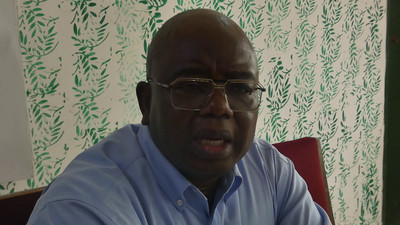
In a recent gathering, Architect Salifu Yakubu, the Managing Director of Memarie Global Association (MGA), captivated his audience with a thought-provoking lecture focused on university graduates and their potential as agents of change. Apexnewsgh reports He emphasized the pressing need for individuals in society who can uplift others and foster positive transformation. Dr. Yakubu shared compelling case studies of notable graduates who have made significant impacts, drawing parallels to well-known figures like Steve Jobs and Bill Gates. These icons, despite not completing their university education, have left indelible marks on the world, demonstrating that success is not solely defined by traditional academic paths. However, Dr. Yakubu did not shy away from addressing the challenges that university graduates often face. He urged them to remain aware of these obstacles and to cultivate their self-esteem despite the difficulties. The key, he suggested, lies in harnessing their education and experiences to devise innovative solutions to the pressing problems in society. As the lecture concluded, attendees were left inspired and motivated, equipped with the understanding that they have the power to enact change and contribute meaningfully to their communities. Dr. Yakubu’s message was clear: regardless of the challenges ahead, the potential for greatness lies within each graduate, waiting to be realized. The room was filled with aspiring professionals, eager to absorb his insights on the evolving landscape of employment in Ghana. As he spoke, the energy in the room was palpable, with participants fully engaged and ready to dive deeper into the conversation. With a clear voice and passionate demeanor, Architect Yakubu shared his thoughts on the traditional pathways for graduates. “Gone are the days where everybody will graduate from university and secure a wonderful job from the government of Ghana,” he remarked, challenging the audience to rethink their expectations. While his words carried a sense of urgency, they also offered a reassuring promise: universities have provided graduates with essential tools that can lead to success. He emphasized the importance of innovation and initiative, urging graduates to recognize the potential in every idea, no matter how small. “We urge our graduates to understand that their future lies not solely in government employment, but in harnessing their skills to create opportunities for themselves,” he said, sparking a sense of empowerment among those present. Architect Yakubu’s conviction resonated deeply as he spoke about the capabilities instilled in graduates. He highlighted their ability to innovate, problem-solve, and adapt to changing circumstances. “It is now up to you to unleash your potential, transform your ideas into reality, and become change-makers in your communities,” he declared, leaving the audience inspired and motivated. As the lecture transitioned into a question-and-answer session, the room erupted with lively discussion. Participants eagerly shared their insights and experiences, further enriching the dialogue. By the time the event concluded, it was evident that Architect Yakubu had ignited a spark of ambition within the audience, encouraging them to forge their own paths and embrace the future with confidence.
African Unity and Empowerment: Breaking Free from the Shackles of Inferiority
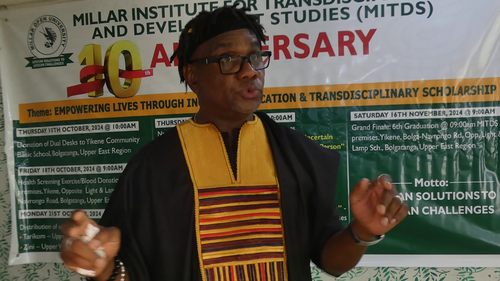
At a public lecture held at the Millar Institute for Transdisciplinary and Development Studies (MITDS) ahead of its 10th anniversary, Marvin Hokstam, Executive Director of Broos Institute, passionately addressed the audience on the biggest challenge facing Africans globally. Apexnewsgh reports “Our greatest obstacle is overcoming the mindset of inferiority imposed upon us,” he emphasized. For centuries, Africans have been conditioned to believe in their own inadequacy, a legacy of colonialism and oppression. This mindset hinders economic growth, mediocrity, and self-actualization within African communities worldwide, including the Caribbean, Suriname, and the US. Hokstam stressed that education is the key to liberation. “We must educate ourselves about ourselves, our history, and our culture from an Afrocentric perspective.” By doing so, Africans can reclaim their identity, determine their future, and build a brighter tomorrow. However, Hokstam acknowledged that adopting this solution won’t be easy. “We’ve been brainwashed by Eurocentric narratives, making it difficult to reteach ourselves.” Yet, he remains optimistic, emphasizing the importance of educating future generations. “As ancestors-in-the-making, we must create a legacy of empowerment for our descendants. Let us teach them the right way, so they don’t have to unlearn misconceptions later.” Hokstam’s words resonated deeply, inspiring a new wave of African unity and self-determination. However, Marvin Hokstam passionately spoke about the lingering impact of colonialism and slavery on people of African descent. “For centuries, we’ve been confined by the limitations of white supremacy, forced to adopt European names, identities, and religions. Our true heritage was erased, replaced by the colonizer’s narrative.” Hokstam used the analogy of a goldfish in a tiny bowl to illustrate the stifling effects of Eurocentrism. “Just as the fish will never grow in a confined space, our potential is stifled by the dominant culture. But when freed from these constraints, we can thrive.” He shared his country, Suriname’s, complex history as a melting pot of ethnicities, colonized by the Dutch from the 15th century until 1975. Africans were brought as slaves, forced to work for 300 years, and stripped of their names, identities, cultures, and religions. “By the time slavery ended in 1863, we had lost our sense of self,” Hokstam said. “We were given European names, like mine, Hokstam, which means nothing. Our African past and future were stolen.” Hokstam emphasized the importance of rediscovering their true identity, free from Eurocentric constraints. “Our music, art, and scientific contributions are extraordinary, but often dragged back into the suffocating confines of dominance. It’s time to break free and reclaim our heritage.” He stressed Speaking about Broos and MITDS, Hokstam says, the collaboration between Broos Institute and MITDS marks a significant step towards this vision. He further shared, “I was drawn to MITDS’s African-centered approach, aligning with our activism in the Netherlands.” Together, they aim to rewrite the narrative, fostering a proud and empowered African identity. Broos Institute Executive Director concluded the audience was left with a profound message: education, self-awareness, and unity hold the power to shatter the chains of inferiority, unlocking a brighter future for Africans worldwide. The public lecture, delivered by Marvin Hokstam, drew a diverse audience, including PhD students from the Millar Institute for Transdisciplinary and Development Studies (MITDS), as well as professionals from various fields. The event provided a platform for intellectual discourse and exchange of ideas among academics, practitioners, and community leaders. Following the captivating lecture, Marvin Hokstam presented a beautifully crafted art piece to Prof. David Millar, Founder of the Millar Institute for Transdisciplinary and Development Studies (MITDS), as a token of appreciation. Prof. Millar graciously accepted the gift. In a surprising gesture of reciprocity, Prof. Millar offered Marvin Hokstam, Executive Director of Broos Institute, an office apartment within the MITDS premises. This generous offer aimed to strengthen the partnership between Broos Institute and MITDS. “This gesture will facilitate our collaborative efforts,” Prof. Millar stated, “enabling us to work closely together to advance our shared vision of promoting African heritage and identity.” Marvin Hokstam expressed gratitude, saying, “This office space will serve as a hub for our joint initiatives, fostering innovation and progress. We look forward to a fruitful partnership.” The exchange symbolized the beginning of meaningful collaboration, poised to yield impactful outcomes in education, research, and community development. The anniversary theme was centered on: Empowering lives through inclusive education and Transdisciplinary scholarship. Source: Apexnewsgh.com Contact: +233256336062/ +233248250270
NDC’s Daniel Mahama Fails to Engage with Talensi Constituents at NCCE Event
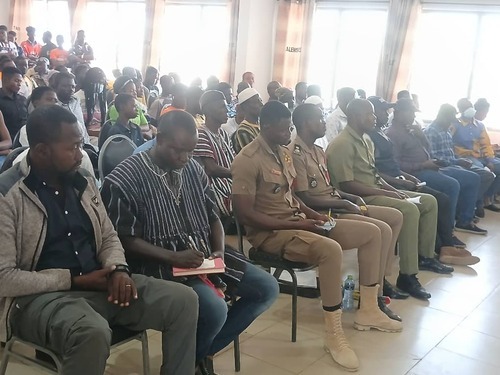
In the lead-up to the 2024 elections, a significant event organized by the National Commission for Civic Education (NCCE) aimed to foster dialogue and promote peaceful campaigning among parliamentary candidates in the Talensi Constituency. Apexnewsgh reports The gathering was an opportunity for candidates to present their visions, policies, and commitments to their constituents. However, the absence of Daniel Mahama, the National Democratic Congress (NDC) parliamentary candidate, cast a shadow over the proceedings. While candidates from the New Patriotic Party (NPP) and the People’s National Convention (PNC) were present and engaged, Mahama’s absence did not go unnoticed. Questions arose about why he had chosen to skip such an important platform. Michael Nangena, the NDC Constituency Communication Officer, initially stated that they were unaware of the event. Later, he admitted that the NCCE had indeed reached out, but the local NDC chapter had requested a rescheduling due to their late-starting campaign. The National Commission for Civic Education (NCCE) official in the Talensi District confirmed that letters was sent to all parties, the NDC and NPP and PNC regarding the parliamentary candidates’ debate/dialogue. Further inquiries revealed a tangled web of communication issues. The NDC Constituency Chairman acknowledged that NCCE had contacted them but claimed they had not received an official letter. He maintained that they communicated their unavailability and were awaiting a response that never came. The controversy surrounding Mahama’s decision to boycott the dialogue raised questions about his commitment to engaging with the electorate. As the NDC traditionally emphasizes democratic values and accountability, his absence appeared inconsistent with party principles. To complicate matters, Dan Mahama later claimed that his decision was influenced by an incident involving the PNC candidate, who had allegedly insulted his political mentor, John Atia, on a local radio station. This incident seemed to serve as the tipping point for Daniel Mahama, prompting him to withdraw from the debate altogether. As the political landscape in Ghana evolves with the approaching elections, the importance of transparency and candidate engagement is more critical than ever. With the NCCE’s efforts aimed at fostering peaceful and inclusive elections, candidates like Mahama face scrutiny as they navigate the delicate balance between personal grievances and the democratic process. Mr. Alibo of the governing NPP and the People’s National Convention (PNC) Candidate took advantage of the National Democratic Congress (NDC) parliamentary candidate Daniel Mahama’s absence from a recent dialogue in Talensi. They effectively communicated their vision and plans for the constituency, impressing attendees with their preparation and commitment. The dialogue, organized by the National Commission for Civic Education (NCCE), aimed to promote issue-based campaigning and peaceful elections. It’s a crucial platform for parliamentary candidates to articulate their policies and plans. Source; Apexnewsgh.com