
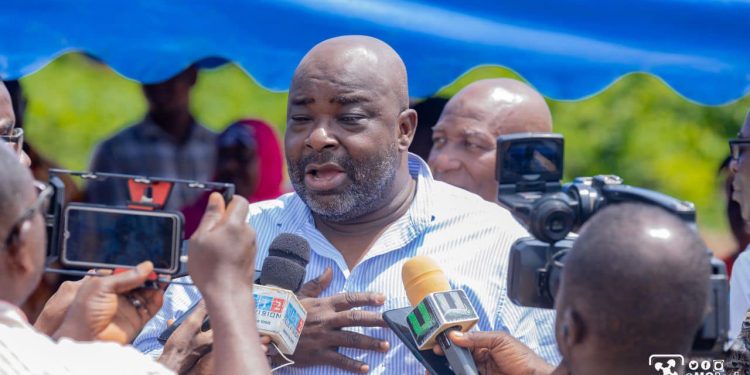


Ghana’s Minister for Roads and Highways, Kwame Governs Agbodza, came out swinging on Tuesday, delivering a pointed rebuttal to critics who have accused the government’s flagship Big Push infrastructure programme of leaning too heavily on sole sourcing.
Standing before Parliament, the minister did not just defend the programme, he dismantled the allegations piece by piece, calling them misleading and flatly unsupported by the facts already placed before the House.
“We have established a system where no contractor is paid without measurable progress,” he declared, setting the tone for an address that was as much about accountability as it was about infrastructure.
At the heart of the controversy is the procurement method used to award contracts under the Big Push, a sweeping initiative currently overseeing the reconstruction and upgrading of more than 2,000 kilometres of roads across all 16 regions of Ghana. Critics have suggested that sole sourcing has become the default tool of choice, raising questions about transparency and value for money.
The minister rejected that characterisation outright. According to him, only 44 percent of major contracts, including those under the Big Push, were awarded through sole sourcing, while more than 400 contracts have gone through open competitive tendering. Every contract, he stressed, has been awarded in strict compliance with the Public Procurement Act and its regulations, with full details publicly available on the Ministry’s website for anyone willing to look.
But beyond the numbers, the minister offered context that he argued critics have been too quick to ignore. Ghana’s road network, he reminded Parliament, is in a state of serious deterioration. Given the scale and urgency of the challenge, he said, a rigid insistence on lengthy procurement processes alone would delay critical projects, inflate costs, and ultimately deepen the country’s economic difficulties. The law, he noted, allows for a balanced use of procurement methods, and that is precisely what the Ministry has done.
One of the more striking revelations from the minister’s address was the fate of 23 major road projects inherited from the previous administration, projects valued at GHS 14.88 billion that had been left entirely without funding. Rather than abandon them, the current government integrated these stalled projects into the Big Push programme and secured new financing to get them moving. Among those rescued are the Suame Interchange, the Ofankor–Nsawam Road, and the Adenta–Dodowa Road — projects that, in the minister’s words, might have remained frozen indefinitely without the current approach.
The programme itself has been structured with competition in mind. It targets 12 key economic corridors, broken into 54 lots, a deliberate design intended to attract more contractors, drive competition, and accelerate delivery on the ground.
On the question of value for money, Minister Agbodza outlined a series of safeguards built into the programme: in-house survey, design, and costing by state agencies; independent value-for-money assessments of contractor proposals; and payments strictly tied to verified, measurable work completed. He also pointed to an ongoing collaboration with the Ghana Institution of Surveyors to further strengthen independent cost verification, a move he said underscores the government’s commitment to getting this right.
He also took direct aim at critics who have drawn unfavourable comparisons based on cost-per-kilometre figures, arguing that such analyses are fundamentally flawed. They fail, he said, to account for differences in project scope, engineering complexity, and additional infrastructure components such as interchanges and bridges, factors that can dramatically affect cost without reflecting any wrongdoing.
The minister did not shy away from contrasting the current administration’s record with that of its predecessor. He noted that many of the road projects inherited from the previous government lacked proper authorisation and had not gone through competitive procurement, a situation that contributed to road sector arrears exceeding GHS 40 billion. Since taking office, he said, the government has paid over GHS 11 billion toward clearing that inherited debt.
With the programme operating under continuous parliamentary oversight, including regular ministerial questioning, committee reviews, and independent professional validation, Hon. Agbodza made clear that the Big Push is not operating in the shadows.
Sole sourcing, he insisted, remains the exception, not the rule. And as he urged Parliament and the public to get behind what he described as a transformative effort to improve road infrastructure, reduce transport costs, create jobs, and stimulate economic growth, his message to critics was unambiguous: check the facts before you undermine the progress.
Source: Apexnewsgh.com