
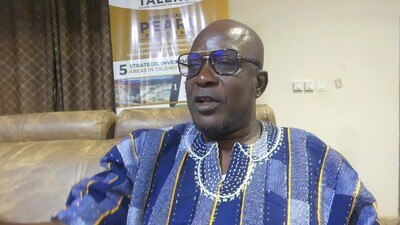




Leading business executive Sir Sam Jonah has issued a strong warning over what he describes as growing and systemic political interference in Ghana’s insurance sector, cautioning that it threatens the industry’s integrity and public trust.
When Sir Sam Jonah took the podium at the 11th Annual Conference of the Insurance Brokers Association of Ghana in the Eastern Region, the room quickly understood this would be no routine address. Ghana’s most prominent business statesman had arrived with a diagnosis, and it was not a comfortable one.
At the centre of his remarks was a problem he described as no longer isolated or occasional, but deeply embedded in the fabric of how insurance business is conducted in Ghana. Political interference, he warned, has moved from the margins of the industry to its very core, and the consequences are being felt across the entire sector.
“There’s a growing and deeply troubling pattern of political and socioeconomic interference in the conduct of insurance business in Ghana,” he told delegates, his words carrying the weight of someone who had watched the problem grow over many years.
What was once an occasional disruption, he said, has metastasised into something far more dangerous. “What was once an occasional disruption has become something more systemic, more embedded, more dangerous.”
Sir Sam Jonah laid out the mechanics of this interference with striking clarity. Contracts, he revealed, are no longer being awarded based on performance or merit. Political direction, not professional assessment, is increasingly driving decisions. Insurance portfolios, particularly those belonging to state enterprises, are being handed out through personal connections and political leverage rather than competitive tender or professional selection.
“Insurance portfolios are moved not through competitive tender or professional selection, but through personal access and political leverage,” he said.
The distortions do not stop there. Brokers and insurers, he noted, are being pressured to accept placements they openly admit they cannot manage, taking on risks beyond their capacity simply because the instruction comes from above. And on pricing, he pulled no punches, warning that premiums are being loaded fraudulently, with no genuine risk assessment, serving purely as a vehicle for extracting money.
But perhaps his most pointed remarks were reserved for the human cost of these practices. When the system fails, and he suggested it inevitably will, it is not the politically connected who bear the consequences.
“When things go wrong… it is not the politically connected individuals who bear the cost. It is the taxpayer… who pays… and receives nothing in return.”
He called it plainly what it is: betrayal.
Beyond the financial damage, Sir Sam Jonah warned that political interference is corroding something harder to rebuild, public trust. When access matters more than competence, and connections outrank qualifications, the very institution of insurance is hollowed out from within.
“It damages the institutions of insurance itself. It erodes public trust… and signals that competence is irrelevant, and that access is everything,” he said.
He was careful, however, to draw a clear distinction. His concern is not with politically exposed persons participating in the industry, that, he said, is their right. What he insists on is that participation must be governed by the same professional standards that apply to everyone else.
“The placement of insurance must be subject to professional standards, open competition, proper actuarial assessments, and the primacy of the policyholder’s interest,” he stated firmly.
And lest anyone mistake these as aspirational ideals, Sir Sam Jonah made his position unambiguous.
“These are not aspirations,” he said. “These are non-negotiable requirements.”
Source: Apexnewsgh.com