






The Power of Grass Biochar in Sustainable Agriculture and Mitigating Climate Change

Feature By Ngamegbulam Chidozie Stephen As I traveled through the Upper East, North East, Upper West, Northern, and Savannah regions, I heard a recurring theme from farmers: frustration. The source of their frustration was not drought, pests, or diseases, but rather the high cost of agrochemicals, particularly fertilizers. However, their concerns are deeply intertwined with the escalating impacts of climate change. Farmers in these regions, who rely heavily on agriculture for their livelihoods, expressed their concerns about the escalating prices of fertilizers. They lamented that the high cost of these essential inputs was eating into their profits, making it difficult for them to sustain their farming businesses. Climate change has exacerbated this issue, as rising temperatures and changing rainfall patterns have led to decreased crop yields, forcing farmers to rely more heavily on agrochemicals to maintain productivity. Moreover, the intensive use of chemical fertilizers can lead to soil degradation, water pollution, and loss of biodiversity – all of which are further exacerbated by climate change. As temperatures rise, soil moisture decreases, and extreme weather events become more frequent, the use of chemical fertilizers can have devastating consequences for the environment. The farmers’ concerns are not unfounded. Climate change is projected to increase temperatures in West Africa by up to 3.5°C by 2100, leading to more frequent droughts, floods, and heatwaves. This will have a disproportionate impact on smallholder farmers, who are already struggling to adapt to the changing climate. Grass Biochar a game changer The concept of biochar has been around for over 2,000 years, dating back to the “slash-and-burn” agricultural method practiced by ancient civilizations. However, the modern understanding and application of biochar as a tool for environmental management and climate change mitigation have developed significantly over the past few decades. The term “biochar” emerged in the early 2000s, in conjunction with growing concerns about soil management and carbon sequestration.¹ Since then, research and development of biochar technologies have accelerated, with various organizations and initiatives promoting its use as a sustainable solution for environmental and agricultural challenges. Some notable milestones in the development of biochar include: A. 2001: The International Biochar Initiative (IBI) was established to promote the use of biochar for environmental management and climate change mitigation. B. 2009: The IBI published a report highlighting the potential of biochar to mitigate climate change by sequestering carbon in soils. C. 2012: Researchers began exploring the use of biochar as a soil amendment to improve soil fertility and reduce greenhouse gas emissions. D. 2024: The Biochar Basics series was published, providing introductory information on biochar used as a container substrate component. Today, biochar is recognized as a multifunctional material with various applications, including carbon sequestration, soil fertilization, water filtration, and contaminant immobilization. Innovative Grass Biochar Offers Promising Solutions for Climate Change and Sustainable Agriculture However, despite all these years of Biochar existence, no scientist or researcher has come out with the innovation of ‘Grass Biochar’. Fortunately, following the skyrocketing increase of chemical fertilizers and some other farming inputs which has become huge challenge for farmers especially in the northern parts of Ghana, in a groundbreaking development, Prof. David Millar of the Millar Institute for transdisciplinary and Development Studies (MITDS) went into research and later came out with ‘Grass Biochar’, an organic fertilizer with the potential to significantly combat climate change while promoting sustainable agriculture. This innovative product harnesses the power of biochar, derived from grass, to provide numerous environmental benefits. One of the key advantages of ‘Grass Biochar’ is its ability to store carbon in the soil for extended periods. By converting grass into biochar, the carbon is locked away, effectively reducing atmospheric CO2 levels and helping to slow global warming. Studies indicate that widespread adoption of biochar could remove up to 10 gigatons of CO2-equivalent from the atmosphere annually, with the potential to decrease global greenhouse gas emissions by 10-20%. In addition to its carbon-sequestering properties, Grass Biochar enhances soil health by improving fertility, structure, and water-holding capacity. This leads to better plant growth, reduced soil erosion, and healthier ecosystems, as resilient soils can absorb and store even more carbon. Moreover, Grass Biochar plays a vital role in reducing greenhouse gas emissions. It has shown effectiveness in lowering nitrous oxide (N2O) and methane (CH4) emissions from soils. By promoting efficient nutrient cycling, it minimizes the need for fertilizers, thus further decreasing N2O emissions. Grass Biochar also supports regenerative agriculture practices, which promote soil conservation and biodiversity. By utilizing readily available biomass like grass, its production encourages sustainable land management while also addressing the issue of waste, as grass is often viewed as a nuisance. The benefits of Grass Biochar extend to climate change adaptation as well. Fields enriched with biochar exhibit improved drought resilience and enhanced water retention, helping farmers navigate climate variability and extreme weather conditions effectively. Furthermore, the potential impact goes beyond environmental benefits. The Grass Biochar initiative could create job opportunities in production and application sectors. Enhanced soil fertility leads to improved crop yields, thereby bolstering food security and availability. To fully realize the climate change mitigation potential of Grass Biochar, government support is essential. Recommendations for action include research funding to explore optimal production methods and scalability, as well as policy incentives such as subsidies or carbon credits to encourage farmer adoption. Educating farmers, policymakers, and stakeholders about the benefits of biochar and best practices will also be crucial for successful implementation. Prof. Millar’s Grass Biochar not only presents a viable solution to tackle climate challenges but also promotes sustainable agriculture, ultimately contributing to a more secure food future. Engaging Prof. Millar, he emphasized that the resources required for grass biochar production are readily available at the local level, unlike chemical fertilizers. He revealed the project has reached 11 communities across 5 regions, aims to train women’s groups in the production of grass biochar, a revolutionary organic fertilizer. The impact of this initiative has been nothing short of remarkable. Women who were once struggling to make ends meet are now equipped with the knowledge
Feature: Interesting factors contributing to the underdevelopment of Upper East Region

:Written By Ngamegbulam Chidozie Stephen No doubt, the Upper East Region of Ghana is a wonderful place to live in, especially with people from rich cultural practices and traditions, a region blessed with tremendous tourist sites all over. However, in the Upper East Region, one of the unfortunate canker or if you like, a defunct micro-finance i have seen hitting the region back to back apart from defunct Diamond Winners, God is Love, Power Ground and the almighty DKM micro-finance is the lack of zeal for ‘development’ from the elites and those who are supposed to know better, i mean those elites from the Upper East Region. No wonder in my last article in October 2021, one of my resource persons from the region strongly holds the views that the region main canker is caused by the elites, “I see our number one problem as the elite who are educated, they are the problem of the Upper East Region, not the uneducated people” Alhaji Awal Ahmed Kariama, Executive Director at RISE-Ghana maintained Fortunately, Upper East Region has produced very notable individuals and personalities who should have turned things around. But sadly, the reality is that these notable, brilliant and worthy personalities mostly based outside the region, fear coming back home to help develop their own region where they are created as individual gifts and blessings from the most high. Another interesting point bedeviling development in our communities and region is the trending attitude of our chiefs allowing themselves used by politicians by way of offering them appointments and positions in their government. To me, i have strong view that chiefs should not engage in any government activity but must use their office to lobby for development for their people and region. Chiefs must be respected by politicians for the role they play towards development. It is the job of traditional rulers to mediate between the people and the government. It is also their role to fight for the rightful development for their people and region through their office such as Regional House of Chiefs. Is that really the case in the Upper East Region? i guess you already know the answer? There is a saying that: “One does not learn how to use the left hand in old age” Yes, that is a fact. A man who decides to divert his or her children’s minds away from their own region isn’t patriotic to his region. A man who does not care about the welfare of his people back home isn’t worthy to be called a native. A man who is given a good opportunity in a high office that is expected to bring development to his or her people and he or she misused the opportunity, there is no guarantee such a person will be able to bring development if given another opportunity. This is one of the predicaments bedeviling the people of the Upper East Region. In the Upper East Region, with some allocated time,13w one could easily count around the number of storey buildings within the region compared to other regions and majority of these top buildings belong to strangers who on their own are struggling to make the region a better place for everyone. However, mostly when you traveled to Accra or Kumasi, most modern buildings you see across are owned by someone from the Upper East region. Then, you asked yourself what could be the problem? Well, I think is our mentality. I was so surprised and shocked in 2021 when one of the region’s prominent personality informed me during one of our phone conversations that he hasn’t visited home for 33 years and this prominent figure has children and none of them had visited home as well and I mean their father’s compound. During that conversation he was able to informed me that her daughter is due for marriage anytime she wishes because she is of age. So, you see? How will such children have their region at heart, especially when their father is careless about the region? Meanwhile, the man’s only reason was that his siblings died all as a result of family issues. So, the parent had to travel down south for greener pastures with few of them left. So, in this case, it will definitely be a hard thing to learn how to use a left hand as an old man isn’t it? His 33 years old decision is today affecting the innocent people of his family, community, district, constituency and the region developmentally. He is the only one who was able to share that with me but i knew, there are many more with such a tough decision. No wonder, the people of the Upper East Region are not moved by the non-availability of the Passport Office Application Center for a whole region. Because, after all those who normally travel and understand the importance of a traveling passport are living outside the region. Isn’t that regrettable as a region? No wonder, they are not moved by the continuously failed promises by politicians. In December 2021, we were told by the Upper East Regional Minister Stephen Yakubu that the signing of a concessional loan facility of $20 million between the governments of Ghana and Saudi Arabia in 2019 for the completion of Bolgatanga Regional Hospital has been truncated and the people of Upper East are quiet and pleased with such a piece of disturbing news after years of battling on local radio stations across the region between communicators of NDC and NPP claiming who should take glory for the hospital renovation project. Meanwhile, when i reached out to the BONABOTO Regional chairman Dr. Esmond Agurgo Balfour to know their plans following the announcement made by the regional Minister about the cancellation of the initial Bolgatanga Regional Hospital concessional loan facility of $20 million between the Ghana government and Saudi Arabia, he confirmed that they have received the information as a group. He described the information as a piece of disappointing news.
UER: The family of two crippled sisters in Bolgatanga cries for intervention as life becomes unbearable.
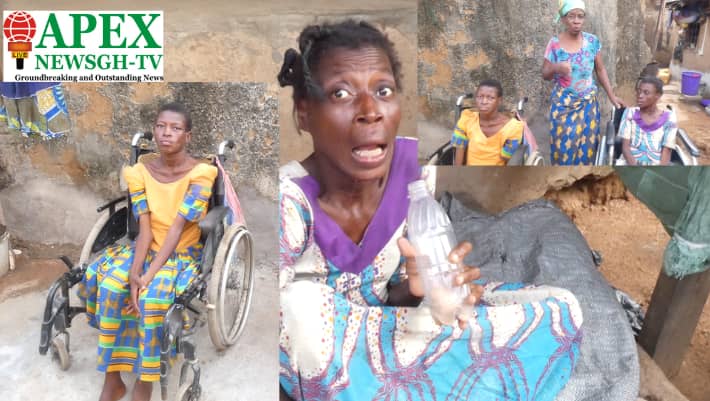
The story of two crippled sisters Ayine Abotsi and Paulina Abotsi from Bolgatanga Atulbabisi of the Upper East Region is a touching and emotional one. The two cripple sisters, according to their widow mother Madam Janet Abotsi, were not naturally born crippled. Paulina was 20 years old and became crippled and Ayine was also seen as a cripple 13 years ago. According to their mother’s explanation when Apexnews Gh-TV crew visited the family; “Paulina started crying and was saying to me see a snake, see a snake, I turned around and I could not see any snake. Then she fell down and did not walk again. I rushed her to the hospital and they said it was a spiritual problem, So, I took her to Fountain Gate Chapel and they prayed for her, she was able to walk. One day, I went to my father’s house and I came back home, only to see her standing outside the house, and looked so scary. We took her to church again and they prayed for her and immediately she became weak and paralyzed till today. “As for Ayine, Even though she was disabled, she was able to walk. But unfortunately, someone took advantage of her situation and impregnated her, when she was due to give birth, Ayine delivered inside a lorry alone and I took her home. After 2years, she went to church and afterwards, she could not rise to walk again and they brought her back to the house. That is how she became crippled till date”. Their widow mother narrated In the case of Ayine and Paulina, begging for alms as others who found themselves in such a condition will do, that isn’t possible for them looking at the condition they both see themselves health-wise. In the absence of their mother Madam Janet who now survives the family, by selling fried yam and kosee at home, Ayine and Paulina passed faeces and urine on themselves. Their place of shelter is very pathetic, “I could remember their mother Madam Janet telling me sorry my son, our room is always smelling because of my children’s condition, please cover your nose well” that was the moment I cried because i was just imagining the difficulty they were passing through all these while. The child delivered by one of the cripples by an unknown person who took advantage of her condition is currently 10 years old and the 13-year son of her late son who died 8 months ago with the inclusion of Ayine and Paulina all survived by the little yam and kosse sells of their widow mother. Their local house is now a death trap and no money to fix it up, feeding Ayine and Paulina has become a tough task and their wheelchairs aren’t functioning well anymore. Therefore, Apexnews Gh as an entity is using its platform to seek for any benevolent organizations and well-meaning individuals both home and abroad who were touched with their current situation to come to the aid of Ayine and Paulina. Apexnewsgh.com/Ghana/Ngamegbulam Chidozie Stephen Please contact Apexnewsgh.com on email apexnewsgh@gmail.com for your credible news publications. Contact: 05555568093