
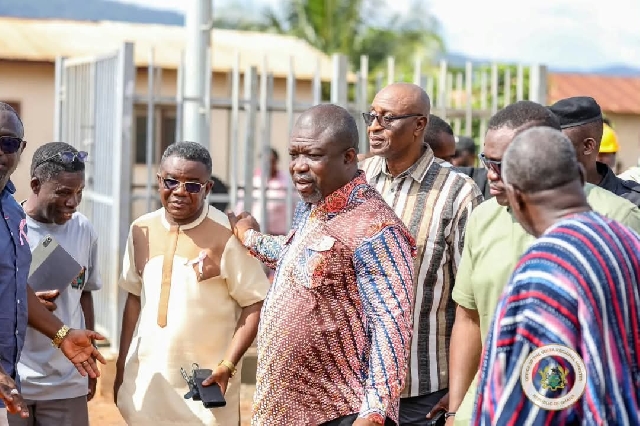
E.T Mensah, Alhassan Andani, Ras Mubarak and others file to contest council of state membership

A staunch National Democratic Congress (NDC) member, E.T Mensah has filed to contest for a Council of State position under the Akufo-Addo government. In all, about 102 candidates from 16 regions filed to contest the regional slots of the Council of State on 12 February, 2021 at the close of nominations on 4 February, Graphic Online reports. Other personalities contesting are Nii Kotei Dzani, Mr Alhassan Andani, former Chief Executive of Stanbic Bank; Mr Ras Mubarak, immediate past MP for Kumbungu, who are vying with four others to represent the Northern Region; Mr Kojo Agyenim Boateng, journalist; immediate past member of the council representating Bono Region; the Akrofosohene, Nana Owusu Achiaw Brempong, immediate past member representing the Ashanti Region and Ms Eunice Jacqueline Buah, a businesswoman, who is seeking re-election for the Western regional slot. Akufo-Addo’s appointments President Nana Addo Dankwa Akufo-Addo has named 11 persons to the Council of State, a statement from the presidency said. They are: 1. Nana Otuo Siriboe II, Juabenhene 2. Archbishop Justice Ofei Akrofi 3. Mr. Sam Okudzeto 4. Mr. Stanley Blankson 5. Prof. Ato Essuman 6. Alhaji Aminu Amadu 7. Dr. Margaret Amoakohene 8. Mrs. Georgina Kusi 9. Mrs. Alberta Cudjoe 10. Kuoro Richard Babini Kanton VI 11. Alhaji Sule Yiremiah “The President, subject to consultation with Parliament, has also appointed, in accordance with Article 89(2)(a)(i)(ii) and (iii), Georgina Theodora Wood, a former Chief Justice, Lt. Gen. J.B. Danquah, a former Chief of Defence Staff of the Armed Forces, and Nana Owusu Nsiah, a former Inspector General of Police, to the Council. The President of the National House of Chiefs, Ogyeahohoo Yaw Gyebi II, is ex-officio a member of the Council, in furtherance of Article 89(2)(b),” the statement signed by the acting director of communications at Jubilee House, Eugene Arhin, said. It added: “The composition of the Council will be complete with the election, due to be held on 12 February 2021, of the regional representatives, in accordance with Article 89(2)(c).” Happy 98.9FM Please contact Apexnewsgh.com on email apexnewsgh@gmail.com for your credible news publications. Contact: 0555568093
Photos: MPs ignore Akufo-Addo’s directive to ‘party’ at Aqua Safari

Members of Parliament (MPs) breached COVID-19 protocols to party during a three-day training on processes and proceedings of Parliament for new MPs held at Aqua Safari in Ada In some photos published on the official Facebook page of the Parliament of Ghana which has since been deleted, MPs from both sides of the House were seen on the dance floor, dancing their hearts out. “One of the ways people bond with each other is through music and dance. After a hard two day’s work, new Members of Parliament took to the dance floor to release some stress,” caption to the photos read. There was no social distancing. By that below-par behaviour, the MPs have not only defied the president but have also undermined the law passed by Parliament based on which the president issued the COVID-19 directives. The president’s televised 23rd COVID-19 address on Sunday 31 January 2021 barred anyone from organising parties, funerals or weddings. The workshop for parliamentarians ended on Monday, 08 February 2021, which clearly means that the party took place after the president’s directives. The workshop preceding the dance party was attended by Alban Bagbin, the Speaker of the 8th Parliament; Osei Kyei Mensah Bonsu, the Majority Leader; Haruna Iddrisu, Minority Leader; Cyril Kwabena Oteng Nsiah, Clerk to Parliament and some former MPs and experts. The attitude of the legislators is a great concern especially when Alban Bagbin, Speaker of Parliament, admonished the MPs to take COVID-19 safety protocols seriously and strictly adhere to them because some members have tested positive for COVID-19. “Even in the House, some members are afflicted by the COVID-19. You may not know who the person is and because of the protocol issues of confidentiality, we are not disclosing those who are now COVID-19 victims. But we have some of us in that category,” Bagbin said. There were reports in the media that some MPs were unwilling to go for COVID-19 tests during a three-day health screening exercise organised for the MPs. The reports indicated that less than a third of the House participated in the free COVID-19 testing, forcing the exercise to be extended. In a subsequent reportage, Joseph Osei Owusu, the First Deputy Speaker of Parliament revealed: “Some Members of Parliament who have, in fact, tested positive to the COVID are still coming to the Chamber. Mr Speaker wishes me to inform you that if those members do not withdraw and isolate, he will be forced to publish the names of members who have tested positive in order to warn the rest of us.” President Nana Akufo-Addo during his 23rd broadcast to the nation since Ghana recorded its first two cases of COVID-19 in March 2020 reimposed the ban on public gatherings as part of measures to contain the rise in COVID-19 cases in Ghana. President Akufo-Addo in his address declared: “Until further notice, funerals, weddings, concerts, theatrical performance and parties are banned. Private burials with not more than 25 people can take place with the enforcement of the social distancing, hygiene and mask-wearing protocols. Beaches, nightclubs, cinemas and pubs continue to be shut. Our borders by land and sea remain closed. All workplaces, public and private must implore a shift system for workers in addition to the use of virtual platforms for business or work.” The president added: “Conferences and workshops can take place with all the appropriate protocols. However, I encourage the use of virtual platforms for such engagements. Restaurants should provide takeaway services and should as much as possible avoid seated services. The National Sports Authority and the Ghana Football Association should ensure compliance with the 25 per cent capacity rule with spectators respecting the social distancing rule and the wearing of the mask.” Check out the MPs on the dance floor: Ghanaweb Please contact Apexnewsgh.com on email apexnewsgh@gmail.com for your credible news publications. Contact: 0555568093
27-year-old artisan allegedly murder a musician

A 27-year-old artisan, Bright Ellis is in the custody of the Cape Coast Regional Police Command for allegedly stabbing to death a 24-year-old musician, Emmanuel Aikins. The Deputy Public Relations Officer of the Central Regional Police Command, Sergeant Isaac Evans Ettie said at about 2:50 pm on Sunday, February 7, 2021, they received a distress call to the effect that a misunderstanding that ensued between an artisan and a musician at the Orange Beach Resort in Cape Coast had turned bloody. It is unclear how the fight started or what caused it, but the police were told that in the course of the fight Bright Ellis pulled a knife and stabbed Emmanuel Aikins, killing him instantly. Emmanuel Aikins, also known as Soft metal, was rushed to the Cape Coast Metropolitan Hospital for treatment but was pronounced dead on arrival. Sergeant Ettie also noted that the suspect who also sustained cuts on his left hand made a report at the police station against the deceased immediately after the incident. “He was then issued with police medical report form to attend hospital for treatment. He was later arrested at the Cape Coast Metropolitan Hospital and detained. The case is currently under investigation,” he added. Please contact Apexnewsgh.com on email apexnewsgh@gmail.com for your credible news publications. Contact: 0555568093.
360 Connect With Afro-Soul Musician Mz Anda

Born Anda Dramani, a female vocalist with the stage name Mz Anda. A Ghanaian by birth from the Savannah Region, Bole. Though a Gonja by tribe, she has lived most of her life at Kasoa the Central Region of Ghana. She attended her early and basic education at Kasoa and continued her secondary education at Mankesim Secondary of which she completed in 2017. For circumstances beyond control, she could not continue her education to the tertiary level. She has always had passion for arts and although she was not certain which aspect of arts she wanted to major in, she studied visual arts. She began showing love for painting and ceramics and later in life she discovered her vocal ability. Started Music professionally in 2018, after her debut release which happened to be her first EP “Spiritual Gangsta”, she took a break to perfect her musical abilities. She resurfaced in 2020 with a cover of Epixode’s “Too Much” which was a big come back for her. Mz Anda defines her style as dynamic afro-soul and has the capability of doing awesome things in any genre she finds herself. She also has a strong passion for live music and believes herself to be more of a performer than a recording artist. Signed to UTSH Music LLC, Mz Anda envisions a promising future as she targets an international career in music. Mz Anda the strong performing artiste believes GHAMRO is doing their work and as such distribution of royalties is their sole duty, as she prepares to release her single titled “May Be” after many years of recess. The afro vibe tune, she believes would cement her stay in the music industry. Please contact Apexnewsgh.com on email apexnewsgh@gmail.com for your credible news publications. Contact: 055556809
Domestic fuel prices quadruple in last decade, largely due to cedi depreciation and taxes: IES Analysts

Over the past decade (2010-2019), Ghana has seen a 347 percent increase in price of Gasoline (Petrol) and a 338 percent increase in Gasoil (Diesel) price at the pump, largely because of Cedi depreciation, taxes and levies. Analysis of data from the Energy Commission (EC), National Petroleum Authority (NPA) and IES’ MarketScan show that by the end of 2019, Ghanaians were paying more than four times the amount paid for a litre of Gasoline in 2010. The average pump price of Gasoline stood at Gh¢1.16 per litre (Gh¢5.22 a gallon) in 2010, but in 2019 the average price was recorded as Gh¢5.18 per litre (Gh¢23.31 a gallon). Likewise, the average pump price of Gasoil moved from Gh¢1.18 per litre (Gh¢5.31 a gallon) in 2010 to Gh¢5.17 per litre (Gh¢23.27 a gallon) in 2019. Year-on-year, the pump price of Gasoline experienced increase of averagely 18.4 percent between year 2010 and 2019. Within this period, 2014 recorded the highest year-on-year increase of 37 percent with an average price of Gh¢2.84 per litre as against Gh¢2.07 per litre in 2013. The slimmest yearly increase of Gasoline pump price was recorded in 2019, as average price per litre jumped from previous rate of Gh¢4.80 to Gh¢5.18. Key determinants of local fuel prices at the pump include; global crude oil price, prices of finished products on the world market, the foreign exchange (Forex) rate of the Cedi to the US Dollar, and the taxies and levies that are slapped on price per litre of domestic fuels. The Ex-pump price (which is the price the public buys fuel at the various filling stations) is a sum of Ex-refinery price, Export Duty, Taxes/Levies, Marketers and Dealers Margins. The Ex-refinery Price constitutes the cost of product on the international market, insurance, freight, and other related charges. The Taxes/Levies include the Price Stabilization and Recovery Levy (PSRL), Road Fund Levy, Energy Fund Levy, Energy Debt Recovery Levy, and the Special Petroleum Tax (SPT). The margins cover the Primary Distribution Margin (PDM), BOST Margin, Fuel Marking Margin, Marketers Margin, and the Dealers (Retailers/Operators) Margin. Prior to full deregulation of the downstream petroleum sector when consumer price for fuel was below the supply cost, government intervened through various forms of subsidization because it had the exclusive right to do so through the NPA. The interventions of government in a way distorted the market as it created perverse forms of incentives. This resulted in unnecessarily high pump prices, which were not a reflection of international market. However, the introduction of the full deregulation has seen Oil Marketing Companies (OMCs) actively negotiating prices with Bulk Distribution Companies (BDCs) as competitive market forces largely influences the current pump prices, to the ultimate benefit of consumers. Domestic fuel prices were seeing sharp annual increases prior to price deregulation in 2015-― 31 percent in 2011, 12 percent in 2012, 22 percent in 2013, and 37 percent in 2014. Nevertheless, from 2015 onwards, the highest annual price rise recorded was in 2018 at 17 percent, with annual increases falling below 8 percent in 2019. This literally means that the introduction of the price deregulation regime in 2015 have greatly contributed to a slowdown in the margin of annual price increases over the last 5 years. Even as price deregulation and the falling prices of crude oil over the past decade offered a great opportunity for fuel consumers to spend less on the commodity, the poor performance of the Cedi against major trading currencies, and the introduction of addition taxes/levies, eroded the benefits presented to consumers. But for some government fiscal policies which led to the introduction of new taxes and margins over the past five years, prices could have been much lower than we see at the pump today. The introduction of a Special Petroleum Tax (SPT) of 17.5 percent in the 2015 fiscal year, the upward adjustment in the Road Fund Levy (RFL), the Energy Debt Recovery Levy (EDRL) and the Price Stabilization and Recovery Levy (PSRL) in 2019, plus the 100 percent increase of the BOST Margin, fundamentally aided in seeing pump prices go up. Additionally, historical data from the Bank of Ghana (BoG) and the US Energy Information Administration (EIA) show that the performance of the Cedi on the Forex market greatly affects the Ex-pump price Ghanaians pay, than crude oil prices does. Over the decade, the Cedi has depreciated by approximately 265 percent, beginning at a yearly average of Gh¢1.43 per US Dollar in 2010 to a yearly average of Gh¢5.22 per US Dollar in 2019. Regardless of general reduction of crude oil prices over the decade, the depreciation of the Cedi, government fiscal policies among other factors significantly affect the price Ghanaians pay at present for finished products. Had it not been the global Covid-19 pandemic, the price of domestic Gasoline which sold at Gh¢5.30 per litre in early 2020, and currently sells at Gh¢5.10 per litre, could have been more than Gh¢6 per litre today. It may be recalled that crude prices slumped in 2020, hitting a 21-year low of US$16 per barrel in April, and trading at negative US$30-plus; first time oil price has turned negative. The spread of the virus significantly dented demand for crude and finished products due to restrictions imposed, thus plunging prices on the world market. The corresponding effect is that the average price of Gasoline and Gasoil in Ghana for the year 2020 was Gh¢4.76 per litre and Gh¢4.77 per litre respectively; an 8 percent reduction over the previous year’s average of Gh¢5.18 per litre and Gh¢5.17 per litre, according to IES MarketScan. IES Analysts: Elizabeth Sam & Abisola Ganiyu Please contact Apexnewsgh.com on email apexnewsgh@gmail.com for your credible news publications. Contact: 0555568093
Public debt, Ofori-Atta and the records; In the midst of complex challenges

The announcement by the Monetary Policy Committee (MPC) of the Bank of Ghana (BoG) that the public debt stock as at the end of November 2020 has risen to GH¢286.9 billion is once again the subject of public debate about prudent management of the public debt stock. The figure represents 74.4% of Ghana’s Gross Domestic Product (GDP). The sustainability of the debt, how Ken Ofori-Atta managed it in the last four years compared to the situation before the New Patriotic Party (NPP) assumed office is sharply in focus. Oftentimes, public debt arises when government spending is more than its revenue and therefore borrows either domestically and/or externally to close the gap. Government budgets capture their spending plans against expected revenue on yearly basis and at all times account for legacy debts of past governments too. As a result, a previous government legacy debts must always be carried on by a new government as arrears – which is well captured by the adage Government is a continuum. Substantial arrears NPP government inherited It is this practice that bequeath to President Akufo-Addo a substantial arrears owed to contractors and other government service providers in excess of GH₵11 billion of which auditor general validated only GH₵6 billion, energy sector pay or take contract commitments of over GH₵6 billion a year, and a financial sector toxic assets valued at over GH₵21billion. Average interest above 20% under NDC Also, the past government was on record to have borrowed heavily at the short-term end of the treasury market at average interest above 20%. This was the state of finances that the Akufo-Addo-led government successfully turnaround in the past four years as affirmed by available development indicators. It was within this difficult context that the success of Mr Ofori-Atta’s stewardship in containing the public debt and passing a Fiscal Responsibility Act and Financial Stabilisation Act must be analysed. GH¢286.9bn public debt stock as at Nov. 2020 The public debt stock as at the end of November 2020 stood at GH¢286.9 billion, representing 74.4% of Ghana’s Gross Domestic Product (GDP) as against GH¢122.6 billion at the end of 2016. Public debt more than tripled between 2012 and 2016 Looking back, between 2012 and 2016, the total public debt stock more than tripled from GH₵36 billion ($8.6bn) to GH₵122.6 billion ($29.3bn), representing a cumulative rise of 24.7% of GDP over the period (from 47.8% to 72.5%). GH₵1bn of domestic debt maturing every week This meant that on a weekly basis, about GH₵1 billion of already contracted domestic debt was maturing for Akufo-Addo-led NPP to look for funds to settle. GH₵4bn domestic debt maturing every week In fact, that meant about GH₵4 billion of domestic debt matured per month at a time when the country’s tax revenue per month was just about an average of GH₵2.2 billion. World Bank Partial Risk Guarantee in 2015 The situation was so bad that for the first time in sub-Saharan Africa, Ghana obtained a World Bank Partial Risk Guarantee (PRG) to issue the Eurobond in 2015, mainly to refinance short-term domestic debt. Touted expertise of NPP gets to work In plain language, the touted expertise of the New Patriotic Party (NPP) government was needed to effectively deal with the problem of refinancing debts anytime they were due. GH₵43.9bn expenditure for 2016 overspent to GH₵50.3bn The total projected fiscal expenditure for 2016 was GH₵43.9 billion, representing 26% of the GDP; but it rather exceeded the target spending of GH₵50.3 billion, representing 30.2% of GDP. Jubilee Debt Campaign in 2016 paints gloomy picture A report, jointly published by seven organisations that constitute Jubilee Debt Campaign in 2016, revealed that Ghana was in a debt crisis because the country was losing around 30% of government revenue in external debt payments each year. It attributed the situation to a combination of the fall in the price of commodities and the rapid pace at which loans were contracted and not being used well enough to ensure they could be repaid. The authors said such huge payments were due to Ghana having borrowed more loans from institutions, such as the International Monetary Fund (IMF), which were used to pay mainly interest on debts that also caused the country’s debt stock to balloon in size. To the Jubilee Debt Campaign report, the situation was expected to stay well above 20% of revenue until, at least, 2035. Debt re-profiling agenda: 15-year bond issued in April Faced with this situation upon assumption of office by the Nana Akufo-Addo-led NPP government, Mr Ofori-Atta announced a debt re-profiling agenda and Ghana issued the first 15-year bond in April and also issued a second seven-year bond. GH₵612m interest savings in 2017 due to debt re-profiling Provisional interest savings arising from government’s implementation of the liability management programme by re-profiling domestic debt was estimated at GH₵612 million for 2017. Lowered rate of debt accumulation This re-profiling ensured that Ghana’s debt stock was innovatively added on yearly basis at rather lowered rate of debt accumulation. GH₵14bn interest paid on Ghana’s debt in 2016 The interest paid on Ghana’s debt was over GH₵14 billion in 2016 when the National Democratic Congress (NDC) government exited power. GH₵80bn interest paid public debt in 4 years Between 2017 and 2020, Ghana has paid over GH₵80 billion as interest on the public debt stock. GHc14.9bn interest cost paid in 2017 Interest cost on these debts had increased from GH₵9.6 billion in 2015 to GHc14.9 billion in 2017. The public debt stock as at the end of 2018 hit GH₵173.2 billion or $35.92 billion. GH₵21.1bn interest cost paid in 2018 In 2018, of the GH₵37.8 billion raised in tax revenues, GH₵21.1 billion was used to service interest payments alone. 55% of tax revenue used to pay interest cost This means that Ghana was spending close to 55% of tax revenue to service interests on past loans alone. GH₵19.756bn interest cost paid in 2019 In 2019, interest payments cost the nation about GH₵19.756 billion on loans borrowed. GH₵24bn interest cost for 2020 For the
We won’t present any witnesses – EC, Akufo-Addo’s lawyers to Supreme Court

Lawyers for President Akufo-Addo and the Electoral Commission (EC) have indicated that they will not present any witnesses in the case ongoing election petition case. Following the conclusion of the cross-examination of the petitioner, John Mahan’s 3rd witness, Rojo Mettle Nunoo, the defense lawyers were to open their defense by announcing their witnesses. They however, unexpectedly announced that they will not call any witness. Justine Amenuvor, representing the Electoral Commission (EC) in the case told the court that, “it is our case that we would not wish to lead any further evidence, and therefore we are praying that this matter proceeds under order 36 rule 43 and C.I. 87 rule 3 (5) and we hereby on that basis, close our case.” Lead counsel for President Nana Akufo-Addo, Akoto Ampaw also made a similar request. Akoto Ampaw argued that the petitioner has not been able to make a solid case in court hence such a decision. This decision was fiercely resisted by Mahama’s lead counsel, Tsatsu Tsikata. Mr. Tsikata was of the view that, among other things the respondents had given the indication during the case management stage that they were going to present a witness and that to an extent influence how the trial has gone so far hence they cannot now decide not to present any witness. The defendants, have already filed their witness statements but according to Justine Amenuvor, the law provides them the opportunity not to present a witness even though they may have filed a witness statement. “My Lord, we are saying that we are not calling any further witness, if the court decides to treat our witness statement as hearsay evidence, well the court is entitled to it but we are not calling evidence,” he said. Meanwhile, the Chief Justice, Kwasi Anin-Yeboah has adjourned the hearing to Tuesday, February 9, 2021, for continuation of arguments. He said the lawyers are to make their various cases heard in Tuesday’s sitting and a decision will subsequently be taken. —citinewsroom Please contact Apexnewsgh.com on email apexnewsgh@gmail.com for your credible news publications. Contact: 0555568093
Election Petition: You can’t run away from cross-examination – Tsatsu to Jean Mensa

The lead counsel for former President John Mahama in the ongoing election petition, Mr Tsatsu Tsikata, has said that Electoral Commission Chair Jean Mensa, cannot run away from cross-examination. Mr Tsikata made the comment in court on Monday, 8 February 2021 while arguing against the decision by the first respondent’s lawyer, Mr Justin Amenuvor, that his side did not intend to call any witnesses in the matter. Mr Akoto Ampaw, the lead counsel for President Nana Akufo-Addo also took a similar stance. “My Lords, we do not intend to call any witness and my Lord, we do not intend to call any witness because in our view, they have not satisfied the burden of proof. So, we can’t be forced to call any witness”, he told the court. Should the court rule in favour of the respondents, it means Mrs Jean Mensa and Mr Peter Mac Manu, will not be mounting the dock for cross-examination. Addressing the court after cross-examining Mr Robert Joseph Mettle-Nunoo, the third of former President John Mahama, Mr Amenuvor, said: “My Lords, with respect, it’s our submission that in view of the [pieces of] evidence led by the witnesses of the petitioner, and our cross-examination so far, speaking for the first respondent, I am of the view that there is sufficient evidence before the court for this petition to be determine and, therefore, my Lords, it is the first respondent’s case that we do not wish to lead any further evidence and, therefore, we are praying that this matter proceeds under Order 36 Rule 4(3) and C.I.87 Rule 3(e)(5) and, we hereby, on that basis, close our case”. Asked by the Bench what that meant for the first respondent’s witness statement, Mr Amenuvor said: “My Lord, under C.I.87 Rule 3(e)(5): ‘If a party who has served a witness statement does not call the witness to give evidence at the trial or put the witness statement in as hearsay evidence, any other party may put that witness statement in as hearsay evidence’. So, My Lords, we are saying we are not calling any further witnesses. If [any party] decides to treat our witness statement as hearsay evidence, well, that side can treat it as such but we are not leading any further evidence”. However, Mr Tsatsu Tsikata, counter-argued: “It is our respectful submission that counsel for the first respondent that not have it opened to him to take the course that he just proposed to this court. Order 36 Rule 4(3) that he referred to, specifically says: ‘Where the defendant elects not to adduce evidence’. In this proceedings, the defendant has put in a witness statement.” “The election that they made to submit the witness statement to the court, is a clear indication that they made an election to the contrary because My Lords, in these proceedings, at the point of case management, Your Lordships basically asked questions from all parties as regards witnesses being called and it is at the point of case management where such an election is notified to the court. “At that point, they elected to submit a witness statement. Now, that witness statement is not yet in evidence; that is true, but this is referring to an election; the point of election came at the point of the case management and we are respectfully submitting that this witness cannot run away from cross-examination when they have elected”, he argued. Chief Justice Anin Yeboah, however, asked Mr Tsikata to tone down on his choice of words, saying “evade” would have been a more appropriate word to use, to which Mr Mahama’s lawyer conceded. Some of the Justices on the Bench also engaged Mr Tsikata with some questions about whether his arguments meant a witness must, by all means, mount the dock even against his or her wish. Justice Gertrude Torkornoo, for instance, wondered if it did not border on human rights. “Mr Tsikata I want to understand something; are you suggesting that a witness can be compelled to give evidence? Mr Tsikata isn’t compelling someone to testify a human rights questions? Nobody can compel a witness to testify”. The court adjourned the hearing to Tuesday, 9 February to hear arguments from both sides and make a ruling on that particular matter. —Classfm Please contact Apexnewsgh.com on email apexnewsgh@gmail.com for your credible news publications. Contact: 0555568093
Election Petition: Supreme Court to decide Jean Mensa’s cross-examination on Tuesday

The Supreme Court will on Tuesday, February 9, hear legal arguments from parties involved in the 2020 Election Petition on whether the chairperson of the Electoral Commission (EC) Jean Mensa will mount the witness box to testify or not. After the Petitioner John Dramani Mahama had closed his case after calling three witnesses, lawyer for the EC said they intend not to call any more witnesses. According to Justin Amenuvor, lawyer for the EC, the Petitioner has not made any case as far as the petition is concerned and therefore wish to wave the rights to call any witness, even though Jean Mensa, Chairperson of the EC has had a witness statement filed on her behalf. Akoto Ampaw, counsel for the 2nd Respondent also gave an indication that they intend not to call any witness despite Peter Mac Manu, filing a witness statement. Lead counsel for the Petitioner, Tsatsu Tsikata said, the EC Chairperson cannot run away from cross-examination and ought to mount the witness box. The court after hearing the parties directed the parties to make a legal argument on Tuesday for the court to decide on it. —starrfm Please contact Apexnewsgh.com on email apexnewsgh@gmail.com for your credible news publications. Contact: 0555568093
Election petition: Jean Mensa, Mac Manu won’t testify – EC, Akufo-Addo lawyers tell Supreme Court

Lawyers for the two respondents in the ongoing election petition have told the Supreme Court that they are not calling any witnesses in the case. The petitioner’s lawyers are, however, opposed to that. Should the court rule in favour of the respondents, it means the Chair of the Electoral Commission, Mrs Jean Mensa and Mr Peter Mac Manu, will not be mounting the dock for cross-examination. Addressing the court after cross-examining Mr Robert Joseph Mettle-Nunoo, the third of former President John Mahama, counsel for the EC, Mr Justin Amenuvor, said: “My Lords, with respect, it’s our submission that in view of the [pieces of] evidence led by the witnesses of the petitioner, and our cross-examination so far, speaking for the first respondent, I am of the view that there is sufficient evidence before the court for this petition to be determine and, therefore, my Lords, it is the first respondent’s case that we do not wish to lead any further evidence and, therefore, we are praying that this matter proceeds under Order 36 Rule 4(3) and C.I.87 Rule 3(e)(5) and, we hereby, on that basis, close our case”. Asked by the Bench what that meant for the first respondent’s witness statement, Mr Amenuvor said: “My Lord, under C.I.87 Rule 3(e)(5): ‘If a party who has served a witness statement does not call the witness to give evidence at the trial or put the witness statement in as hearsay evidence, any other party may put that witness statement in as hearsay evidence’. So, My Lords, we are saying we are not calling any further witnesses. If [any party] decides to treat our witness statement as hearsay evidence, well, that side can treat it as such but we are not leading any further evidence”. The lead counsel for President Nana Akufo-Addo, Mr Akoto Ampaw, took a similar stance. “My Lords, we do not intend to call any witness and my Lord, we do not intend to call any witness because in our view, they have not satisfied the burden of proof. So, we can’t be forced to call any witness”, he told the court. However, Mr Tsatsu Tsikata, lead counsel for former President Mahama, said: “It is our respectful submission that counsel for the first respondent that not have it opened to him to take the course that he just proposed to this court. Order 36 Rule 4(3) that he referred to, specifically says: ‘Where the defendant elects not to adduce evidence’. In this proceedings, the defendant has put in a witness statement.” “The election that they made to submit the witness statement to the court, is a clear a clear indication that they made an election to the contrary because My Lords, in these proceedings, at the point of case management, Your Lordships basically asked questions from all parties as regards witnesses being called and it is at the point of case management where such an election is notified to the court. “At that point, they elected to submit a witness statement. Now, that witness statement is not yet in evidence; that is true, but this is referring to an election; the point of election came at the point of the case management and we are respectfully submitting that this witness cannot run away from cross-examination when they have elected”, he argued. Some of the Justices on the Bench engaged Mr Tsikata with some questions about whether his arguments meant a witness must, by all means, mount the dock even against his or her wish. Justice Gertrude Torkornoo, for instance wondered if it did not border on human rights. “Mr Tsikata I want to understand something; are you suggesting that a witness can be compelled to give evidence? Mr Tsikata isn’t compelling someone to testify a human rights questions? Nobody can compel a witness to testify”. The court adjourned the hearing to Tuesday, 9 February to hear arguments from both sides and make a ruling on that particular matter. —Classfm Please contact Apexnewsgh.com on email apexnewsgh@gmail.com for your credible news publications. Contact: 0555568093