



IMANI Africa: Must the Health Minister destroy jobs and set digitisation back?
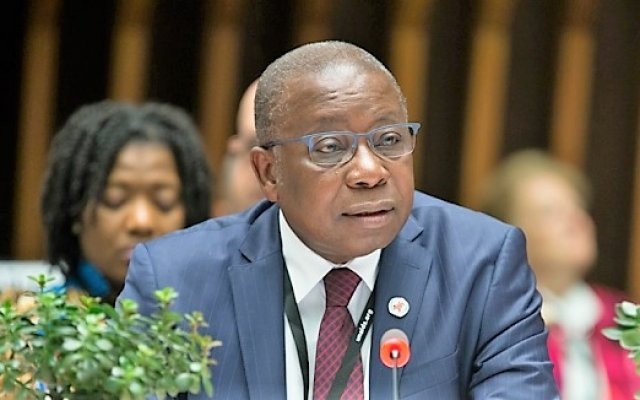
Ghana’s Ministry of Health wants to digitise records in all of Ghana’s public and (religious) mission-owned hospitals and clinics and thus make paper folders for patients a thing of the past. The idea is good, and the plan itself is very old, but serious attempts to execute date back to 2007, culminating in a detailed national e-health strategy in 2010. Among other aims, the overall strategy today encourages the development of an ecosystem of software and ICT innovations to support Health Systems Management across the nation. Different systems being able to talk to each other (interoperability); local development, deployment and support of solutions; and minimising the financial burden on the state through private participation, are some of the core principles of Ghana’s e-Health policy. Although the policy does not rule out the use of foreign software, it nevertheless impliedly supports the development of local solutions for obvious reasons of job creation, local support, and preservation of local medical records in Ghana. On June 28, 2021, the honourable Minister caused a letter to be written by the Director-General of the Ghana Health Service to the entire senior management corps of Ghana’s frontline health services presenting the Lightwave Health Information Management System (LHIMS) as the only authorised Electronic Medical Records (EMR) solution for all government-run and religious mission-operated hospitals (about 20% of the facilities in the national “public health sector” are managed by religious organisations). The Minister is genuinely proud of LHIMS and its vendor, Lightwave eHealth Solutions, a small organisation based in Atlanta with mail handling services in the UK and a couple of project managers in Ghana. So proud that he is fond of reciting the success stories of LHIMS’ deployment in the Central Region, as in a recent testimonial: “Presently 25 health facilities including the Cape Coast Teaching Hospital are online and active. This covers 345 Doctors and 2,312 clinical staff across the region. Twenty Network Radio Masts have so far been installed. So far 379 computing devices have also been deployed.” What is left unsaid is that in recent years, a number of major hospitals, such as Komfo Anokye Teaching Hospital, have been forced to abandon locally developed EMR solutions like HAMS for LHIMS, thereby increasing the latter’s footprint. To get LHIMS entrenched in the Central Region, for instance, HAMS, a competing local product, literally had to be ripped out of places its frugal and longsuffering Ghanaian developers had spent years cultivating to even accept the idea of medical records digitisation. It must be mentioned that local developers in the space built their platforms on their own dime, and had to pay for all the development and testing themselves. They had to prove themselves capable and compete in the market before they could pass due diligence by the public and private hospitals buying their products and services. They have since had to ensure high levels of service to retain these clients. Lightwave has never had to deal with such hurdles. Yet by one fell swoop, the Ministry’s directive, if carried out to the letter, would lose just one of these local EMR vendors as many as 200 clients they have acquired over a period of more than a decade. It should be reasonable to expect that our government officials will support successful local initiative and companies more than foreign ones especially when the foreign vendors do not have a superior product or service. The fact remains that, even with all its touted successes, LHIMS is not a perfect solution. A 2019 study by Princess Gloria Ofori and her colleagues revealed that whilst the LightWave system has indeed reduced waiting time at the Outpatients Department (OPD) of the University of Cape Coast Hospital by 50%, nearly half of the staff (41%) are unable to generate the relevant performance reports from the system. The main reason why LHIMS is displacing all other solutions in the EMR space like those implemented well before it was brought into the country by the likes of IPMC, Queauji (builders of the well-regarded Carewex health IT platform), Progsoft, Spagad, Sanford, Infotech, MedData, and Africa eHealth Solutions etc is simply Ministerial fiat. When these hardy local technology vendors have scraped and penny-pinched to make some headway in a tough market, a bureaucrat in Accra will step into the fray to fight on behalf of Lightwave, forcing customers to abandon solutions they have built a level of comfort with. This is seriously damaging local ICT companies in droves. The Sampson Djaba-founded Lightwave is to be commended for having succeeded in obtaining strong buy-in at the Ministry of Health to modernise the country’s medical records system, but the truth is also that it does not have the capacity to replace the large number of ICT companies currently offering health IT solutions, especially in the EMR segment, to public and mission-run facilities. But even if it did, it is clearly against established policy of interoperability and resilience from having multiple vendors and a diverse ecosystem, as against a single vendor and a single point of failure across the entire health technology landscape. Monopolies are out of fashion everywhere and no good policy allows the creation of single providers who the whole system will soon be entirely reliant on, and thereby create negative dynamics for performance and efficiency as happens with all monopiles. It is clearly more desirable to allow for competition and diversity and ensure standards that create seamless interoperability. An interoperable model will lead to a virtuous cycle of vendors improving their systems in order to be more preferred, and those who slack are likely to be replaced. In the end, users and ultimately patients are the beneficiaries of operationally effective and cost-effective systems and services. This also leads to the development of local capacity and the creation of high-quality jobs in ICT. A credit check report we have seen shows that Lightwave’s reported annual revenues have been under $300,000 in recent years for its Atlanta-based holding entity and also that its full-time employees number less than
MFWA petitions speaker on deteriorating press freedom in Ghana

The Media Foundation for West Africa (MFWA) with the support of some 642 journalists and supporters of press freedom has petitioned the Speaker of Parliament Alban Bagbin requesting a frank debate by the House about the deteriorating press freedom situation in Ghana in order to make appropriate recommendations towards reversing the trend. According to the petition, this request has been prompted by the recent verbal attack on Erastus Asare Donkor, a journalist with Luv FM, by the Member of Parliament for Assin Central, Honourable Kennedy Ohene Agyapong, who also called for the journalist to be beaten. PETITION-TO-THE-SPEAKER-OF-PARLIAMENTDownload “Erastus Asare Donkor was invited by the three-member Committee inquiring into the recent killing of two people during protests in Ejura in the Ashanti Region. His invitation by the Committee was apparently due to his extensive coverage of the killing of social media activist Mohammed Ibrahim Anyass, and the protests that followed. “Commenting on Asare Donkor’s reports and subsequent submissions before the Committee, the Member of Parliament subjected the journalist to insults and called for him to be beaten,” the petition said. Meanwhile, the First Deputy Speaker of Parliament Mr Joseph Osei Wusu has said the Member of Parliament for Tamale North Alhassan Suhuyini who petitioned the Speaker against his colleague lawmaker for Assin Central Kennedy Agyapong will appear before the Privileges Committee. Speaking to journalists in Parliament on Thursday July 23, the Bekwai lawmaker said the matter will be heard as if it is a court trying an accused person. “It is a member of the House who petitioned the Speaker so it is the petitioner who will appear before us. If the petitioner decides that he needs somebody else to assist him to prosecute his case, why not. Remember that when it comes to the privileges committee, it is more or less a trial so our process is no different from the court. “Whatever or however you put your case, you will be guided by the rules of the house, nothing else. “A committee of parliament is only a committee of parliament , we make recommendations to the House so yes, under the rules of parliament whoever recommendations that are permissible under the rules can be made by the committee, decisions are made by the committee.” Mr Suhuyini had said he felt obliged to raise the issues against his colleague Member of Parliament for Assin Central Kennedy Agyapong on the floor of the House because of his background as a journalist. This comes after the Speaker Alban Bagbin has referred Mr Agyapong to the Privileges Committee of Parliament for his utterances against a journalist with the Multimedia Group, Erastus Asare Donkor. Mr Agyapong on Friday, July 9, is reported to have allegedly threatened to attack Mr Asare Donkor, “for the journalistic work that the latter undertook during the recent shootings and killing incident at Ejura” on his television station. The Multimedia Group filed a formal complaint against Mr Agyapong. On Wednesday July 14, Alhassan Suhuyini raised the issue on the floor of the house and asked the Speaker to refer the matter to the Privileges Committee. He said “Mr Speaker, I think that as a former journalist I feel obliged to draw the House’s attention to this conduct of an Honorable colleague of this house which in my view, brings this house into disrepute. “Mr Speaker, I urge you to exercise your powers under 27 and refer this conduct of the Honorable which is becoming unacceptable, to the Privileges Committee to ascertain the veracity of the comments that were made and recommend sanctions if possible that will act as deterrent to other members who may be tempted to act like him.” In response to his request, the Speaker accordingly referred Mr Agyapong to the committee. He said he cannot take a decision on Mr Agyapong over his utterances against a journalist in Ghana. That decision to determine whether or not the conduct smacks of abuse of privileges, he said, rests with the lawmakers as a House, to take. “As it is now, I am compelled to refer it to the Privileges Committee. I want to emphasize that it is the House that will take the decision, it is not the speaker, it is not any other person apart from the House. “That will be your collective wisdom that come to the conclusion whether what is alleged is just a mere allegation or is supported by facts and whether those facts constitute contempt of the House and abuse of a privilege of members. “It is important for me to emphasize here that the privilege and immunity of free speech applies in full force in plenary session and committee sessions, not when members are outside debating issues or on radio and TV. You don’t have that right, that privilege, that immunity to just say anything because you are a member of parliament. “We are not above the law. It is for good reasons because you represent a large number of people, you should be given the full immunity to be able to say what the people say they want you to say. That is why you say it here and you are covered. “That immunity doesn’t extend to you in anywhere else. So pleased the committee should go into the matter, submit the report.” —3news Please contact Apexnewsgh.com on email apexnewsgh@gmail.com for your credible news publications. Contact: 05555568093
Suhuyini to testify against Ken Agyapong on Monday

The First Deputy Speaker of Parliament Mr Joseph Osei Wusu has said the Member of Parliament for Tamale North Alhassan Suhuyini who petitioned the Speaker against his colleague lawmaker for Assin Central Kennedy Agyapong will appear before the Privileges Committee to testify. Speaking to journalists in Parliament on Thursday July 23, the Bekwai lawmaker said the matter will be heard as if it is a court trying an accused person. “It is a member (Alhassan Suhuyini) of the House who petitioned the Speaker so it is the petitioner who will appear before us. If the petitioner decides that he needs somebody else to assist him to prosecute his case, why not. “Remember that when it comes to the privileges committee, it is more or less a trial so our process is no different from the court. “Whatever or however you put your case, you will be guided by the rules of the house, nothing else. “A committee of parliament is only a committee of parliament , we make recommendations to the House so yes, under the rules of parliament whichever recommendations that are permissible under the rules can be made by the committee, decisions are made by the committee.” Meanwhile Mr Suhuyini has said he felt obliged to raise the issues against his colleague Member of Parliament for Assin Central Kennedy Agyapong on the floor of the House because of his background as a journalist. This comes after the Speaker Alban Bagbin has referred Mr Agyapong to the Privileges Committee of Parliament for his utterances against a journalist with the Multimedia Group, Erastus Asare Donkor. Mr Agyapong on Friday, July 9, is reported to have allegedly threatened to attack Mr Asare Donkor, “for the journalistic work that the latter undertook during the recent shootings and killing incident at Ejura” on his television station. The Multimedia Group filed a formal complaint against Mr Agyapong. On Wednesday July 14, Alhassan Suhuyini raised the issue on the floor of the house and asked the Speaker to refer the matter to the Privileges Committee. He said “Mr Speaker, I think that as a former journalist I feel obliged to draw the House’s attention to this conduct of an Honorable colleague of this house which in my view, brings this house into disrepute. “Mr Speaker, I urge you to exercise your powers under 27 and refer this conduct of the Honorable which is becoming unacceptable, to the Privileges Committee to ascertain the veracity of the comments that were made and recommend sanctions if possible that will act as deterrent to other members who may be tempted to act like him.” In response to his request, the Speaker accordingly referred Mr Agyapong to the committee. He said he cannot take a decision on Mr Agyapong over his utterances against a journalist in Ghana. That decision to determine whether or not the conduct smacks of abuse of privileges, he said, rests with the lawmakers as a House, to take. “As it is now, I am compelled to refer it to the Privileges Committee. I want to emphasize that it is the House that will take the decision, it is not the speaker, it is not any other person apart from the House. “That will be your collective wisdom that come to the conclusion whether what is alleged is just a mere allegation or is supported by facts and whether those facts constitute contempt of the House and abuse of a privilege of members. “It is important for me to emphasize here that the privilege and immunity of free speech applies in full force in plenary session and committee sessions, not when members are outside debating issues or on radio and TV. You don’t have that right, that privilege, that immunity to just say anything because you are a member of parliament. “We are not above the law. It is for good reasons because you represent a large number of people, you should be given the full immunity to be able to say what the people say they want you to say. That is why you say it here and you are covered. “That immunity doesn’t extend to you in anywhere else. So pleased the committee should go into the matter, submit the report.” —3news Please contact Apexnewsgh.com on email apexnewsgh@gmail.com for your credible news publications. Contact: 05555568093
GCB Bank Pays Ghc69.62 Million Dividend To Shareholders In Four Years

GCB Bank Limited has in four successive years paid a total amount of GH¢69.62 million to its shareholders including the Government of Ghana as dividend. GCB has been consistent and recorded steady increase in dividend payment to its shareholders from 2017 to 2021 The Bank today paid GH¢14.152 million to the Government of Ghana as dividend for the 2020 financial year. A Deputy Minister of Finance, Mr John Kumah, who received the cheque from Mr Kofi Adomakoh, Managing Director of GCB, lauded the Bank for living up to the expectation of its shareholders. The GHc14.15 million dividend paid represents an increase of 25 per cent over the GHc11.321 million paid to the government in 2019 financial year. In spite of the devastating effects of COVID-19 pandemic on businesses and economies, GCB posted impressive results recording profit before tax (PBT) of GHc611 million in 2020 from GHc574 million recorded in 2019. The Deputy Minister commended the Board, Management and Staff of the Bank for the impressive gains in the face of slow economic growth being experienced in the global environment as a result of COVID-19. “On behalf of the Honourable Minister, I would like to congratulate you, your Board members and the Management and Staff on your consistency in declaring and paying dividend to Government and other shareholders of the Bank despite the challenges,” Mr Kumah said. The Deputy Minister urged state owned enterprises, joint venture companies and mining companies that have declared dividend to make due their responsibility to Government and its shareholders. The GCB MD, Mr Kofi Adomakoh, who described 2020 as a challenging year, said GCB braved the storm and supported Ghana, Ghanaian businesses and individuals to overcome some challenges. He said GCB as a strategic asset with rich heritage would continue to focus and extend financial solutions to Ghanaian companies to thrive. Turning to the future of the Bank, Mr Adomakoh said, “the future looks very bright for the Bank and Ghana.” Please contact Apexnewsgh.com on email apexnewsgh@gmail.com for your credible news publications. Contact: 05555568093
UTAG threatens strike over ‘unfruitful’ negotiation of conditions of service
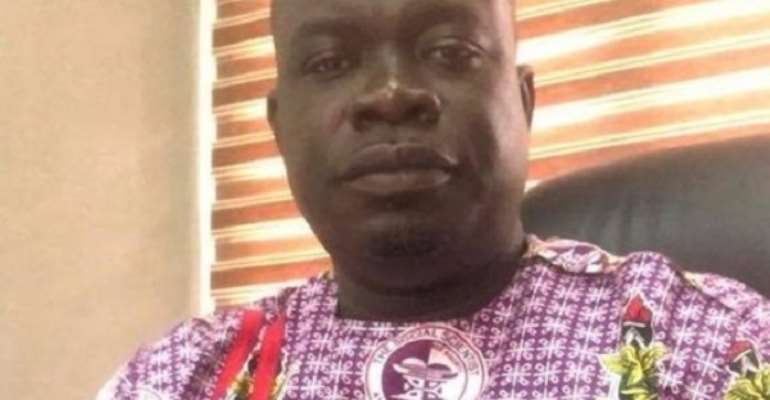
The University Teachers Association of Ghana (UTAG) is insisting that its members will embark on strike beginning August 2 if issues concerning their conditions of service are not addressed by the end of July 2021. President of the Association, Prof. Charles Marfo said the decision is a result of the government’s failure to properly resolve their concerns regarding their conditions of service over a period of time. Prof. Marfo in a Citi News interview in Kumasi said: “Over the years, the fortunes of university lecturers have dwindled. For the past three years, we have been engaging government on our conditions of service.” “So we have indicated to the government that if by the end of July 2021, we do not see anything concrete to better the lives of university lecturers, we have only one weapon and that is strike. If our concerns delay, the strike will continue if it’s declared on August 2, 2021”, he added. Meanwhile, some students of the Kwame Nkrumah University of Science and Technology (KNUST) have urged the government to as a matter of urgency address the grievances of their lecturers to avoid a possible strike. Slow salary negotiations Last month, UTAG, lamented what it calls the slow nature of ongoing negotiations on the salaries and conditions of service of its members. The Association maintains that there is growing tension among its members on the various campuses due to the posture of the government towards finalizing negotiations on their conditions of service, which have been on the table since 2018. It, therefore, gave the government until the end of July to address their concerns. “We have been negotiating with the government about our conditions of service, but it’s been long since we had one. So we thought it wise that it is about time we did. We have been having negotiations on it, but it doesn’t seem to have been fruitful, so we want to begin to get something substantial for our members. We expect the government to be up and doing. If they don’t, the only option left is for us to lay [down] our tools, but no one wants to get on that tangent, Prof. Marfo said. —citinewsroom Please contact Apexnewsgh.com on email apexnewsgh@gmail.com for your credible news publications. Contact: 05555568093
Court orders NCA to stop collecting personal details of mobile phone subscribers

The High Court has ordered the National Communications Authority (NCA) to stop collecting personal information of mobile phone subscribers. Per the orders of the court, the government has 14 days to delete all such data already gathered, and report same to the Court’s Registrar. A private legal practitioner, Francis Kwarteng Arthur, took the National Communications Authority (NCA), Vodafone Ghana, MTN Ghana and Kelni GVG to court in 2020 over President Akufo-Addo’s Executive Instrument on the Electronic Communications law. This order, contained in Executive Instrument 63, as argued by the Attorney-General, was to enable the President to conduct contact tracing as part of the efforts at fighting COVID-19. The personal information was to be collected by the telecommunication companies and lodged with a private company, Kelni GVG for the purposes of the Executive Instrument. Justice Rebecca Sittie, however, held that the President’s directive violates people’s right to privacy. The court also ordered Vodafone, the NCA and Kelni GVG to pay damages of GH¢20,000 each to the private legal practitioner. The emergency legislation signed by President Nana Akufo-Addo on March 24, 2020, sought to provide legal backing to a series of steps undertaken by the government to deal with the COVID-19 pandemic. In line with the Electronic Communications Act, 2008 (Act 775), the law specifically directed network operators to make available data including all called numbers, mobile money merchant codes and uncashed subscriber mobile money transfer data. According to the Executive Instrument, the network operators were to cooperate with the National Communications Authority Common Platform to provide information to state agencies in the case of an emergency. Unhappy with the law, Mr. Arthur went to court to seek an order to quash the President’s directive because to him, the order “violated, are violating or are likely to violate” his “fundamental rights and freedoms”. He was also sought a perpetual injunction to restrain the government, Kelni GVG and the NCA “from using the Executive Instrument to procure the applicants’ personal information from” Vodafone Ghana, his network provider. —citinewsroom Please contact Apexnewsgh.com on email apexnewsgh@gmail.com for your credible news publications. Contact: 05555568093
Agyebeng: ‘I’ll guard my independence jealously’

Special Prosecutor nominee Kissi Agyebeng has told parliament’s Appointments Committee during his vetting on Thursday, 22 July 2021 that he intends to guard his independence jealously in carrying out his made in terms of investigating, preventing, prosecuting corruption cases and managing seized, frozen or confiscated properties. In his view, the relevance of the OSP cannot be overemphasised and, thus, warned: “…The day we scrap this office is the day we say goodbye to our fight against corruption”. “Its relevance is borne out by its attributes and its uniqueness”, he argued, adding: “It is unique, as compared to all the other law enforcement agencies in respect of its mandate because no other institution has been carefully designed and thought-out to fight corruption specifically as Act 959 has done and Hon Chair, in respect of this, the office of the special prosecutor is the gold standard under the UN convention against corruption and the AU convention on the prevention and combatting of corruption”. “The international community, including Ghana ratified these conventions in the early 2,000s, I think 2002 if I’m not wrong, that every jurisdiction requires such a specialised agency, it should be made independent with a specialised trained staff to focus on the fight against corruption”, he observed. According to him, the OSP is relevant because the Attorney General “is a member of cabinet, he’s part of the government. How independent would he be in terms of certain individuals if they were to fall foul of the law if, for instance, they are also members of cabinet or members of the government?” “But in respect of the OSP, the person manning it, who is not part of the government machinery, who is independent; and Hon Chair, if given the nod, I’m going to guard my independence jealously,” he said. Mr Agyebeng also admitted to the committee that: “I am not naive to assume that I am coming to stop corruption”, adding: “There’s no way I can stop corruption”. “God himself will not acclaim to that but I am going to make corruption very costly to engage in”, Mr Agyebeng told the committee. Mr Agyebeng is the Chairman of the Electronic Communications Tribunal. Mr Agyebeng was nominated as Ghana’s second Special Prosecutor following the resignation of Mr Martin Amidu. Mr Amidu resigned from the position on 15 November 2020 citing interference by President Nana Akufo-Addo in his job. In a letter to the Presidency, Attorney General Godfred Dame said: “Kissi Agyebeng possesses the requisite expertise on corruption and corruption-related matters and is of high moral character and proven integrity and satisfies all the other requirements stipulated in section 13(1) and (2) of Act 959.” Section 13(8) of the Office of the Special Prosecutor Act, 2017 (Act 959) requires the President to appoint a person qualified for appointment as Special Prosecutor to that position, within six months of the Office of Special Prosecutor becoming vacant. Please contact Apexnewsgh.com on email apexnewsgh@gmail.com for your credible news publications. Contact: 05555568093
I prefer to wear my own shoes as Amidu’s successor – Agyebeng

Special Prosecutor nominee Kissi Adjabeng has said he prefers to be his own man rather than fll the shoes of his predecessor Mr Martin Amidu. The 43-year-old law lecturer told parliament’s Appointments Committee on Thursday, 22 July 2021: “I prefer to wear my own shoes in the sense that I am my own man and I am coming with my own experiences and professional training conscience and learning of the law as my strategy”. He also described claims made by Mr Amidu against him that he was a surrogate of the botched Agyapa deal, as “uninformed”. “I wasn’t involved in the deal. I was nowhere near it. Indeed, until it started coming up, I didn’t even know what it was”. According to him, “whoever says I am a surrogate of a law firm or implicates me in the Agyapa transaction clearly does not know me because if you know me, you wouldn’t make such allegations”. “All these things that came up, I took them as coming from uninformed positions because I was not involved in the Agyapa transaction in any form or manner.” Mr Amidu had said in a harangue that Mr Agyebeng’s closeness to Attorney General Godfred Dame and President Nana Akufo-Addo’s cousin, Mr Gabby Asare Otchere-Darko, who owns Accra-based Asaase Radio and also co-founder of Africa Legal Associates, a law firm involved in the controversial Agyapa Royalties deal, would undermine his independence. “Asaase Radio should also have told the Ghanaian and international public that its surrogate and nominee Special Prosecutor in the published letter is a personal friend and classmate of the Attorney General, and the owner of Asaase Radio, all of whom attended the University of Ghana’s Faculty of Law, and Ghana Law School”, Mr Amidu wrote. “Asaase Radio and the nominator of the proposed new Special Prosecutor know or ought to have known the extent of the involvement of their surrogate as a lawyer for suspects in pending suspected corruption cases in which the government showed an undue interest in the Office of the Special Prosecutor, which I await to see how independently and impartially those cases will be handled to the conclusion should the President submit the name of the nominee to Parliament, he is approved, and then appointed,” Mr Amidu added. Mr Agyebeng, however, told the committee: “As for relationships, the fact that I was so close to you at some point in our lives would not give you the free pass because of that relationship”. “If there is a matter, I’m not going to say because I know one person or the other, I’m going to give the person a free pass”. “I’m certainly going to investigate, but the truth of the matter ought to be told.” “For the record, that is the truth, and so I am no one’s surrogate. I am my own man, and I prefer to wear my own shoes”, he noted. —classfm Please contact Apexnewsgh.com on email apexnewsgh@gmail.com for your credible news publications. Contact: 05555568093
Appointments C’ttee unanimously recommends Agyebeng’s approval
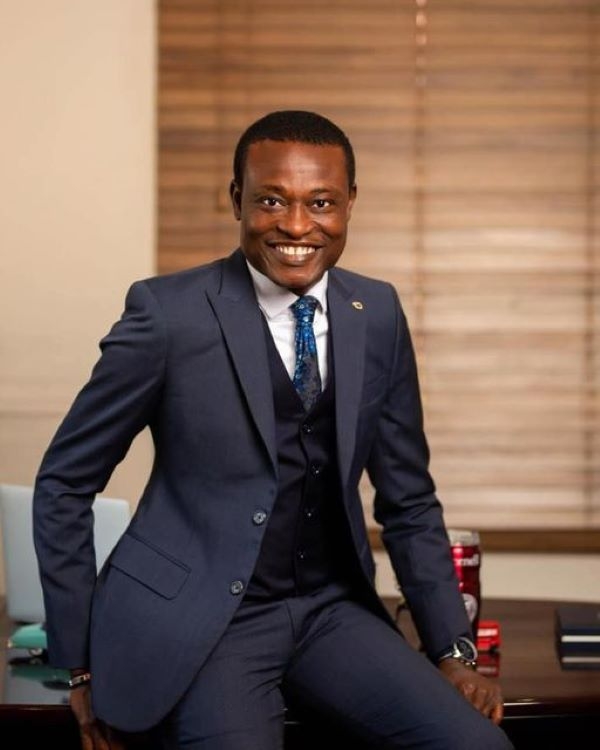
Parliament’s Appointments Committee has unanimously recommended the approval of Special Prosecutor nominee Kissi Agyebeng just after his vetting on Thursday, 22 July 2021. The Chairman of the committee, Mr Joe Osei-Owusu, announced the recommendation. The plenary will debate the report of the committee at a scheduled time. “We put our recommendation for the house to determine whether to approve or disapprove our recommendation”, Mr Osei-Owusu said, adding: “As to how other people view his [nominee’s] answers, I’d rather leave it to them and stay within the rules to make recommendations to the house”. “The committee unanimously agreed to recommend him to the house for approval,” Mr Osei-Owusu said. During his vetting, Mr Agyebeng has told the committee that he intends to guard his independence jealously in carrying out his mandate in terms of investigating, preventing, prosecuting corruption cases and managing seized, frozen or confiscated properties. In his view, the relevance of the OSP cannot be overemphasised and, thus, warned: “…The day we scrap this office is the day we say goodbye to our fight against corruption”. “Its relevance is borne out by its attributes and its uniqueness”, he argued, adding: “It is unique, as compared to all the other law enforcement agencies in respect of its mandate because no other institution has been carefully designed and thought-out to fight corruption specifically as Act 959 has done and Hon Chair, in respect of this, the office of the special prosecutor is the gold standard under the UN convention against corruption and the AU convention on the prevention and combatting of corruption”. “The international community, including Ghana ratified these conventions in the early 2,000s, I think 2002 if I’m not wrong, that every jurisdiction requires such a specialised agency, it should be made independent with a specialised trained staff to focus on the fight against corruption”, he observed. According to him, the OSP is relevant because the Attorney General “is a member of cabinet, he’s part of the government. How independent would he be in terms of certain individuals if they were to fall foul of the law if, for instance, they are also members of cabinet or members of the government?” “But in respect of the OSP, the person manning it, who is not part of the government machinery, who is independent; and Hon Chair, if given the nod, I’m going to guard my independence jealously,” he said. Mr Agyebeng also admitted to the committee that: “I am not naive to assume that I am coming to stop corruption”, adding: “There’s no way I can stop corruption”. “God himself will not acclaim to that but I am going to make corruption very costly to engage in”, Mr Agyebeng told the committee. Mr Agyebeng is the Chairman of the Electronic Communications Tribunal. Mr Agyebeng was nominated as Ghana’s second Special Prosecutor following the resignation of Mr Martin Amidu. Mr Amidu resigned from the position on 15 November 2020 citing interference by President Nana Akufo-Addo in his job. In a letter to the Presidency, Attorney General Godfred Dame said: “Kissi Agyebeng possesses the requisite expertise on corruption and corruption-related matters and is of high moral character and proven integrity and satisfies all the other requirements stipulated in section 13(1) and (2) of Act 959.” Section 13(8) of the Office of the Special Prosecutor Act, 2017 (Act 959) requires the President to appoint a person qualified for appointment as Special Prosecutor to that position, within six months of the Office of Special Prosecutor becoming vacant. —classfm Please contact Apexnewsgh.com on email apexnewsgh@gmail.com for your credible news publications. Contact: 05555568093
MTN Ghana Adjudged Business Of The Decade By Millennium Excellence Foundation
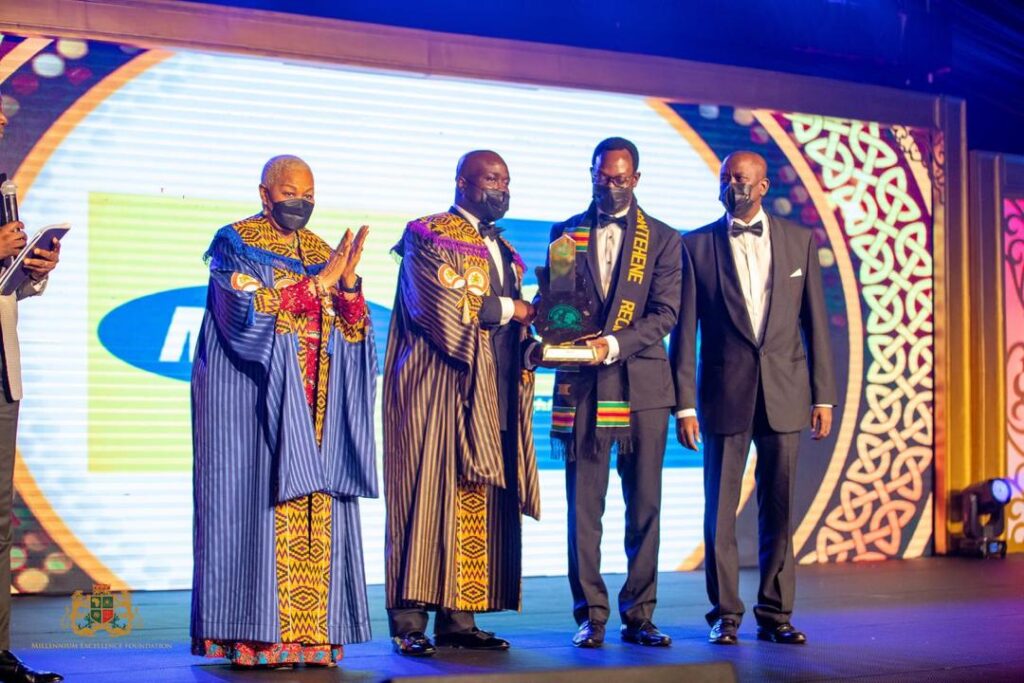
The Millennium Excellence Foundation has conferred on MTN Ghana the ‘Business of the Decade’ award at the Millennium Excellence Awards held on Saturday July 17, 2021 at Manhyia in the Ashanti Region. MTN was among a few selected companies who achieved the highest rating by the esteemed Millennium Excellence Foundation Research and Award Committee team. A citation presented to MTN Ghana for the award read, “MTN Ghana has been delivering best services in the telecom industry. In the past decade, MTN has distinguished itself as the market leader and pacesetter in all aspects of communication services provision. MTN Ghana has been in the forefront of technology, digitization and innovation. MTN Ghana was the first to deliver a Data Center, 4G, MoMo and more, enabling it to stay miles ahead of the competition. The company has also been a leading tax payer and employer. The MTN Foundation has also changed many lives with its series of CSR programmes. MTN also contributes immensely to sports development.” The Chief Executive Officer of MTN Ghana Mr. Selorm Adadevoh who accepted the award on behalf of the company said, “MTN is pleased to receive this recognition which is an affirmation of the organization’s quest to ensure the provision of exceptional services to its customers through immense investments in all aspects of its operations. As a leading telecommunications service provider, we believe everyone deserves the benefits of a modern connected life therefore the organization continues to commit resources to meet both the digital and communication needs of customers.” Commenting further on the award the CEO said, “This award is coming at the time of MTN Ghana’s 25th Anniversary celebration and it is an affirmation of the company’s contribution to national development over the years. We wish to sincerely thank the Life Patron, His Royal Highness Otumfuo Osei Tutu II and the Millennium Excellence Foundation, for the recognition. This award will encourage us to go the extra mile in ensuring our customers and the nation as a whole continues to benefit from the operations of MTN in Ghana”, he added. The Millennium Excellence Awards is hosted only once every five years to recognize institutions and individuals who have contributed to national development. The ‘Business of the Decade’ award is the first award MTN Ghana has received from the Millennium Excellence Foundation since the inception of the awards. Apexnewsgh.com/Ghana/Ngamegbulam Chidozie Stephen Please contact Apexnewsgh.com on email apexnewsgh@gmail.com for your credible news publications. Contact: 05555568093