

Kenya borrows Dr. Mahamudu Bawumia’s newborn I.D digitalization ideas completely
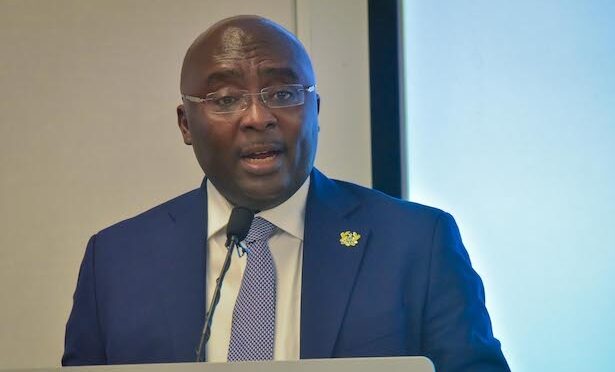
In 2021, Ghana’s Vice President Dr. Mahamudu Bawumia announced, that barring any unforeseen circumstances, every newborn child delivered in Ghana next year will get, within a few months, a Ghanacard number. Apexnewsgh report According to Vice President, the actual card will be issued when the child is grown and the biometrics are fully formed (after age 6). Dr. Bawumia said the move forms part of the digital reforms being undertaken at the Births and Deaths Registry to make it more in tune with the times and provide better protect information on the citizens and residents of Ghana. However, after two years of that announcement by Ghana’s Vice President Dr. Mahamudu Bawumia, it appears the Kenyan government has emulated the idea of Ghana’s Vice President in that direction. On Monday, February 6, 2023, Cabinet Secretary Kithure Kindiki made a similar announcement that the Interior Ministry will be digitizing birth and death records starting March 1, 2023. He said, all children born in Kenya will soon be assigned a unique identification number at birth that will later be used in school and eventually become their national identity number. He added, newborns, will soon be assigned a Unique Personal Identifier (UPI) at birth. This will later become the individual’s national ID, social security number, health insurance number and eventually the death certificate number. “It will be their Nemis (National Education Management Information System) number in school. When they turn 18, it will be the ID, NHIF, NSSF and will be the number of your death certificate,” he said, adding that Kenya is now transitioning to a smart ID system. “In the period between the time the UPI is introduced and 18 years later when it will transit into the ID, the Ministry is working on introduction of the Third-Generation, smart and digital ID,” Cabinet Secretary Kithure Kindiki stressed For publication please kindly contact us on +233256336062 or Email apexnewsgh@gmail.com
Death toll after major quake climbs to more than 2,300 in Turkey, Syria
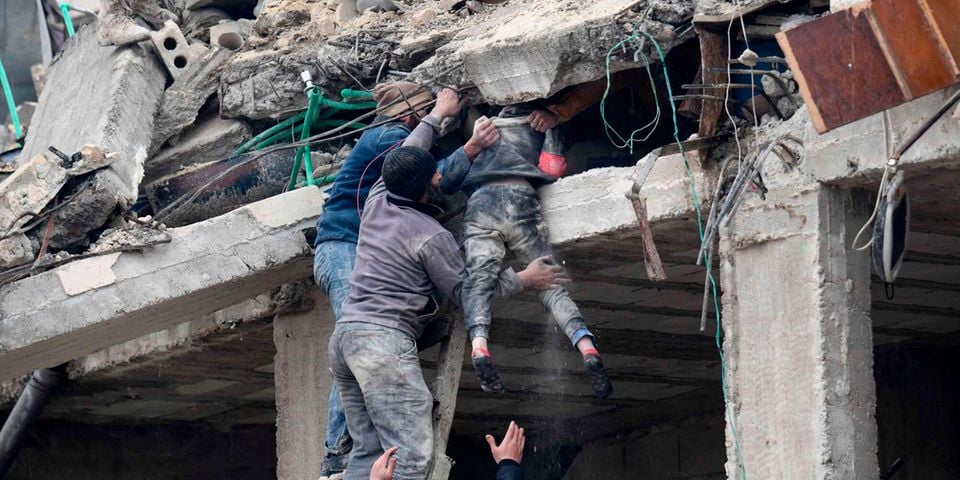
The most powerful earthquake in nearly a century struck Turkey and Syria early Monday, killing over 2,300 people in their sleep, levelling buildings and causing tremors felt as far away as Iraq. The 7.8-magnitude quake wiped out entire sections of major Turkish cities in a restless region filled with millions of people who have fled the civil war in Syria and other conflicts. The head of Syria’s National Earthquake Centre, Raed Ahmed, told pro-government radio that this was “the biggest earthquake recorded in the history of the centre”. At least 810 people died in government-controlled parts of Syria, according to the latest toll. At least 1,498 people also died in Turkey, Turkish authorities said. Shocked survivors in Turkey rushed out into the snow-covered streets in their pyjamas, watching rescuers dig through the debris of damaged homes with their hands. “Seven members of my family are under the debris,” Muhittin Orakci, a stunned survivor in Turkey’s mostly Kurdish city of Diyarbakir, told AFP. “My sister and her three children are there. And also her husband, her father-in-law and her mother-in-law.” The rescue was being hampered by a winter blizzard that covered major roads in ice and snow. Officials said the quake made three major airports in the area inoperable, further complicating deliveries of vital aid. Election test for Erdogan The quake struck at 04:17 am (0117 GMT) at a depth of about 17.9 kilometres (11 miles) near the Turkish city of Gaziantep, which is home to around two million people, the US Geological Survey said. Turkey’s AFAD emergencies service centre put the quake’s magnitude at 7.7, updating an initial estimate of 7.4. Turkish President Recep Tayyip Erdogan, who will be under intense pressure to oversee an effective response to the disaster heading to a tightly-contested May 14 election, conveyed his sympathies and urged national unity. “We hope that we will get through this disaster together as soon as possible and with the least damage,” the Turkish leader tweeted. Washington, the European Union, and Russian all immediately sent condolences and offers of help. Turkey also received a message of support from its historic rival Greece, whose relations with Ankara have suffered from a spate of border and cultural disputes. Ukrainian President Volodymyr Zelensky offered to provide “the necessary assistance” to Turkey, whose combat drones are helping Kyiv fight the Russian invasion. And Iran, which together with Russia is trying to help Ankara restore its relations with Damascus following its efforts to help oust Syrian President Bashar al-Assad, sent separate messages of condolence to both sides. ‘People under rubble’ Images on Turkish television showed rescuers digging through rubble across city centres and residential neighbourhoods of almost all the big cities running along the border with Syria. Some of the heaviest devastation occurred near the quake’s epicentre between Kahramanmaras and Gaziantep, where entire city blocks lay in ruins under the gathering snow. Kahramanmaras Governor Omer Faruk Coskun said it was too early to estimate the death toll because so many buildings were destroyed. “It is not possible to give the number of dead and injured at the moment because so many buildings have been destroyed,” Coskun said. “The damage is serious.” A famous mosque dating back to the 13th century partially collapsed in the province of Maltaya, where a 14-story building with 28 apartments housed 92 people also collapsed. In other cities, social media posts showed a 2,200-year-old hilltop castle built by Roman armies in Gaziantep lying in ruins, its walls partially turned to rubble. “We hear voices here — and over there, too,” one rescuer was overheard as saying on NTV television in front of a flattened building in the city of Diyarbakir. “There may be 200 people under the rubble.” Power outages The Syrian health ministry reported damage across the provinces of Aleppo, Latakia, Hama and Tartus, where Russia is leasing a naval facility. AFP correspondents in northern Syria said terrified residents ran out of their homes after the ground shook. Even before the tragedy, buildings in Aleppo, Syria’s pre-war commercial hub, often collapsed due to the dilapidated infrastructure, which has suffered from lack of war-time oversight. Naci Gorur, an earthquake expert with Turkey’s Academy of Sciences, urged local officials to immediately check the region’s dams for cracks to avert potentially catastrophic flooding. Officials cut off natural gas and power supplies across the region as a precaution, also closing shools for two weeks. “The size of the aftershocks, which may continue for days although mostly decreasing in energy, brings a risk of collapse of structures already weakened by the earlier events,” David Rothery, an earthquake expert at the Open University in Britain. “This makes search and rescue efforts dangerous.” Turkey is in one of the world’s most active earthquake zones. The Turkish region of Duzce suffered a 7.4-magnitude earthquake in 1999, when more than 17,000 people died –including about 1,000 in Istanbul. Experts have long warned a large quake could devastate Istanbul, a megalopolis of 16 million people filled with rickety homes. The last 7.8-magnitude tremor shook Turkey in 1939, when 33,000 died in the eastern Erzincan province. AFP—
Gold-for-Oil: 11 OMCs fail to reduce prices on first consignment

Some 11 out of 27 Oil Marketing Companies (OMC) that benefitted from the Gold-for-Gold policy have failed to reduce the prices of their commodities, Dr Amin Adam, the Deputy Minister for Energy has said. The situation, he said had been a setback on the policy intended to improve the supply of the commodity, positively influence price change, and shore up the exchange reserve of the country. “National Petroleum Authority (NPA) has to be very rigorous in ensuring that the framework that will be published to govern the pricing of the product is a strong framework. “And they have to ensure that they are able to monitor all those OMCs that will take the product to ensure they reflect in their pump prices,” he said in a media engagement. Ghana piloted the Gold for Oil policy with the delivery of 41,000 metric tonnes from the United Arab Emirates (UAE), which arrived at the Tema port on Sunday, January 15, 2023. Speaking in an interview with the Ghana News Agency (GNA), Mr Duncan Amoah, the Executive Secretary of the Chamber of Petroleum Consumers Ghana (COPEC), said it was encouraging to have more than 50 percent of OMC reducing their prices under the policy. He, however, called for “purposeful planning” with a clear objective of either ensuring fuel security or reduction in pump prices. That, he said, would require a constant supply of the commodity on the market to meet the demands. “You must be focused and know that 41 000 metric tonnes might not do the trick. So, If I am bringing 41, another cargo must come at 60, and must come at 70, to be able to contain the market demand. “If you are going to throw a little in the ocean and expect a ripple effect, you might not get it,” he said. The prices of fuel in Ghana are mainly determined by the world market price of the commodity, cedi depreciation, taxes and levies. As of November 2021, the government had imposed 12 different taxes and levies on petroleum products while the Cedi had declined by more than 55 per cent between January and October 2022. Mr Amoah urged the Bank to Ghana (BOG) to focus on addressing the volatility of the Cedi by, “using the gold to back the Cedi so that it can have a certain semblance of stability for trading. Mr Alex Mould, a former Chief Executive Officer (CEO) of the Ghana National Petroleum Corporation (GNPC), said the Gold-for-Oil policy was a smokescreen by some players to enter and control the oil import and gold export market using government apparatus. “People with the license to these things are not happy because they can be eliminated,” he stated. Source: GNA
This is how Ghana politicians are praying for Christian Atsu
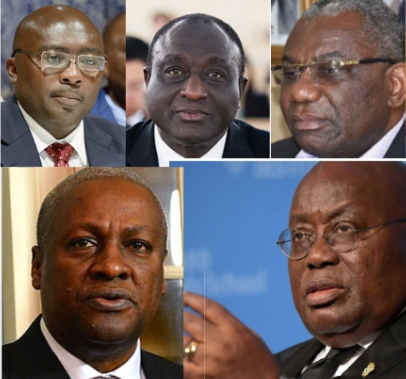
According to a report, over 1,600 people have been killed and thousands more injured after the catastrophic earthquake that rocked Turkey and Syria overnight, flattening neighborhoods while families were asleep. Apexnewsgh.com report This The former Chelsea and Newcastle winger Christian Atsu a Ghanaian professional player is reportedly ‘stuck trapped under the rubble of a destroyed building’ following a 7.8 magnitude earthquake in Turkey. The news has so far generated a massive level of sympathy and prayers from Ghanaians. Below are some of the reactions by Ghanaian politicians. Let's continue to pray for our brother, Christian Atsu, and his club director. The city of Hayat is in the region affected by the earthquake. Let's continue to pray that God spares their lives. https://t.co/51RKJOc7AZ — John Dramani Mahama (@JDMahama) February 6, 2023 May their souls rest in perfect peace. Our hearts and prayers go out to the survivors, and we pray that our fellow Ghanaian, Christian Atsu, is found safe and sound. 2/2 pic.twitter.com/7GOtpYyKAI — Nana Akufo-Addo (@NAkufoAddo) February 6, 2023 https://twitter.com/MBawumia/status/1622647471267512322 My prayers are with Ghanaian International player, @ChristianAtsu20, reportedly among the victims trapped in the earthquake that struck Turkey & Syria. I wait in great hope for the safe recovery of all still unaccounted for & commiserate with all affected by the disaster. pic.twitter.com/f9IcIVuDoy — Alan Kyerematen (@AlanKyerematen) February 6, 2023 It is my prayer that the Ghanaian International footballer, Christian Atsu is found safe. My heartfelt condolences to families and friends who have unfortunately lost their beloveds as a result of the earthquake. #PrayForAstu pic.twitter.com/iN2Y7joFV7 — Boakye Kyeremateng Agyarko (@bkagyarko) February 6, 2023 For publication please kindly contact us on +233256336062 or Email apexnewsgh@gmail.com
Turkey: Atsu trapped under rubble of a destroyed building in the 7.8-magnitude earthquake

Former Chelsea and Newcastle winger Christian Atsu is reportedly ‘stuck trapped under rubble of a destroyed building’ following a 7.8 magnitude earthquake in Turkey. More than 1,600 people have been killed and thousands more injured after the catastrophic earthquake that rocked Turkey and Syria overnight, flattening neighbourhoods while families were asleep. As reported by multiple outlets in Turkey, a search and rescue operation is underway for Ghanaian international Atsu – who joined Turkish Super Lig club Hatayspor last summer. Two of his team-mates as well as members of the technical staff were said to have been pulled out of the rubble, though Atsu – who scored a dramatic late winner for his club yesterday – is still missing. Atsu joined Chelsea in 2013 but never played a competitive minute for the club as he was sent out on loan for a number of seasons including to Everton and Newcastle. Though he made just five appearances at Everton, he impressed enough on loan at Newcastle to make a permanent move to the Magpies. In total, he made 107 appearances for the club, scoring eight goals, before joining Saudi side Al-Raed in 2021. Atsu was in action last night for Hatayspor, scoring a goal in the seventh minute of stoppage time in a 1-0 victory over Kasimpasa. Hatayspor player Onur Ergurn, meanwhile posted in an Instagram story saying reports that he is missing were incorrect. ‘Thank you very much to everyone who called and asked,’ the midfielder said. ‘The news is not true. I’m fine. ‘I can’t answer the phone because there is a network problem. Get well soon to all of us.’ Turkish keeper, Ahmed Turkaslan of Yeni Malatyaspor is also said to be missing. The clubs assistant coach İlhan Var said: ‘We have not found our goalkeeper Ahmet Eyup Turkaslan yet. There are no signs right now. His wife came out and described where he could be.’ The wife of Hatayspor manager Volkan Demirel shared a tearful message after a massive aftershock with a magnitude of 7.5 hit Turkey’s south hours after the original quake. Source: dailymail.co.uk
Just In: Former President joins his ancestors
General Pervez Musharraf, Pakistan’s former president who took power in a bloodless coup in 1999 and launched a fight against Islamist extremism, has died at the age of 79, Daily Mail reports. General Musharraf was a controversial military ruler who led a reluctant Pakistan into aiding the US war in Afghanistan against the same Taliban fighters his nation had previously backed, even as Islamic militants twice targeted him for assassination. The former special forces commando became president through the last of a string of military coups that hit Pakistan after its founding amid the bloody 1947 partition of India. He ruled the nuclear-armed state after his 1999 coup through turbulent times, including tensions with India, an atomic proliferation scandal and an Islamic extremist insurgency. Pakistan’s Former President General Pervez Musharraf He stepped down in 2008 while facing possible impeachment. During his time in office, he became an unlikely ally of the US and Nato, supporting them in the war against terror, and visited the UK during Tony Blair’s premiership. After stepping down, Musharraf lived in self-imposed exile in Dubai to avoid criminal charges, despite attempting a political comeback in 2012. His family announced last June that he had been in hospital for weeks while suffering from amyloidosis, an incurable condition that sees proteins build up in the body’s organs. Shazia Siraj, a spokeswoman for the Pakistani consulate in Dubai, confirmed his death and said diplomats were providing support to his family. “I have confronted death and defied it several times in the past because destiny and fate have always smiled on me,’ Gen Musharraf once wrote. “I only pray that I have more than the proverbial nine lives of a cat.” Pakistan, a nation which is now home to 220 million people, drew US attention a little under two years after it seized power due to its border with Afghanistan. Al-Qaeda leader Osama bin Laden launched September 11, 2001, attacks 2001 from Afghanistan, sheltered by the country’s Taliban rulers, and General Musharraf knew what would come next. “America was sure to react violently, like a wounded bear,” he wrote in his autobiography. “If the perpetrator turned out to be al-Qaeda, then that wounded bear would come charging straight toward us.” By September 12, then-US secretary of state Colin Powell told Musharraf that Pakistan would either be “with us or against us”. He said another American official threatened to bomb Pakistan “back into the Stone Age” if it chose the latter. Gen Musharraf chose the former. A month later, he stood by then-president George W Bush at the Waldorf Astoria in New York to declare Pakistan’s unwavering support to fight with the US against ‘terrorism in all its forms wherever it exists’. Pakistan became a crucial transit point for Nato supplies heading to landlocked Afghanistan – even though Pakistan’s powerful Inter-Services Intelligence agency had backed the Taliban after they swept into power in Afghanistan in 1994. Before that, the CIA and others funnelled money and arms through the ISI to Islamic fighters battling the 1980s Soviet occupation of Afghanistan. The US-led invasion of Afghanistan saw Taliban fighters flee over the border into Pakistan, including bin Laden, whom the US killed in 2011 at a compound in Abbottabad. They regrouped and the offshoot Pakistani Taliban emerged, beginning a years-long insurgency in the mountainous border region between Afghanistan and Pakistan. The CIA began flying armed drones from Pakistan with Musharraf’s blessing, using an airstrip built by the founding president of the United Arab Emirates for falconing in Pakistan’s Balochistan province. The programme helped beat back the militants but saw more than 400 strikes in Pakistan alone kill at least 2,366 people, including 245 civilians, according to the Washington-based New America Foundation think tank.
Peter Obi shakes internet with unusual photo of him Standing on Rock in Ogun State.

Peter Obi, the Labour Party (LP) presidential candidate, has generated some massive controversy after a photo of him standing on a rock appeared online. Peter Obi on Saturday stormed Ogun State in continuation of his campaigns for the 2023 elections. He was in Ogun State alongside his running mate, Yusuf Datti Baba-Ahmed, the Director-General of his campaign team, Akin Osuntokun, and some other chieftains of the Labour Party. Speaking on the peculiarity of the Ogun State rally, Obi took to his Twitter account to appreciate the support he has gotten from some prominent people in the state. One of the photos shared shows the former governor of Anambra State standing on the rock which is called ‘Okwute’ in Southwest Nigeria. Meanwhile, many supporters of the Labour Party flagbearer expressed excitement, even as they consider the photo significant and took time to wish him good luck ahead of the election. For publication please kindly contact us on +233256336062 or Email apexnewsgh@gmail.com
Read one of the interesting reasons why the Upper East Region was and still underdeveloped

A well-known social activist Mr. Yen Nyeya has revealed, that one of the top-notch reasons why the north and more especially Upper East Region is underdeveloped was as a result of the activities of the colonial authorities. Apexnewsgh.com report Mr. Nyeya made the interesting revelation during an exclusive interview with Ngamegbulam Chidozie Stephen of Apexnewsgh.com on Friday, February 3, 2023. Answering a question about the underdevelopment bedeviling the Upper East region, the social activist said: “When it comes to the Upper East Region or the north in particular, what happened is that during the colonial rule, the north specifically was created as a reservoir of labour. That meant that the colonial authorities by time realized that they were numerous natural resources. So, the idea was to preserve the north as a labour force to go down to the south and provide labour for the south, so that the colonial authorities will extract as much wealth as possible. So, the north was deliberately underdeveloped and that is why up till now, you would find out that a lot of people from the north especially the Upper East Region go down to the south to work. He explained He further added, that region only witnessed some developmental projects after independence, “we were lucky that we had Dr. Kwame Nkrumah who was much more developmental and he brought about Free Education, Free Medical Health and we have even found out that he even set up factories in this region. We had the Meat Factory, we had the Tomatoes Factory, we had the Rice Mill and he made Bolgatanga the capital because incidentally, Bolgatanga is the center of the town”. Unfortunately for us, there was a coup on 24th February 1966 and Nkrumah’s big projects stopped until Achampong came. Mr. Nyeya to Apexnewsgh.com For publication please kindly contact us on +233256336062 or Email apexnewsgh@gmail.com