


ECG Disconnects Ghana Water Limited Over Massive Debt

The Electricity Company of Ghana (ECG) has disconnected Ghana Water Limited (GWL) from the national power grid due to an outstanding debt of GH¢999.6 million. The disconnection occurred on Tuesday, June 17, as part of ECG’s ongoing nationwide revenue mobilisation and disconnection exercise targeting indebted state institutions and private entities. The ECG task force has intensified efforts to retrieve debts owed to the company, with GWL being the latest target. Following the disconnection, ECG issued a 48-hour ultimatum to GWL to settle its outstanding debt or risk an extended disconnection of power supply to its main pumping stations, crucial for nationwide water distribution. In a related development, the ECG task force disconnected the Ghana Broadcasting Corporation (GBC) over an outstanding debt of GH₵3,153,484.98. GBC had failed to comply with a previously agreed-upon structured payment plan, leading to the disconnection. The ECG’s actions are part of a broader initiative to tackle persistent non-payment and improve the financial stability of the power sector. The company is determined to recover debts owed by state institutions and private entities, ensuring the sustainability of the power sector. Source: Apexnewsgh.com/Ngamegbulam Chidozie Stephen
COPEC Slams Government Over Energy Sector Management

The Executive Director of the Chamber of Petroleum Consumers (COPEC), Duncan Amoah, has criticized the government for its handling of the energy sector, particularly regarding the Tema Oil Refinery (TOR) and the Bulk Oil Storage and Transportation Company (BOST). Speaking to the media, Amoah expressed concerns about the government’s priorities and commitment to long-term sector reforms. Amoah questioned why the government hasn’t utilized a portion of the Energy Sector Shortfall and Debt Repayment Levy to revamp TOR, a crucial state energy asset. He emphasized that reviving TOR would be a strategic move to stabilize the energy sector and reduce dependence on external factors. Amoah also criticized BOST for operating like a private profit-making entity instead of fulfilling its mandate as a public buffer to protect consumers from price hikes. He questioned why BOST is collecting margins from consumers while behaving like a commercial Bulk Distribution Company (BDC) focused on making profits. Amoah’s remarks come amid public concerns over high fuel costs and the government’s commitment to rebuilding strategic assets like TOR and enforcing public-interest mandates at BOST. He stressed that the government should prioritize the public interest over profit-making, ensuring that state assets serve their intended purposes. The COPEC Executive Director’s comments underscore the need for reforms in the energy sector, with a focus on revitalizing state assets and ensuring the proper functioning of public entities, such as BOST. The government faces scrutiny over its management of the sector and its impact on consumers. Source: Apexnewsgh.com/Ngamegbulam Chidozie Stephen
Small-Scale Miners Make Progress in Meeting Gold Trading License Deadline

The Concerned Small Scale Miners Association is confident about meeting the June 21 deadline set by the Ghana Gold Board (GoldBod) for compliance with the new gold trading license regime. After an initial extension was granted due to documentation delays, the association’s President, Michael Kwadwo Peprah, reports significant progress. According to Peprah, the Environmental Protection Agency (EPA) has streamlined its processes, establishing additional offices at the district level to support existing structures. This development has greatly reduced the time required to obtain necessary clearances for gold trading licenses. Peprah noted that relevant state institutions are now prioritizing the GoldBod licensing process, accelerating the regularisation of small-scale miners nationwide. With these improvements, the association is optimistic about meeting the June 21 deadline. The Ghana Gold Board had warned that June 21 would be the final deadline for compliance, with no further extensions allowed. The association’s progress suggests that its members are well on track to meet the requirements, ensuring their continued participation in the gold trading industry. Source: Apexnewsgh.com/Ngamegbulam Chidozie Stephen
Minister Opoku Praises A2 Company’s Poultry Feed Factory as Game-Changer
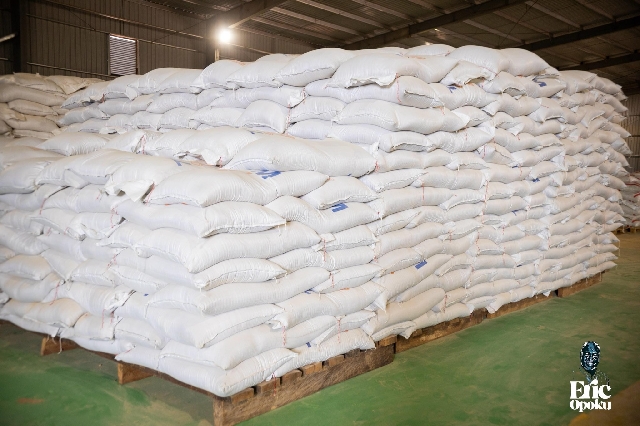
The Minister for Food and Agriculture, Mr. Eric Opoku, has paid a working visit to the site of a state-of-the-art poultry feed factory under construction by A2 Company in Kumasi. Apexnewsgh reports The facility, branded “NKOKƆ NKETENKETE FEED,” promises to revolutionize Ghana’s poultry industry with its impressive processing and storage capacity of 30,000 tonnes of maize and soya beans. Minister Opoku commended A2 Company for its visionary investment, highlighting the project’s potential to reduce poultry feed costs, support local maize and soya producers, and cut down on imports. He emphasized the power of public-private partnerships in addressing national challenges like food security, unemployment, and import dependency. The A2 poultry feed project is expected to create hundreds of direct and indirect jobs for Ghanaians, deepening value addition within the agricultural value chain. The Minister’s visit underscores the government’s commitment to supporting agribusinesses that contribute to Ghana’s food self-sufficiency agenda and provide sustainable livelihoods. The brand NKOKƆ NKETENKETE FEED is set to officially launch soon, promising a major boost for Ghana’s poultry farmers. With its potential to transform local economies and drive youth employment, this initiative is poised to make a lasting impact on the country’s agricultural sector. Source: Apexnewsgh.com
Cease Using Titile, GTEC Ordered Phillis Naa Koryoo Okunor

The Ghana Tertiary Education Commission (GTEC) has taken decisive action against Member of Parliament Phillis Naa Koryoo Okunor for Awutu Senya East, directing her to stop using the academic title “Doctor immediately.” In a formal letter, GTEC clarified that Ms. Okunor lacks the necessary academic qualifications and accreditation to bear the title. The Commission emphasized that only individuals with earned doctoral degrees from accredited institutions can use the title “Dr.” in official and public communications. GTEC’s decision aims to protect the integrity of academic titles and maintain public trust. GTEC urged public figures to strictly adhere to ethical and academic standards, ensuring the authenticity of their credentials. The directive follows concerns raised by the academic community and the public about the legitimacy of Ms. Okunor’s use of the title. As of now, the MP has not issued a formal response to GTEC’s directive. The Commission’s action serves as a reminder of the importance of academic integrity and the need for public figures to uphold the highest standards. Source: Apexnewsgh.com/Ngamegbulam Chidozie Stephen
NPP National Chairman Stephen Ntim Steps Down Due to …..

The National Chairman of the New Patriotic Party (NPP), Mr. Stephen Ayesu Ntim, has officially stepped down from his role due to pressing health issues, marking the end of a remarkable political journey that spanned over two decades. In a letter dated June 16, 2025, and signed by his family, led by Kingsley Oteng and MP Adelaide Ntim, a formal request for a leave of absence was made on his behalf. The family cited “cognitive dissonance and mental incapacitation” as the reasons for Mr. Ntim’s decision, emphasizing that his continued engagement in party activities could further endanger his health. The letter underscored Mr. Ntim’s unwavering loyalty to the NPP and appealed to the party’s leadership to prioritize his well-being above all else at this critical moment. Stephen Ntim’s journey to the chairmanship was not an easy one. After four failed attempts in 2005, 2010, 2014, and 2018, he finally ascended to the position in 2022, winning with a commanding 4,014 votes. Despite his perseverance and commitment, the NPP experienced its worst electoral setback in history under his stewardship, losing both the presidency and its parliamentary majority. With Mr. Ntim’s temporary departure, First Vice Chairman Danquah Smith Buttey will step in as Acting National Chairman, under the NPP’s constitution. As the party navigates this transition, Mr. Ntim’s legacy and contributions to the NPP will undoubtedly be remembered. The family and party members are likely to appreciate Mr. Ntim’s dedication and service to the NPP, and wish him a speedy recovery. As he takes a well-deserved break, the party will continue to move forward, building on the foundations laid by its leaders. Source: Apexnewsgh.com/Ngamegbulam Chidozie Stephen
Ghana’s Economy Gets Boost as Fitch Ratings Upgrades Credit Score

Ghana’s Finance Minister, Dr. Cassiel Ato Forson, has hailed the recent credit rating upgrade by Fitch Ratings as a significant milestone in the country’s economic recovery journey. Fitch upgraded Ghana’s Long-Term Foreign-Currency Issuer Default Rating (IDR) from CCC to B- with a Stable Outlook, citing progress in debt restructuring, improved macroeconomic stability, and signs of sustained fiscal discipline. Dr. Forson described the upgrade as a clear sign of growing investor confidence in Ghana’s economic recovery. In a statement on his Facebook wall, he assured Ghanaians that this achievement is just the beginning of broader economic revitalization efforts being pursued by the government under President John Dramani Mahama’s “RESET” agenda. “We are unwavering in our resolve to revive the economy and deliver lasting relief, full and shared prosperity to the good people of Ghana,” Dr. Forson said. The Finance Minister emphasized that the government remains committed to restoring macroeconomic stability, lowering inflation, ensuring debt sustainability, and creating inclusive opportunities for all citizens. Dr. Forson highlighted recent gains, including increased investor confidence, exchange rate stabilization, and gradual disinflation, as evidence of the success of prudent policy decisions and structural reforms. He called for a collective national effort and trust, promising that the government will continue to work tirelessly to rebuild the economy, restore hope, and improve livelihoods across the country. The credit rating upgrade marks a new chapter in Ghana’s economic journey, and Dr. Forson’s statement serves as a testament to the government’s determination to drive economic growth and prosperity for all citizens. Blow is FITCH story Fitch Ratings – Hong Kong – 16 Jun 2025: Fitch Ratings has upgraded Ghana’s Long-Term Foreign-Currency Issuer Default Rating (IDR) to ‘B-‘ from ‘Restricted Default’ (RD). The Outlook is Stable. A full list of rating actions is at the end of this rating action commentary. Key Rating Drivers Relations with Commercial Creditors Normalised: The upgrade of Ghana’s Long-Term Foreign-Currency IDR to ‘B-‘ from ‘RD’ reflects Fitch’s assessment that Ghana has normalised relations with a significant majority of external commercial creditors. Ghana restructured its USD13.1 billon Eurobonds in October 2024. About USD2.6 billion of non-performing external debt still needs to be restructured. Of this, Fitch considers USD700 million to be commercial debt, representing 5% of total external commercial debt initially included in the restructuring perimeter. Ghana is negotiating with these outstanding commercial creditors, and we assess holdout risks as small. Debt Restructuring Near Completion: Ghana ratified the memorandum of understanding on the restructuring of its bilateral official debt in January 2025, covering USD5.1 billion. Of the USD2.6 billion of external debt that still needs to be restructured, USD1 billion is due to supranational entities and USD840 million is due to creditors that Fitch considers official. We expect Ghana will fully complete its external debt restructuring by end-2025. Past Fiscal Slippage; Declining Deficits: The primary fiscal deficit (commitment basis) widened to 3.9% of GDP in 2024 from 0.2% in 2023, against a target of a 0.5% surplus, consistent with Ghana’s record of large fiscal slippages in election years. The arrears accumulated in 2024 are still being audited, and this commitment deficit may be revised down. The new administration targets a 1.5% primary surplus in 2025, mostly driven by primary expenditure reduction. We expect inflation-related expenditure pressures will contribute to a more gradual fiscal consolidation path. We forecast a primary surplus of 0.5% of GDP in 2025 and 0.9% in 2026 and an overall deficit of 3.6% in 2025 and 3.2% in 2026 on a commitment basis, after 7.9% in 2024. Manageable Debt Service Obligations: We forecast foreign-currency-denominated debt service (including domestic US dollar-denominated bonds) will reach 1.2% of GDP (USD1.2 billion) in 2025 and 1.4% (USD1.9 billion) in 2026, assuming a restructuring of the remaining claims in 2025, with interest payments of 0.5% of GDP in 2025 and 0.4% in 2026. The rebound in unencumbered international reserves in 2024, to USD6.8 billion and our expectation of continued accumulation in 2025 and 2026, supports Ghana’s ability to meet these obligations. We forecast local-currency debt service (excluding T-bill refinancing) will reach 3.8% of GDP in 2025 and 3.9% in 2026. Of this, 3.6% and 3.7% is interest payments. T-bond principal payments will increase to 2.2% of GDP in 2027 with the first domestic debt exchange programme (DDEP) bond maturities. We believe Ghana will be able to meet these obligations, based on our assumption that the T-bond market will be reopened in 2025, with an expected drop in inflation helping normalise market conditions. Liquidity Risks: We expect the interest/revenue ratio will remain broadly stable, at 26% in 2025 and 2026, from 25% in 2024 and a peak of 48% in 2021. This will be driven by a declining stock of debt, offset by resumption of interest payments on external commercial debt and a step-up in coupon payments on the DDEP, with the weighted average coupon on the DDEP bonds increasing to 9.1% in 2025 from 5.4% in 2024. The interest/revenue ratio is above the ‘B’ and the ‘C’/’D’ medians of 13% and 16%, respectively, and is a key constraint on the rating. Ghana had deposits of 4% of GDP at end-2024, and we project the government will slowly rebuild fiscal buffers, to 4.6% of GDP in 2026. Yields on T-bills have dropped significantly in recent months, reducing immediate liquidity risks. Our view of local-currency debt servicing conditions supports the upgrade of the Long-Term Local-Currency IDR. Falling Debt: Strong nominal GDP growth, fiscal consolidation, remaining debt restructuring, and much larger than anticipated exchange rate appreciation in recent months will contribute to public debt falling to 60% of GDP in 2025 and 2026, from 72% in 2024 and a peak of 93% in 2022 when Ghana announced its intention to default. This compares with our 2026 ‘B’ median forecast of 51%. Current Account Surpluses, Reserve Accumulation: We forecast the current account surplus (CAS) will narrow from a record high of 4.3% of GDP in 2024 to 1.1% in 2026, on our assumption of increased imports driven by economic growth, and a projected decline in key export prices. This is a