


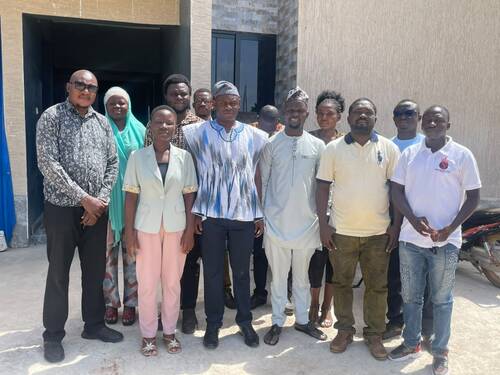
MITDS Chairman Calls for Support as Institute Marks 7th Graduation

The Millar Institute for Transdisciplinary and Development Studies (MITDS) on Saturday, September 20, 2025, held its seventh graduation ceremony in Bolgatanga, marking yet another milestone in the institute’s 11-year journey of academic excellence. Chairman of the MITDS Council, Naa Ganglaar Bog-Belagr Tater V, in his address, recalled the institute’s humble beginnings in 2014 and its growth into a recognized center for higher learning. He described the journey as “long and interesting,” adding that he felt honored to witness its transformation from afar in the early years to serving closely as Council Chairman today. “Last year, I pledged on behalf of the Council to continue the unfinished development agenda of our predecessors,” he reminded the gathering. “I wish to reiterate this pledge and commitment. We will continue to support the academic and administrative progress of MITDS.” The Chairman expressed gratitude to partners who have stood by the institution, including the University for Development Studies (UDS), MITDS’ affiliate institution; the Ghana Tertiary Education Commission (GTEC), which is preparing MITDS for chartering; and the National Investment Bank (Bolgatanga branch), which supported the institute with its first overdraft facility when all other banks turned them down. Highlighting the institute’s achievements, Naa Ganglaar proudly noted that MITDS has so far produced 36 first-degree holders, 22 MPhil graduates, and 37 PhDs. “I am very proud to be a Council Chairman who is part of such remarkable deliverables,” he said. On the future of MITDS, he outlined major milestones, including the reaccreditation of MPhil and PhD programs, the establishment of new faculties and departments, partnerships with international institutions such as Broos Institute in the Netherlands and LUITEBM University in Zambia, as well as collaborations with SOFT Advisory Consulting and UDS Distance Education programs. He further called on government and development partners to support MITDS with critical infrastructure such as a library complex, IT facilities, a conference hall, and an administration block. “Every infrastructure seen and unseen was fully funded from internal and private sources,” he stressed. “There has never been any donor support since the inception of the institute in 2014. If we want MITDS to do more, they will need support.” The Chairman also urged national policymakers to consider a dedicated Grass Economy Policy for Northern Ghana, drawing from MITDS’ groundbreaking research on the use of dry grass, which he believes can reduce bushfires and their impact on climate change. Turning his attention to the graduates, Naa Ganglaar commended the 11 PhD candidates prepared to receive their degrees. “I congratulate them in advance and admonish them to continue to make us proud wherever they find themselves,” he said. “They have a duty to give back to their families, the Nation, and the World at large.” With those remarks, the Chairman formally declared the congregation duly constituted and invited the Vice Chancellor of UDS to perform the statutory function of conferring degrees. Source: Apexnewsgh.com
Millar Institute Marks Seventh Graduation, Unveils New Faculties and Bold Research Innovations

The Millar Institute for Transdisciplinary and Development Studies (MITDS) in Bolgatanga has held its seventh graduation ceremony, with President of the Institute, Prof. David Millar, announcing major academic and research breakthroughs that position the institute as a growing force in Ghana’s higher education landscape. Prof. Millar, addressing the gathering with what he described as “extreme excitement,” said the event was not only a celebration of academic achievement but also a continuation of the Institute’s journey following its 10th anniversary last year. “Today, we are marking the seventh graduation event of MITDS. This is no mean achievement and you all took active part in getting us this far,” he noted. The President revealed that MITDS has secured accreditation to expand from one faculty to three, with newly created departments covering culture and development studies, indigenous innovation and communication, and endogenous education and lifelong learning. He urged stakeholders to support the promotion of these programs. “I wish to call on you all to help advertise these new faculties and programmes when they are up and running,” Prof. Millar appealed. In a bold move, MITDS has also developed what Prof. Millar described as “the first of its kind in Ghana”, a Post-Doctoral and Post-Master Research Programme designed to sharpen the skills of young academics to produce world-class research. Highlighting the Institute’s flagship Grass Economy Project, Prof. Millar detailed groundbreaking research that is turning ordinary grass into economic products such as charcoal briquettes, brown paper alternatives to plastics, and biochar for soil fertility. “This landmark achievement has the potential of cascading into a massive Grass Industry for Northern Ghana. It will simply turn grass, a nuisance in northern Ghana, into grass as an economic commodity,” he declared. The project, he noted, has already attracted global attention, with the Food and Agriculture Organization (FAO) featuring it among its international success stories. Prof. Millar acknowledged challenges such as inadequate infrastructure and staffing. He explained that MITDS has never received dedicated government or donor funding for infrastructure and continues to rely on internal resources. Despite this, he praised the commitment of the Institute’s council and management, led by Chairman Naa Ganglaar Bog-Belagr Tater V, for keeping MITDS on track. In line with its statutes, MITDS has upheld a Disability Clause, supporting students with impairments to complete their studies. Prof. Millar cited the case of a PhD student with visual impairment who was able to graduate before his passing, as well as another graduate with walking impairment. As eleven PhD students graduated under the mentorship of the University for Development Studies (UDS), Prof. Millar left them with a simple but striking message: “If you like the experience you have had at MITDS, tell others. If you don’t like the experience, then tell us.” Prof. Millar reaffirmed the Institute’s commitment to providing “quality tertiary education with a difference” despite financial constraints, stressing that MITDS would continue to innovate, collaborate, and contribute solutions to Ghana’s development challenges. Source: Apexnewsgh.com