
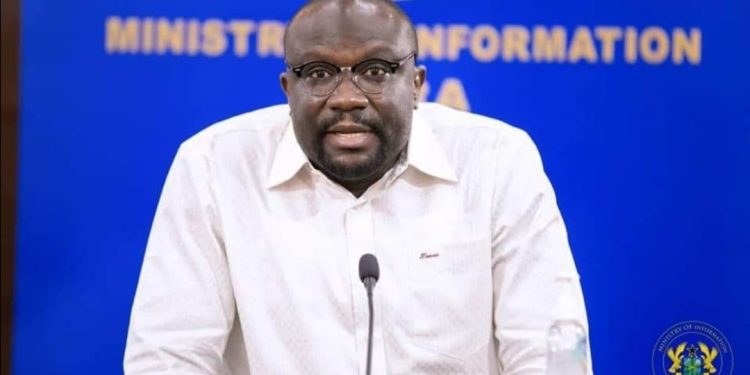
Stan Dogbe had plenty to say about the opposition. What he would not say was whether he had anything to do with a GH¢11.9 million government contract.
The Deputy Chief of Staff at the Office of the President stepped into the public spotlight in March 2026, not to answer uncomfortable questions swirling around him, but to celebrate the ruling National Democratic Congress and taunt the New Patriotic Party over its crushing defeat in the December 2024 general election. It was a performance full of confidence. Yet beneath the bravado lay a silence that critics found far more telling than anything he actually said.
The controversy had been building for weeks. At its centre was the Ghana Gold Board, known as GoldBod, a newly established institution that had, in the months following its creation in April 2025, embarked on a significant procurement exercise. Among its most consequential decisions was the award of a renovation contract worth GH¢11,901,736.13 to a firm called Correca Ghana Limited, for works on the old Bank of Ghana head office at No. 1 Thorpe Road, Accra, a building GoldBod had rented to house its expanding operations after outgrowing the dilapidated premises of its predecessor, the Precious Minerals Marketing Company.
The contract required the works to be completed within six weeks of signing. On paper, it was one of three procurement deals with a combined value of nearly GH¢15 million. The other two, covering the supply of fifteen laptop computers and office furniture, went to Get4Less Ghana Limited and Grace-Filled Venture respectively, both awarded through a single-source procurement method that had received prior approval from the Public Procurement Authority. A PPA letter dated 7 November 2025 quoted the combined price of those two contracts at GH¢3,246,288.88.
But it was the renovation contract that drew the sharpest scrutiny. Reports began circulating on social media alleging that Correca Ghana Limited shared not just an address and operational premises with Woezor TV, a television platform owned by Stan Dogbe — but also the same ownership structure and directorship. If true, the implications were serious: a senior presidential aide potentially benefiting from a multi-million-cedi public contract awarded by a state institution under the same government he served.
GoldBod did not stay quiet. Through its Media Relations Officer, Prince Kwame Minka, the institution issued a detailed statement challenging what it described as deliberate falsehoods being spread across social media platforms.
The board insisted the renovation contract had not been sole-sourced, as critics alleged. Three companies — Correca Ghana Limited, Project Direct Limited, and Building Construction Limited — had participated in a restricted tendering process formally approved by the PPA on 24 June 2025, following GoldBod’s request on 26 May 2025. Correca Ghana Limited had won the bid on merit, the statement said, and had completed the works in a timely and professional manner.
On the laptops, GoldBod was equally firm. The fifteen Lenovo ThinkPad T14S units, each with Core i7 1355U processor, 16GB RAM, and 512GB SSD, were purchased at GH¢21,500 per unit, a price the institution said was consistent with the open market rate listed on the supplier’s own website. Get4Less Ghana Limited had been selected because it was the only supplier found capable of meeting the required quantity and delivery timelines at the time.
The contracts, GoldBod added, had been published on its official website on 10 March 2026, in accordance with Section 42(1)© of the Ghana Gold Board Act, 2025 (Act 1140). The institution framed the disclosures as evidence of its commitment to transparency, and pointedly praised its CEO, Sammy Gyamfi, for championing that culture.
The contracts were signed by GoldBod’s Deputy CEO, Richard Nunekpeku.
When Stan Dogbe finally addressed the controversy publicly, he did so on Facebook — twice, on 14 March 2026, and with characteristic combativeness. He praised Sammy Gyamfi and the GoldBod team for their transparency, echoing the NDC’s longstanding rhetoric on accountability. He defended Woezor TV, celebrating its growth over the past four years and highlighting its role in broadcasting provisional election results that showed the NPP winning just over 38 per cent of the vote in 2024. He denied that the station operated from Dzorwulu, as some reports had claimed.
What he did not do was answer the central question: did he have any ownership interest in Correca Ghana Limited? Did he play any role in the awarding of the renovation contract? Reports had also noted that some signatures on the procurement documents appeared to have been scanned — a detail that added another layer of concern to an already murky picture.
Dogbe attributed the entire controversy to political reprisals from a wounded NPP, still smarting from its electoral humiliation. His message, in essence, was that the attacks were not about accountability — they were about revenge.
Not everyone was satisfied with that framing. Hubert Tieku, who identifies himself on the social media platform X as Chief Executive and Managing Director of Agora Collective Co. Ltd, and also as a lawyer and researcher, alleged that Correca Ghana Limited had secured the renovation contract not through competitive merit, but through political connections and ties to senior government officials.
It was an allegation that cut to the heart of the matter, and one that neither Dogbe nor GoldBod had directly refuted in terms of the company’s relationship to the Deputy Chief of Staff.
The Ghana Gold Board maintained that it had followed due process at every step: seeking PPA approvals, publishing contracts, and selecting qualified firms. It called on the public to reject what it termed the work of “desperate purveyors of fake news.”
Yet the questions persisted. Who, exactly, owns Correca Ghana Limited? What is its relationship, if any, to Stan Dogbe and Woezor TV? And why, with so much public attention focused on those questions, had the man at the centre of the storm chosen to mock his political opponents rather than simply answer them?
The controversy surrounding GoldBod’s procurement contracts had become about more than renovation works and laptop computers. It had become a test of whether transparency, so loudly proclaimed, would extend to the one place it was most needed, the truth about who stood to gain.