

1V1D: Over Ghc 200 Million shared by party boys for no work done –NORPRA Report
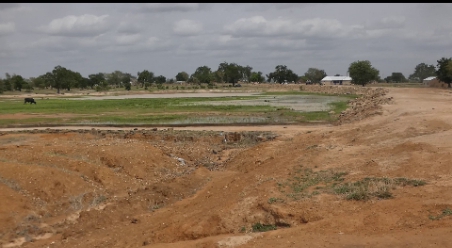
A report conducted by the Coalition of Northern Ghana CSOs led by the Northern Patriots in Research and Advocacy (NORPRA) after a 6-month implementation of the One Village, One Dam (1V1D) Expenditure and Performance Tracking project in five regions in the northern part of Ghana clearly reveals the monies were shared by party boys in the name of 1V1D for no meaningful work done. The extensive report dubbed ‘Ghana’s Oil Money on Dried Dams’ was supported by the Africa Centre for Energy Policy (ACEP) under its Extractive Industry and Climate Change Governance Fund (EICCG). Engaging journalists during the report launch On Monday, May 29, 2023, the Executive Director of Northern Patriots in Research and Advocacy (NORPRA) Bismark Ayorogo explained, “We went round to do expenditure and performance tracking of One Village One Dam across the 5 regions in northern Ghana and to also find out from communities members through focus view discussions, interviews, and assessment, what they make of the dam in terms of its performance. And this is at the back of the policy of government to provide One Village One Dam, so that there will be increased agricultural productivity, increase food security, creation of jobs, and a reduction in migration from the rural communities to the urban centers particularly the Southern part of the country from the north”. Mr. Ayorogo said upon their study: “They were able to track expenditures of 285 One Village One Dam and at the end of it all, we realized that government spent over Two Hundred Million Ghana Cedis (Ghc 201,000.000.00) on these dams and when we strike the average we realized that government spent over Six Hundred and Seventy Thousand Ghana Cedis (Ghc 670,000.000.00) per dam against the contract sum as we saw in award letters Two Hundred and Fifty Thousand”. According to Mr. Ayorogo most of the places they visited, the community members were saying they have not contributed in any way to increase food security or agricultural productivity in their communities. So, we want to find out more from other communities. The policy says, the dams are there to help create jobs, increase food security, agricultural productivity. “We went to most of the communities and one of them is Gbedembilisi Community in the Builsa South, we got there and we were able to get 20 farmers and the first we asked is, has One Village One Dam benefitted and all the 20 disagreed that, the dam doesn’t have enough water for all year farming because the dam was dried. We went to Jadema Community and asked the question if, One Village One Dam has enough water for all-year farming. One Village One Dam has contributed to increased agricultural productivity? One Village One Dam has contributed to food security? And One Village One Dam contributed to reducing migration as a result of Job opportunities? These are statements we picked from the policy document of the government from the 2017, 2018,2019, and 2020 to 2021 budget statements and the economic policies of the government and regrettably, the community members who participated in the focus group discussion and backed it with a community score card, said the dams did not contribute in any way. So, went further to the dams to see it ourselves and shockingly, almost all the dams were dried. No single dam was functioning, no single dam was having water and there was no dry season farming around any of the dams we visited”. He revealed We decided to continue, who knows, if the 285 dams may not be enough to conclude what we have gotten, there is still a need to extend to other communities and fortunately, because of the good leadership of this community who are always ready to participate in the development process of their community, we got the Chief and Assemblyman of Dachio to help us talk to the community members. Meanwhile, when journalists were transported to the Dachio shoddy constructed dam, the evidence available revealed the shoddy job done by the contractor was rather causing more harm than good. Evidence also shows that the Dachio Dam spillway is just at the same high-level size with a building block which has resulted to massive erosion at the community even to the extent of affecting Chief House. Engaging the Chief of the Dachio community Naaba Akaliga II at the dam site when we visited his community, he openly told pressmen that, the government did not mean well for his community with their poverty eradication project. “They only came to punish us in Dachio, they don’t want to give us any dam, that is why I described it at the initial stages that it was a football park and not a dam. This dam doesn’t help anybody in Dachio, and neither do we drink from it. Maybe, some people are fetching water from it to build their houses, is the only thing I can say. This dam does not help us anywhere. This is not the site for the dam, why would they leave the site and come where houses are built to construct a dam? They wanted to destroy us. I regretted convincing my people to vote for this government” the chief expressed. Hon. Zakari Abdul Aganbire, a Dachio Assemblyman who was also present at the dam scene when a team of journalists visited the scene said: “Looking at the land that was handed over to the contractor, if they had moved up a little, all these places would have been the land for the people to use for the dry season farming. But they came and landed at the land and constructed the dugout. In fact, there was no supervision. “Looking at the spillway, the least rain that falls gathers a little water and the rest dashes out, which has created a galley in the community”. The last time people of Cape Coast came to do research, when I brought them this way it wasn’t easy for us, because the community members thought they were
Massive Rot Uncovered At GNPC ….Workers Demand Corporation Be Saved From K.K Sarpong & Freddie Blay

The Ghana National Petroleum Corporation (GNPC) has been described as “can of worms” which must be opened up and thoroughly audited to appreciate the extent of the rot happening in the state institution under the management of Dr. Kofi Kodua Sarpong, its Chief Executive Officer (CEO). They mentioned procurement issues, property rentals, renovation works among others, as issues of concern, which are ongoing at the Corporation and need the urgent attention of the President, Nana Akufo-Addo, because they don’t see the Energy Minister, Mathew Opoku Prempeh, as leading a crackdown exercise at GNPC to stop the financial hemorrhage. The demands are coming on the heels of revelation by the Executive Director of the Africa Centre for Energy Policy (ACEP) Ben Boakye that Dr Sarpong, while leaving the Tema Oil Refinery (TOR) as Managing Director, left behind a debt of US$1.4 billion from a debt of about US$400 million. The ACEP boss said, “In 2015, a government committee, with the Bureau of National Investigations (BNI) and KPMG, recommended further investigation into the debt and use of funds at TOR. However, as vulnerable as the Ghanaian public is, he gets rewarded with a more significant portfolio in GNPC”. Insiders, have painted a picture of an institution that is decaying, tardy and unproductive, which must be salvaged from the current management of Dr. Sarpong, and board of directors led by the National Chairman of the governing New Patriotic Party (NPP), Freddie Worsemawu Blay, who has just been retained. Also of particular interest to the GNPC insiders, are the reckless use of funds in the name of the GNPC Foundation headed by Ogyeahohoo Yaw Gyebi II, the Paramount Chief of Sefwi Anhwiaso traditional area, who doubles as the President of the National House of Chiefs and the granting of scholarship packages. Interestingly, Ogyeahohoo Yaw Gyebi II, who is on the GNPC board, is also a member of the Public Interest and Accountability Committee (PIAC); an independent statutory body mandated to promote transparency and accountability in the management of petroleum revenues in Ghana, but many insiders, say his management of the GNPC Foundation, must be probed. PIAC, until recently was chaired by Dr. Steve Manteaw, but it doesn’t appear to have looked into the operations of GNPC. Also cited to The Herald, was the employment of cronies, which has bloated the workforce of GNPC. Both the current board and management, have been in charge of the Corporation in the last four years, but many of the workers; both retired and serving, insist there is no clear direction for the strategic state institution. For instance, the workers alleged that the GNPC Foundation, has recorded lots of mismanagement of funds in the award of scholarships. There are claims of politicians eating from funds allotted from the foundation, while the children of cronies of various managers, are on one scholarship or the other. This paper learnt that, the Corporation has recorded some procurement issues in recent times. Mention was made of a building at a suburb of Takoradi in the Western Region bought from the owners of Global Haulage, whose financial institution; Royal Bank, the GNPC Chief Executive had worked with before its collapse, following the clean-up of the banking sector. The Global Haulage building, this paper learnt, was bought for nearly US$8 million. What is interesting is that at the time of purchasing the Global Haulage building, GNPC, had almost completed a building project which started under the management of Alex Mould during the John Mahama administration. The uncompleted building, The Herald, learnt has been left to the vagaries of the weather. Furthermore, mention has also been made of the renting of a building facility from one John Taylor at Tema, near the Petroleum House, which has been under renovation for years now without any end in sight. Indeed, many say the renovation work, had been abandoned, while GNPC continuous to cough up outrageous amounts in United States Dollars to settle the said Mr Taylor for the use of his building to house officials of the corporation. The cost of the rent, according to insiders, is running into millions of dollars, since GNPC occupied it some years ago, and there is no effort to stop the financial hemorrhage by completing the Petroleum House renovation works for the workers to return. The last four years, has seen lots of staff recruitments into the Corporation, but The Herald was told, most of these staff, are not technically inclined to assist in the core mandate of GNPC. They are said to be largely administrative staff. The Freddie Blay board, is also mentioned as lacking technical expertise, hence difficult to monitor and evaluate the work of the management led by Dr. KK Sarpong, and to the insiders the return of the board will not bring anything of value to the country. Freddie Blay, is cited as sleeping on the job and signing many documents without reading them. Also mentioned is the construction of numerous facilities at educational institutions in the country, including the GHS12 million University of Mines and Energy (UMaT) and the US$5 million GNPC School of Governance and Law at the University of Cape Coast (UCC) in the name of getting GNPC Professorial Chairs in four public universities as some of the procurements which must be probed. About two weeks ago, the Executive Director of the Africa Centre for Energy Policy (ACEP) hit hard at the GNPC boss, Dr. Sarpong, for insulting Civil Society Organizations (CSOs) over the US$1.65 billion controversial GNPC- AGM Petroleum and Aker Energy oil deal. Benjamin Boakye in an open letter, suggested that Dr. Sarpong’s escapades and incompetence at the Ghana Cocoa Board (COCOBOD) and Tema Oil Refinery (TOR) were such that he should not have gotten any other public appointment, but he was rather given another job at GNPC. “TOR was handed to Dr Sarpong with a total debt of about $400 million. At the time, the State needed the genius to save the company. Not only that, the public was billed, through
K.K. Sarpong ‘appears more as Aker’s spokesperson than GNPC CEO’ – Ben Boakye

The Executive Director of the Africa Centre for Energy Policy (ACEP), Mr Benjamin Boakye, has said the CEO of the Ghana National Petroleum Corporation (GNPC), Dr K.K. Sarpong appears more of a spokesperson for Aker Energy than the arrowhead for the state oil company. In an article responding to some assertions made by Dr Sarpong against civil society organisations who have raised concerns about GNPC’s bid to acquire stakes in Aker and AGM oil blocs, Mr Boakye said: “The most worrying part of Dr. Sarpong’s public commentary is his extreme lack of control over the transaction he champions”. “It could be deliberate but the accompanying risk for Ghana is chilling”, Mr Boakye noted, adding: “He appears more as a spokesperson for Aker than GNPC, defending and changing numbers to make Aker look good”. “Dr Sarpong says he is not aware of Aker looking to sell its assets without success. This is not just unbelievable; it portrays a lack of attention to detail in his bid to short-change the public. If GNPC did any due diligence on why Aker wanted to sell, they would have chanced on online publications and direct quotes from the CEO of Aker Energy that they were looking for investors, including a possible sale of stakes to the market. That would have helped GNPC to investigate why they failed to get any buyer”, he said. In his article, Mr Boakye said: “Dr Sarpong doesn’t have control over the few numbers involved in this transaction. His struggle to remember what is informing the transactions only leaves him accusing CSOs of ignorance. All of a sudden, he is putting out new numbers different from what he presented to Parliament. He told Parliament that the total cost incurred by Aker is $800 million; this included an ambiguous $280 million described as money spent on other activities. Now Dr. Sarpong is quoting $399.2 million as the total cost incurred. It appears we are now making progress in the attempt to clean the transaction. Perhaps the more heat he gets, the lower the numbers for Ghana”. Read Mr Boakye’s full statement below: Ben Boakye asks: Who can compete with GNPC’s Kahuna to drive me more nervous? I have followed a series of interviews granted by Dr. KK Sarpong and sometimes froze, literally, in complete disbelief of what damage he is doing to the country in an attempt to litter the media space with hate for CSOs. By design or not, he injects extreme nervousness than I have seen. The strategy was evident; he pontificates his achievements in public life to sedate the minds of Ghanaians to think that he is doing the right thing with the Aker transaction. He tries hard to discredit CSOs in the crudest way possible, so the public will listen to him, not the CSOs. Additionally, he displays an unpardonable lack of control over the Aker transaction, which makes his amnesia of the history of Aker/AGM in Ghana almost forgivable. For the avoidance of doubt, CSOs have deliberately abstained from personalising this transaction, but we are capable of descending that lane. On Peace FM, Dr. Sarpong claimed an outstanding achievement of consigning Ghana Cocoa Board (Cocobod) to a debt-procuring enterprise for almost three decades. He owned the idea to syndicate loans to purchase cocoa beans, a practice that has escalated from borrowing hundreds of millions in the 1990s to billions today. Dr Sarpong should note that CSOs will not celebrate his legacy of debt procurement, instead of building capital for the trade of a commodity that Ghana continues to play a dominant role in the global supply market. It is even shocking that the GNPC Kahuna goes way back into time to account for his public life with such surgical precision on what he thinks is public-worthy. I would have thought that the most relevant and recent context of his public life to the ongoing Aker transaction is his stewardship of Tema Oil Refinery (TOR). TOR was handed to Dr Sarpong with total debt of about $400 million. At the time, the State needed the genius to save the company. Not only that, the public was billed, through the TOR Debt Recovery Levy, to support Dr. Sarpong to turn the company’s fortunes around. Instead, he left the company with a debt of over $1.4 billion, having received about $580m from the levy. In 2015, a government committee, with the Bureau of National Investigations (BNI) and KPMG, recommended further investigation into the debt and use of funds at TOR. However, as vulnerable as the Ghanaian public is, he gets rewarded with a more significant portfolio in GNPC. Here again, his stewardship of the Corporation thus far remains a template of “how not to run a national oil company,” which will remain a subject of academic scrutiny for so long. He frustrated ExxonMobil on the selections of a local partner for one whole year, creating inactivity on Exxon’s block until Government compromised on Goil. Under his watch, the Government has paid about $260 million for unutilised domestic gas and flared about $200million worth of gas in 2020 alone. At the same time, Dr. Sarpong spends his time negotiating the import of LNG at an additional cost of about $300 million a year to the public on a take-or-pay contract, ignoring the warnings of IMF on the fiscal consequences in its article IV report for 2021. He demonises existing investors with his kitchen engineers, then comes out in the open crying about exiting investors and blaming energy transition. Aker’s jackpot is only one of many bad judgments of GNPC under his leadership. To avoid public scrutiny of the Aker transaction, the Kahuna of GNPC spends time bastardising CSOs and craftily portraying that we lack knowledge of the entire transaction. However, it gets too apparent that if he paid little attention to CSOs, some nervy moments in his interviews, which I will return to shortly, would have been avoided. On the point of lack of knowledge, he got worryingly deflated by