



Our Journey Has Only Just Begun” – Valedictory Speech by Dr. David Jesining Sumbo at MITDS 7th Graduation
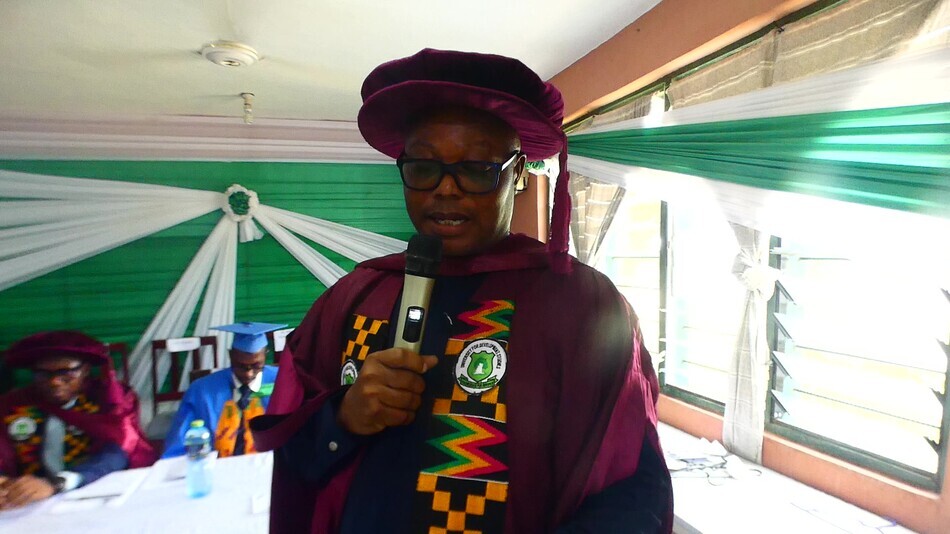
The atmosphere at the Millar Institute for Transdisciplinary and Development Studies (MITDS), Bolgatanga, was filled with pride and emotion as Dr. David Jesining Sumbo delivered a heartfelt valedictory address during the 7th graduation ceremony. Dr. Sumbo began his speech with deep gratitude, recognizing the collective effort that had carried the PhD graduands through their academic journey. “Our supervisors, mentors, advisors, and all the academic and non-academic staff of MITDS challenged us, guided us, and sometimes simply gave us a listening ear. This is very much appreciated.” He lauded the University for Development Studies (UDS) for its supervisory role, particularly through its Quality Assurance Directorate, which ensured academic excellence at MITDS. With admiration, he singled out the institution’s founder: “Prof. Millar has been the pillar of the institution, making himself available to all students, whether directly supervising them or not. No student was left stranded.” The valedictorian’s words also highlighted the often unseen role of family support. He spoke movingly of his daughter, Dr. Songbawiere, whose encouragement kept him motivated: “Anytime I raised doubts about how long I would use the certificate before retirement, she reminded me that the certificate is not for me, but for the children. That gave me a completely different perspective.” Reflecting on the struggles and triumphs of the doctoral journey, Dr. Sumbo described it as both exciting and frustrating. “As adult learners, we had to juggle between responsibilities at home and at work while maintaining high-quality standards. It was not easy, but it is fulfilling to know that you have contributed in your own little way to knowledge.” He commended his colleagues—clergymen, academics, development workers, businessmen, for becoming a family through the shared rigors of their studies. Their bond, he said, should not end at graduation: “Our friendship and comradeship have deepened over the period. Let’s continue to forge ahead to impact the world with our new skills acquired based on the MITDS philosophy.” For Mr. Sumbo, the greatest lesson of the PhD was not just academic achievement but a deeper humility and curiosity. “The more we learn, the more we realize how much remains to be understood. Somewhere, something incredible is waiting to be known,” he said, quoting Carl Sagan. As he closed, Dr. Sumbo urged his fellow graduates to see development as a lifelong collective mission: “Development is not a destination, it is a continuous, collective journey and ours is only just beginning. So let’s not stop here. Let’s stay curious, stay humble, and continue searching—not just for answers, but for better questions.” Source: Apexnewsgh.com
UDS Vice Chancellor Calls for Swift Chartering of MITDS at Seventh Graduation

The Vice Chancellor of the University for Development Studies (UDS), Prof. Seidu Alhassan, represented by Prof. Abdulai Abubakari, has urged government and regulatory bodies to expedite the process of granting a Presidential Charter to the Millar Institute for Transdisciplinary and Development Studies (MITDS). He made the call during the Institute’s seventh graduation ceremony held on Saturday. Prof. Abubakari, speaking on behalf of the UDS Vice Chancellor, said it was both an honour and a privilege to be part of the milestone celebration of MITDS, describing the Institute as “a cherished baby of UDS.” “Since the inception of MITDS, UDS has played her mentoring role to the fullest. We have provided lecturers, supervised student theses, and examined works to support the Institute from day one,” he remarked. He revealed that UDS had recently renewed its affiliation certificate with MITDS to strengthen their collaboration. He also expressed appreciation for the space MITDS had offered UDS to mount its distance education programme. Touching on the future of MITDS, Prof. Abubakari commended the Institute’s progress in teaching, research, publications, and community service, describing their achievements as “worth mentioning and emulating.” He, however, emphasized the importance of the next step in its journey. “To be found worthy of a Presidential Charter is a great landmark in the academic ladder. It is only then that MITDS can award her own degrees in place of UDS degrees,” he stressed. He called on the Ghana Tertiary Education Commission (GTEC), government, GETFund, and other support agencies to assist MITDS, especially in expanding its ICT and Artificial Intelligence infrastructure. To the graduates, the Vice Chancellor offered words of encouragement and a challenge for lifelong learning. “Education is a life-long endeavor. The conferment of a degree today is only another phase of your academic life. Feel challenged to expand your horizon and make yourself more relevant and marketable for your family, your country, and the world at large,” he urged. He reminded the graduates that they would be carrying UDS certificates and, therefore, must be “worthy ambassadors of their alma mater and shine their light wherever they find themselves.” With blessings and good wishes, he concluded his address before proceeding with the conferment of degrees. Source: Apexnewsgh.com
MITDS Chairman Calls for Support as Institute Marks 7th Graduation

The Millar Institute for Transdisciplinary and Development Studies (MITDS) on Saturday, September 20, 2025, held its seventh graduation ceremony in Bolgatanga, marking yet another milestone in the institute’s 11-year journey of academic excellence. Chairman of the MITDS Council, Naa Ganglaar Bog-Belagr Tater V, in his address, recalled the institute’s humble beginnings in 2014 and its growth into a recognized center for higher learning. He described the journey as “long and interesting,” adding that he felt honored to witness its transformation from afar in the early years to serving closely as Council Chairman today. “Last year, I pledged on behalf of the Council to continue the unfinished development agenda of our predecessors,” he reminded the gathering. “I wish to reiterate this pledge and commitment. We will continue to support the academic and administrative progress of MITDS.” The Chairman expressed gratitude to partners who have stood by the institution, including the University for Development Studies (UDS), MITDS’ affiliate institution; the Ghana Tertiary Education Commission (GTEC), which is preparing MITDS for chartering; and the National Investment Bank (Bolgatanga branch), which supported the institute with its first overdraft facility when all other banks turned them down. Highlighting the institute’s achievements, Naa Ganglaar proudly noted that MITDS has so far produced 36 first-degree holders, 22 MPhil graduates, and 37 PhDs. “I am very proud to be a Council Chairman who is part of such remarkable deliverables,” he said. On the future of MITDS, he outlined major milestones, including the reaccreditation of MPhil and PhD programs, the establishment of new faculties and departments, partnerships with international institutions such as Broos Institute in the Netherlands and LUITEBM University in Zambia, as well as collaborations with SOFT Advisory Consulting and UDS Distance Education programs. He further called on government and development partners to support MITDS with critical infrastructure such as a library complex, IT facilities, a conference hall, and an administration block. “Every infrastructure seen and unseen was fully funded from internal and private sources,” he stressed. “There has never been any donor support since the inception of the institute in 2014. If we want MITDS to do more, they will need support.” The Chairman also urged national policymakers to consider a dedicated Grass Economy Policy for Northern Ghana, drawing from MITDS’ groundbreaking research on the use of dry grass, which he believes can reduce bushfires and their impact on climate change. Turning his attention to the graduates, Naa Ganglaar commended the 11 PhD candidates prepared to receive their degrees. “I congratulate them in advance and admonish them to continue to make us proud wherever they find themselves,” he said. “They have a duty to give back to their families, the Nation, and the World at large.” With those remarks, the Chairman formally declared the congregation duly constituted and invited the Vice Chancellor of UDS to perform the statutory function of conferring degrees. Source: Apexnewsgh.com
Millar Institute Marks Seventh Graduation, Unveils New Faculties and Bold Research Innovations

The Millar Institute for Transdisciplinary and Development Studies (MITDS) in Bolgatanga has held its seventh graduation ceremony, with President of the Institute, Prof. David Millar, announcing major academic and research breakthroughs that position the institute as a growing force in Ghana’s higher education landscape. Prof. Millar, addressing the gathering with what he described as “extreme excitement,” said the event was not only a celebration of academic achievement but also a continuation of the Institute’s journey following its 10th anniversary last year. “Today, we are marking the seventh graduation event of MITDS. This is no mean achievement and you all took active part in getting us this far,” he noted. The President revealed that MITDS has secured accreditation to expand from one faculty to three, with newly created departments covering culture and development studies, indigenous innovation and communication, and endogenous education and lifelong learning. He urged stakeholders to support the promotion of these programs. “I wish to call on you all to help advertise these new faculties and programmes when they are up and running,” Prof. Millar appealed. In a bold move, MITDS has also developed what Prof. Millar described as “the first of its kind in Ghana”, a Post-Doctoral and Post-Master Research Programme designed to sharpen the skills of young academics to produce world-class research. Highlighting the Institute’s flagship Grass Economy Project, Prof. Millar detailed groundbreaking research that is turning ordinary grass into economic products such as charcoal briquettes, brown paper alternatives to plastics, and biochar for soil fertility. “This landmark achievement has the potential of cascading into a massive Grass Industry for Northern Ghana. It will simply turn grass, a nuisance in northern Ghana, into grass as an economic commodity,” he declared. The project, he noted, has already attracted global attention, with the Food and Agriculture Organization (FAO) featuring it among its international success stories. Prof. Millar acknowledged challenges such as inadequate infrastructure and staffing. He explained that MITDS has never received dedicated government or donor funding for infrastructure and continues to rely on internal resources. Despite this, he praised the commitment of the Institute’s council and management, led by Chairman Naa Ganglaar Bog-Belagr Tater V, for keeping MITDS on track. In line with its statutes, MITDS has upheld a Disability Clause, supporting students with impairments to complete their studies. Prof. Millar cited the case of a PhD student with visual impairment who was able to graduate before his passing, as well as another graduate with walking impairment. As eleven PhD students graduated under the mentorship of the University for Development Studies (UDS), Prof. Millar left them with a simple but striking message: “If you like the experience you have had at MITDS, tell others. If you don’t like the experience, then tell us.” Prof. Millar reaffirmed the Institute’s commitment to providing “quality tertiary education with a difference” despite financial constraints, stressing that MITDS would continue to innovate, collaborate, and contribute solutions to Ghana’s development challenges. Source: Apexnewsgh.com
Millar Institute Donates 28 Dual Desks to Yikene Basic School

The Millar Institute for Transdisciplinary and Development Studies is celebrating its 10th anniversary with a heartwarming gesture. Apexnewsgh reports To celebrate this milestone, the institute has generously donated 28 dual desks to Yikene Basic School, underscoring its unwavering commitment to education and corporate social responsibility. During the donation ceremony,Mr. Isaac Dasoberi, a proactive member of the anniversary planning committee, took the opportunity to emphasize the significance of supporting less privileged schools. “Education is our priority,” he passionately stated. “Charity begins at home, and Yikene community is our home.” He said In a touching display of gratitude, Mr. Dasoberi extended acknowledgment to the Yikene Chief for his invaluable support, advice, and interventions over the past decade. Furthermore, he expressed deep appreciation to the schoolteachers for their unwavering dedication. On behalf of Prof. Millar, the institution and the planning committee chairman, Mr. Dasoberi formally presented the donation to the Municipal Education Director ably represented by the PRO Mr. Agunga-Dongo Fredrick Ayine, highlighting the institute’s unwavering commitment to giving back to its community and promoting education. This heartwarming gesture exemplifies the Millar Institute’s dedication to making a positive impact on its community and fostering a culture of learning and development. At the donation ceremony, Madam Patience Iyaaba, Dean of Teachers at Yikene Basic School, took the stage with a confident yet warm smile. She began her speech by expressing profound gratitude to the Millar Institute for Transdisciplinary and Development Studies (MITDS) for their unwavering support. “Thank you so much for the support you have given us,” she began. “Yikene school is a relatively new school, with the Junior High section established only 4-5 years ago. Despite our youth, we’ve achieved tremendous success, thanks to the community, Prof. David Millar, and other supporters.” Madam Iyaaba then painted a vivid picture of the school’s remarkable journey, highlighting its academic accomplishments. She proudly shared that due to the school’s outstanding academic performance and discipline, the enrollment had significantly increased. Moreover, she joyfully announced that the school had achieved outstanding BECE performance, ranking among the top 10 schools in the municipality. Madam Iyaaba attributed these successes to the community’s involvement and the invaluable support of organizations like MITDS. “We’re grateful for this donation of 28 dual desks, which will enhance our learning environment,” Madam Iyaaba said, her voice filled with genuine appreciation. “We wish MITDS a happy 10th anniversary and continued success in their endeavors.” The Bolgatanga Municipal Director of the Ghana Education Service, Agunga-Dongo Frederick Ayine, expressed gratitude to the Millar Institute for Transdisciplinary and Development Studies and Prof. Millar for their generous donation. The municipality was facing a staggering deficit of 9,000 furniture pieces, with only 150 dual desks received from the Government of Ghana that year. This shortfall was even more alarming considering that over 100 furniture pieces became unusable each term. Mr. Ayine emphasized that without community support, the municipality risked falling behind in education. However, there was a beacon of hope. The Millar Institute’s donation marked a significant step towards bridging this gap. Prof. David Millar had been a steadfast supporter of education, previously collaborating with the Municipal Chief Executive to provide furniture to schools. Mr. Ayine acknowledged this effort and urged school teachers to reciprocate the trust placed in them. “To whom much is given, much is expected,” Mr. Ayine reminded the teachers. “Once people are investing in you, it means they have a certain level of trust in you to deliver.” He encouraged the teachers to take good care of the donated furniture, ensuring that the investment yields positive results. This partnership between the Millar Institute and the Bolgatanga Municipal Education Service served as a model for community-driven initiatives that could propel education forward in the region. By working together, they were able to create a brighter future for the students and the community at large. Meanwhile, Yikene Assemblyman, Hon. Asaare Francis Akolbila, was overjoyed as he stood witness to a heartwarming gesture from the Millar Institute. The institute had generously donated 28 dual desks to Yikene Basic School, and Mr. Akolbila couldn’t contain his delight. “The donation is a tremendous relief for our children,” expressed Akolbila, his face beaming with happiness. “For far too long, they’ve had to make do with lying on the floor while learning, which has significantly impacted their educational experience.” Emphasizing the critical need for proper furniture, the assemblyman highlighted its role in creating a conducive learning environment. “This donation will greatly contribute to improving the quality of education in our area,” he stressed. Hon. Akolbila expressed his heartfelt gratitude to the Millar Institute, coinciding with their 10th-anniversary celebration. “As you mark this milestone, I pray that God richly blesses you and continues to enhance your institution,” he conveyed with sincerity. The assemblyman’s sentiments resonated with the community’s deep appreciation for the Millar Institute’s unwavering commitment to education and development. This meaningful partnership is poised to leave a lasting impact on Yikene’s youth, empowering them to reach their full potential. The PTA Chairman, Mr. Gilbert Azanto, expressed deep gratitude towards Professor Millar for the generous gift of 28 dual desks from the Millar Institute. “Professor Millar’s kindness has truly brought happiness to our school,” Azanto remarked. “This donation will greatly improve our learning environment.” However, Azanto also used the opportunity to draw attention to other critical needs within the school. Pointing out unfinished projects, he evoked the famous words from Charles Dickens’ beloved novel: “Like Oliver Twist, we ask for more.” Mr. Azanto extended a warm invitation to the people of Yikene and to kind-hearted individuals outside the community to rally behind the school’s development. “We require assistance to finish these projects and ensure our children receive the best possible education.” The PTA chairman’s plea shed light on the ongoing challenges faced by Yikene Basic School. Despite the contribution from the Millar Institute, the school still requires support to address its infrastructure and resource deficiencies. Madam Victoria Aloni of Bolgatanga West Circuit School Improvement and Support Officer (SISO) has expressed heartfelt appreciation for the
The MITDS Journey
In 1990, Professor David Millar, the President of the Millar Institute for Transdisciplinary and Development Studies (MITDS), had a vision to create an Open University. This vision he shared with his wife, Mrs. Lydia Mamata Millar. With great determination, they both acquired a piece of land for the school facility. Professor and Mrs. Millar worked tirelessly towards their dream, and in 2014, he officially launched the Millar Institute for Transdisciplinary and Development Studies (which he first registered Open University). He became the Foundation President of the Institute and has been its President. He firmly believed that every long journey begins with a first step and that every night ultimately gives way to a new day. Located in Yikene, a community in the Bolgatanga Municipal, MITDS quickly became known as the first private and Open University in the Upper East Region of Ghana. Despite the presence of several local universities in Ghana that have established partnerships with external universities under the Open University Concept, the landscape of tertiary education in Ghana such as MITDS was significantly influenced by Prof. Anamoah-Mensah’s report in 2006. This report challenged Ghanaian universities to transition from traditional on-campus, satellite campus, and distance learning models to Open University Systems. In response to this call, Prof. Millar and his institution, the MITDS (Millar Institute for Tertiary Development Studies), emerged as one of the first fully Ghanaian-owned institutions to address the recommendations put forth by Prof. Anamoah-Mensah. MITDS has taken steps to ensure that it operates within a duly composed and functional Council, ensuring transparent governance. Furthermore, the various structures and programs offered by the institute have obtained the necessary Accreditations Affiliation of MITDS since inception has always been granted by University for Development Studies (UDS). Hence they have since been awarding the degrees. Ghana Tertiary Education Commission (GTEC) provided the legal status of institutional accreditation and reaccreditation, program accreditation and reaccreditation, and institutional audits thus far. In 2014, MITDS was established as an institution. Four years later, in 2018, they held their first graduation ceremony for the inaugural class of students. However, the institution faced challenges in attracting students, leading to low enrollment numbers. According to records from MITDS in 2018, the student population was 105. Out of the total number, 4 students deferred their programmes and 26 were irregular for various reasons. At that time, female enrolment was 30%, which fell short of the school’s target of 50%. To address this issue, Professor Millar, the head of MITDS, announced during the graduation ceremony that they had made the decision to gradually phase out their undergraduate programs, starting with no longer accepting Level 100 or Level 200 students. This decision was described as a temporary measure, and Prof. Millar mentioned that they would assess the situation and reactivate the program if circumstances improved. Currently, MITDS is focusing on expanding their offerings of Master’s and PhD programs. To further promote research, they also actively pursued research grant opportunities that include scholarships for students. In 2018, Professor Millar enthusiastically announced that MITDS has designed and is now offering Post-Graduate Certificate Courses. These courses were developed in response to the high demand from individuals already employed and seeking career-oriented short courses. As a result, MITDS has introduced a range of six-month Post-Graduate Certificate Courses, including: – Policy and Strategy Studies – Information and Informatics – University Administration – Advanced Business Administration – International Relations – Agri-Business Studies In 2018, MITDS collaborated with the University of Bern in Switzerland and engaged in a two-year Community-based Sustainable Food Programme in Kalbeon and Gowrie-Kunkwa. Additionally, MITDS collaborated with ECOLAND Germany (BMZ) to prepare for a Diploma Programme in hands-on Organic Farming and Bio-dynamic Agriculture, which was expected to conclude in October 2021. Professor Millar expressed his satisfaction in giving back to these communities, who have been long-standing partners and social laboratories for MITDS. He also promised to continue cooperation with them whenever the opportunity arises. In response to the One District One Factory policy of the New Patriotic Party, MITDS has identified seven potential projects for implementation. We are currently working towards securing buy-ins for these projects. The projects include: The GARWASI Project (formerly known as the Grass for Charcoal Project). This project has been expanded to include the development of paper for paper bags and toilet rolls using the same technology. Expansion of the Groundnut Sector under Irrigation. Transformation of Groundnut vines into organic fertilizer. Addressing the challenges posed by Fulani Herdsmen. Transformation of the Bolgatanga Meat Factory into a multi-purpose Abattoir. Development of the Bamboo plant for the production of matchsticks and toothpicks. Linking the Wulugu Ranching project with Nasia Rice Production. Establishment of the Pwalugu multi-vegetable Factory. Implementation of the Walewale Organic Fertilizer Factor In 2022, Professor Millar and the MITDS introduced a groundbreaking innovation involving grass. During his graduation speech, Professor Millar announced that MITDS’s flagship program, aimed at promoting a grass economy in northern Ghana has resulted in remarkable accomplishments. These accomplishments include: – The development of Grass Charcoal Briquette (GARWASI PROJECT), an alternative to tree-charcoal in the pursuit of sustainable renewable energy. This project has garnered attention from the FAO, leading to the signing of a ten-month contract worth Ghs 400,000. This contract will enable the introduction of this technology to five communities on a pilot basis, with the potential to expand to twelve additional communities. – Another noteworthy milestone is the successful transformation of everyday grasses into brown paper, which can be utilized for various purposes. In 2018, the school made the exciting announcement that its second and third internal refereed journal, the Ghana Journal for Culture and Development (CULTRAD), had been released for public consumption. Additionally, during that same period, the school published four essential course books, specifically designed for the Masters and PhD programs. These books are readily available for purchase. A few years ago, the institute established a unit dedicated to editing, proofreading, and restructuring final post-graduate thesis works, particularly PhD theses, into published books. This process is similar to what is practiced
Graduation: MITDS graduates PhDs and MPhils completed students, introduces new programme

Millar Institute for Transdisciplinary and Development Studies has introduced a new programme to help upgrade the research skills, techniques, and knowledge of young academics who will want to conduct cutting-edge research of international quality. This was made known by the President of Millar Institute for Transdisciplinary and Development Studies Prof. David Millar during his speech at the 5th congregation of the Institution on Saturday, May 27, 2023. Meanwhile, Prof. Millar hinted that the school is securing funds to kick-start the programme. Addressing the congregation, the President of the Millar Institute with excitement also announced the school’s seventh edition of the internal refereed journal: Ghana Journal for Culture and Development (CULTRAD) is out, as he encourage scholars and particularly students to get a copy. Meanwhile, the new MITDS Council Chairman Naa Lawyer Ganglaar Bog-Belagr Tater V who also participated in the graduation ceremony also eulogized the graduating students for their relentless effort in seeing themselves through such a milestone despite some of the challenges along the way. Expressing his gratitude to the graduating students and the institution, Naa Lawyer Ganglaar Bog-Belagr Tater V said, it is an honor and a dream come true for him to be presiding over the congregation for the second time as the Chairman of the occasion. “For me, this is the first time I feature as Council Chairman although I was a member of the previous Council. We are yet to be inaugurated but it is only proper for me and the newly constituted Council to say a very special thank you to the Prof. Saa Dittoh regime. The choice of Prof. Saa Dittoh to chair was the best thing to ever happen to MITDS”. Naa Lawyer Ganglaar Bog-Belagr Tater V said. Director of Academic Planning and Quality Assurance at UDS Prof. Shamsu-Deen Ziblim who delivered a speech at the graduation ceremony on behalf of the UDS Vice Chancellor Prof. Seidu Alhassan said, without government support, he is already amazed at the quality of teaching, research and community service currently going on in Millar Institute for Transdisciplinary and Development Studies; as he strongly supports the call for the government to be visible in their endeavors. Extending his congratulatory message to the graduands, Prof. Shamsu-Deen Ziblim said, they should see the conferment of a degree at today’s graduation as another phase of their academic life. He encourages them to feel challenged and continue to keep expanding their horizon in other to make themselves even more relevant and marketable for themselves. Meanwhile, giving a valedictory speech on behalf of the graduands, Dr. Emmanuel Batesim Atami said, the enterprise of embarking on a postgraduate study at MITDS appeared a never-ending enterprise. Narrating some of their challenging times as students, Dr. Atami said: “There were times they got to the academic wonderland and uncertainty and a modicum of frustration asked themselves, “What at all brought us here?” stressing that the hour of fulfillment is here”. Meanwhile, extending their gratitude the graduands said, their first appreciation and high sense of indebtedness goes to the president of the MITDS, Prof. David Millar, the astute academic. “Prof. your patient and facilitative spirit is your most distinguishing urge. Please, keep that nitch, never let go of it, and both you and this esteemed institution will witness great dimensions of progress never imagined”. “To the faculty and staff of the university, we register our most sincere gratitude. You collectively cultivated in us several critical rudiments to shape us into real academic thinkers. You will forever remain in our memories and be a guiding touch in practice wherever we will find ourselves” However, graduands further used the occasion to extend an appeal, especially to agencies interested in the growth of education in the country to consider turning an eye to the MITDS as a young and developing institution there a myriad of logistical, academic, and human resource areas that require partnership, collaboration, and support to propel the institution deliver improved services. Source: Apexnewsgh.com/Ghana Please contact Apexnewsgh.com on email apexnewsgh@gmail.com for your credible news publications. Contact: 0256336062
MITDS Matriculation: Prof. Millar extends an appeal to the government, GETFund, Donors or any Philanthropist for assistance
President of Millar Institute for Transdisciplinary and Development Studies Prof. David Millar has made a passionate appeal to the Ghana Government, GETFund, and any Donor or Philanthropist, to assist the Institution at this toddling stage of our life with more academic facilities such as ICT Services, Library, and Classroom. He added: “We also need an Administration Block to enable us to relinquish the made-shift facility we currently are in” Prof. Millar appealed the Seventh Matriculation Ceremony of 2022/2023 students held at the school hall on Saturday, February 25, 2023 Meanwhile, MITDS matriculated 14 Ph.D. and 3 MPhil students at its seventh matriculation ceremony. Addressing the congregation Prof. Millar said: “We are proud to announce that we have the following application for our Post- Graduate Programme. Ph.D. we have 14 (fourteen) students and it brings our last index number to Eighty Seven (87). So, it means this small space has positioned itself to give birth to 87 seven doctors if they so desire. And is a full fee pay. So you can understand that if 87 students paid their money in full that means that the people appreciate what we do here”. He further reminded Matriculants that by swearing the Matriculation Oath and signing the Matriculation Register, they have accepted to abide by all the Rules and Regulations governing the conduct of Junior Members of this Institute as specified in the Handbook for Junior Members. “Dear Matriculants, examinations are an important aspect of your training in this Institute If any student refuses to write examinations, for no reason or without any written permission and approval, he or she will face the necessary punishment”. Prof. Millar stated The President reiterated that MITDS is committed to providing balanced access to female applicants, physically challenged persons, and socially excluded/ marginalized persons to pursue our academic programmes. As an Open University, we are committed to engaging with all well-meaning NGOs/CSOs to provide quality community service. We are also committed to an enhanced ICT-based education to expand access to quality education and the best practices both locally and internationally”. He said Source : Apexnewsgh.com/Ghana Please contact Apexnewsgh.com on email apexnewsgh@gmail.com for your credible news publications. Contact: 0256336062
Stakeholders of Ghana Federation of Forest and Farm Producers endorses newly introduced grass charcoal

Stakeholders with the Millar Institute for Transdisciplinary and Development Studies in the new grass charcoal innovation have given some exciting testimonies, following the grass charcoal training they have acquired from the Millar Institute. Grass charcoal or if you like briquettes is a new innovation introduced by Prof. Millar of the Millar Institute for Transdisciplinary and Development Studies. The new innovation came along with huge benefits and some communities have described it as a life changer, especially for the people living in rural communities. Through this innovation, bush fire burning and even farmers who continuously cry about losing their farm produce through bush fire burning will cry no more. This is because what we do know as a nuisance grass has now become an essential commodity to landowners across the Savannah ecological zones. Stakeholders, who were part of the dialogue engagement organized by the Millar Institute on Friday, February 24, 2023, say they are particularly excited because the innovation makes use of a very simple material and also makes use of locally available materials. Mr. Mark Akparibo, Executive Director of Tere- Bere lauded Millar Institute for the new innovation. According to Mr. Akparibo, they are looking at how they can improve upon the environment and key issues are basically fire and its environmental effects. “The Millar Institute has been able to develop through research brought about grass charcoal which has also been translated into the training of various Forest and Farm Producers. My organization Tere-bere is one of the organizations that benefited from the training program and we are quite excited to be sharing some of the results we are having in grass charcoal production and other Organic matter from crops that are also been used for grass charcoal”. “We are particularly excited because the innovation makes use of a very simple material and also makes use of locally available materials”. “I can say that for my group, we decided that we will go beyond just grass and to look for other locally available materials to be able to produce the grass briquette and i must say that we have been able to produce some grass charcoal which our members are using within their localities”. “Through our various research programs, we have realized that close to about 90% of biodiversity in the northern savannah ecological zone is been reduced through bush burning. So, a lot of what is happening is as a result of bush burning which also reduces the tree cover in the ecological zone but also prevents another biodiversity from thriving. So, we believe that if bush burning is able to stop, close to 90% of our forest resources will grow up”. Mr. Akparibo expressed Executive Director of Community Action in Development and Research Eric Dalinpuo, told Apexnewsgh.com that, his group members received the new innovation with excitement. According to him, his members were able to produce what they are using daily in their various households. However, stressing they are now looking at producing in a commercial quantity. Explaining Further he said, “We had a project with FAO called the FFF project and under the FFF project, we have a number of organizations that comes together as beneficiaries of FFF project and these organizations come together and formed what we called Ghana Federation of Forest and Farm Producers GhaFFAP and under the umbrella of GhaFFAP, the Millar Institute has gotten also some funding from FAO to take us through this lovely new product that’s coming up call grass briquette and fortunately all the organization under GHaFFAP were eligible to get training from Millar Institute and they did well, they went round and train all the organizations and these organizations that have huge membership are also trickling down the training to their membership. So, we are beneficiaries. Since we received the training from Millar Institute, we have to replicate it to so many member groups and the member groups are so happy and so much interested in the new learning and some of them are making the charcoal at their household level. Now, what we want to do, is to see how we can go commercial because this is something we have the material available everywhere and they can fetch this grass to begin to make income for themselves. So, is the income-making aspect that is important to us as an organization, It is true they can use it for their house cocking but how will they make extra income for themselves? So, we will see how we can get a potential buyer and see if we can also bring our women together to produce in the commercial quantity we can supply. Nana Kwame Paul Executive Director of Organic Farming Association (ABOFA) who was also part of the Dialogue meeting organized by the Millar Institute on Friday said, with regards to the production of the grass briquette which was introduced to them in the year 2022, they took the initiative and decided to expand and train more on the briquettes innovation. “Initially when the call came, people had some perceptions and they were asking whether is possible to produce charcoal with grass but luckily for us, we had training at the Ofrokrom at the Chief Palace. “We started with a few women that were committed to producing the grass, we try to bring in other things that were not used and were thrown away by people such as coconut hats, maize stalls, maize sticks, and the normal grass”. “A lot of stakeholders have come on board hopefully to be trained and other NGOs want us to train their groups in these charcoal briquettes”. “Honestly speaking, I have tested it, I have used it in my house and I have seen the difference because I have the normal charcoal and the briquettes and when you compare the period of using it, will tell you that you have to go for grass briquette. It takes a longer time to reduce in size and have more of the dust. It also has
Grass Charcoal: A Hidden Gold In The Open

By Ngamegbulam Chidozie Stephen Grass, popularly known in the African circle as a nuisance grass because of its irrelevant, will soon become another raw gold, especially within the African continent. This is because nuisance grass has become a remedy for the increasing wood fuels which has a more negative impact on our society. According to government statistics, about 80 percent of households in Ghana depend directly on wood fuels (firewood, charcoal, and other biomass) for cooking. An investigation conducted by Ngamegbulam Chidozie Stephen of Apexnewsgh.com shows that citizens are moving to wood fuels products such as firewood and charcoal to be specific due to the continuous increase in the price of Liquefied Petroleum Gas (LPG), meaning the lower class of citizens can no longer afford the purchase of LPG. Charcoal is very essential as far as our cooking activities are concerned but, should we continue to allow the felling of economic trees such as rosewood and shea trees for charcoal production? Especially, if not for anything else, these trees are noted for their contribution to the economy and benefits to citizens themselves. However, aside from the economic importance of these precious trees, in this era of climate change, the felling of these trees for the production of charcoal posed a massive threat to our environment as a people. Now the question is, what is the remedy? To me, the remedy is simply “Grass” which I described as a “Hidden Gold in the Open” a commodity that is accessible to all across the African continent. In Ghana, Professor David Millar, the President of Miller Institute for Transdisciplinary and Development Studies in his own wisdom has come out with a new innovation that will address most issues ranging from bushfire burning, felling of economic trees, and creating of job opportunities for especially people in the rural area with grass as a commodity. If not for the intervention of the Ghanaian Professor, no one has thought or dreamed that nuisance grass in today’s world could be an essential commodity or source of livelihood for the ordinary African living in that rural community. Grass briquette Charcoal will surely be a replacement for wood fuels, especially as the information is gradually penetrating across, people will begin to appreciate the kind of opportunities the nuisance grass is bringing on board. When people realized that the stress of felling a tree for charcoal production is huge compared to the less stress used to produce grass charcoal, they will definitely shift their attention towards grass charcoal production. That is a fact, because no one enjoys suffering. I call on African leaders to embrace this wonderful grass-charcoal innovation by Prof. Millar which has come as a remedy for more employment opportunities for the unemployed, especially in our rural communities across the continent. The Grass-Charcoal innovation to me still remains a “Hidden Gold in the Open”. Source: Apexnewsgh.com/Ghana For publication please kindly contact us on 0256336062 or Email apexnewsgh@gmail.com