




Not long ago, Ghana’s Tema Oil Refinery (TOR) was a shadow of its former self, debt-ridden, operationally crippled, and hemorrhaging talent. Today, its furnaces are burning again. But the man who helped turn the tide says the journey back from the brink was anything but straightforward.
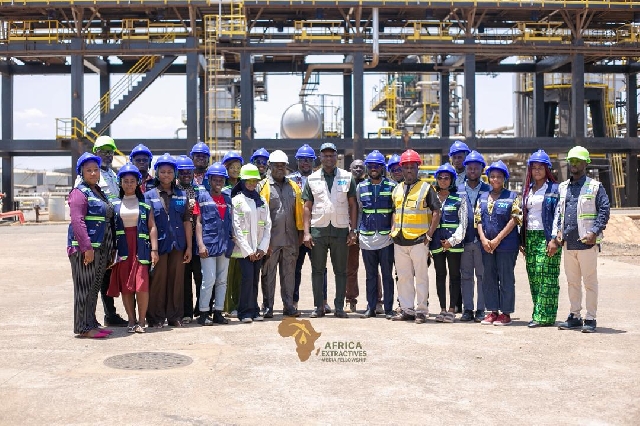
Edmond Kombat, Managing Director of TOR, offered a candid and at times sobering account of the refinery’s recent history during an engagement with fellows of the African Extractive Media Fellowship (AEMF), describing the state of the institution before its revival as “depressing” and nearly beyond recovery.
Kombat traced the refinery’s descent from a relatively stable footing in 2016 to what he characterised as a near-collapse by 2024. At the heart of the crisis was a debt burden that had once been brought under control, reduced from $650 million to approximately $300 million before 2017, only to balloon again to around $517 million in the years that followed. The financial deterioration was accompanied by operational shutdowns, poor maintenance, and mounting liabilities across the board.
The scale of the financial obligations was staggering. TOR had accumulated significant debts to the Ghana Revenue Authority, the Electricity Company of Ghana (ECG), Ghana Water, and various staff-related funds. Years of unaudited accounts and massive cumulative losses compounded the institutional rot. On the ground, the physical infrastructure told an equally grim story: 17 storage tanks were out of service, and key processing plants sat idle.
Beyond the balance sheet, Kombat painted a picture of an institution hollowed out from within. Internal divisions, low staff morale, and a high attrition rate saw skilled workers depart for opportunities in the Middle East and at larger facilities such as the Dangote Refinery. “The place was so depressing that it almost looked like there was no way out,” he admitted.
Rather than waiting for a government bailout, management took a different approach upon assuming leadership, one focused on internal reform and rebuilding trust from the ground up. Central to this effort was addressing the human resource grievances that had long festered within the institution. Over 300 staff petitions were reviewed, resulting in promotions and salary adjustments designed to restore confidence and reignite productivity.
With limited financial capacity, TOR turned to unconventional revenue strategies to keep the lights on. The refinery extended its operational hours, attracted regional clients — including Burkina Faso — for petroleum storage services, and worked to rebuild confidence among private petroleum service providers. According to Kombat, these measures helped stabilise revenue streams and provided the foundation for initial restoration works.
The clearest sign that TOR’s recovery was real came on December 19, 2025, when the refinery resumed refining operations after years of inactivity — a milestone that few had believed possible just months earlier. In a testament to the capability of its workforce, the primary processing unit, known as the Crude Distillation Unit (CDU), was successfully restored by in-house engineers without any external technical support. Work is now ongoing to rehabilitate the secondary processing unit, the Residual Fluid Catalytic Cracker (RFCC), which is expected to further enhance output and product value once operational.
The rebuilding effort has extended to critical infrastructure across the refinery. Storage tanks are being rehabilitated, the loading gantry is being modernised, and a recruitment drive is underway to address an ageing workforce. To date, over 400 temporary workers and 300 permanent staff have been engaged as part of the recovery phase.
Kombat was emphatic about the strategic importance of TOR to Ghana’s energy security. The refinery holds a unique position in the national petroleum supply chain, it is one of the few facilities capable of producing aviation fuel and premix fuel, and boasts storage capacity estimated at one million metric tonnes, with connections to key national and regional supply routes. Allowing such an asset to fall into irreversible disrepair, he warned, could have serious consequences, especially in an era of heightened geopolitical tensions that continue to disrupt global oil markets.
Yet for all the progress made, Kombat was careful not to overstate where TOR stands today. “We are just scratching the surface,” he said, stressing that the refinery’s recovery remains in its early stages and that continuity in both management and policy direction will be essential to consolidating the gains achieved so far.
The story of TOR’s revival is still being written, but for the first time in years, it appears to have a fighting chance at a different ending.
Source: Apexnewsgh.com