

10 most likely to be President in future
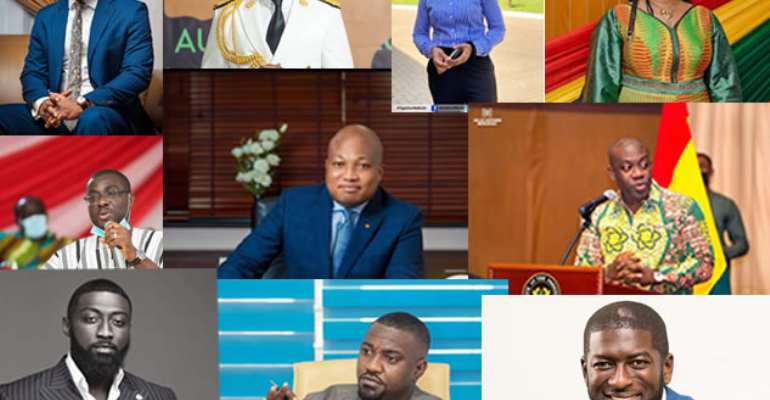
Ghana’s democracy since independence in 1957 has experienced some appreciable growth and evolved in the last 6 decades with more people yearning to take up leadership roles This is evident in the number of young men and women venturing into the political space which hitherto used to be a reserve for the older folk. Student politics in tertiary institutions has birthed a lot of young people with a burning desire and an unrelenting drive to take their destinies and that of the country to a different pedestal. The age-old notion of wisdom and experience being the repository of old age is fast fading away as the 21st-century youth have challenged the norm and are rising to the occasion especially in the political sphere. In recent times, the urge and drive for Ghanaian youth are geared towards establishing a more perfect country to promote the general welfare of the citizens, provide for common defense for those who speak truth to power, and ensure posterity. In no particular order, here are 10 potential people likely to be president of Ghana in the future. 1. John Dumelo A Ghanaian actor, farmer, and politician who has within a short time demonstrated enough passion and resilience to his cause to making Ghana a better place. The 37-year-old actor and NDC’s Ayawaso Wuogon Parliamentary candidate for the 2020 elections gave his opponent a run for her money despite losing in the end. For most political watchers, John Dumelo demonstrated guts, immeasurable confidence and performed surprisingly well, especially transitioning from the field of Creative Arts to mainline politics. This tips the successful actor as a potential figure to run for the highest office of the land considering how far he has come. 2. Zanetor Rawlings The eldest daughter of former President, the late Jerry John Rawlings is gradually following in the footsteps of her father. The 42-year-old is currently a Member of Parliament (MP) for the Klottey Korley constituency in the Greater Accra region. She is regarded by many as a future flag bearer of the National Democratic Congress(NDC) due to her sharp rise in the political spectrum. In the run-up to the 2020 elections, some school of thought claimed she was being figured by former president John Mahama as a running mate and it won’t be a surprise to see her climb up the political ladder to the level of a flag bearer or a future President. 3. Emmanuel Kojo Jones Mensah Popularly known as Kojo Jones, the 32-year-old business executive whose drive and passion for creating employment opportunities landed him in business, has been at the forefront championing a development agenda throughout the country. The young and passionate entrepreneur is a graduate of Coventry University and the London Metropolitan University, respectively. His love to give back to society has seen him provide potable water, stationery, among other things to many poor and needy communities around the country through his KJM Foundation initiative which is a nonprofit organization. Though his thoughts are unknown, his name stands tall among other contenders for a position like this. His passion to make Ghana a world-class country is very much alive which is why his name cannot go unmentioned in this post. 4. Nana Kwame Bediako Widely known as Cheddar or Freedom Jacob Caesar, the real estate mogul arguably is one of the most sought-after young entrepreneurs in Ghana. With a mission of building a united new Africa and bridging it with the rest of the world, his Freedom Movement advocates for an elevation in the education, civilization, and empowerment of African people around the world who seek to have their value and legacy restored. It, therefore, does not beat imagination seeing his name appear in this list. 5. Sarah Adwoa Safo As far as successful female politicians go, Sarah Adwoa Safo cannot be ignored or underrated. The New Patriotic Party (NPP) stalwart is currently the Member of Parliament for Dome Kwabenya constituency and Minister for Gender, Children, and Social Protection. She is also an entrepreneur and a graduate of the George Washington University who served as the Procurement minister under the first term of President Akufo Addo’s government. In less than a decade in Parliament, Madam Adwoa Safo is one of the most vocal voices in the House as far as women are concerned. 6. Sammy Awuku His impeccable communication prowess rose him to the rank of Deputy Communications Director of the New Patriotic Party. Sammy’s unflinching love and commitment to the NPP accelerated him quickly to join the rank and file of the party as the National Youth Organiser after a landslide victory in the NPP’s 2013 congress. The 37-year-old brilliant and hardworking youth leader as he is, he works tirelessly and effortlessly to rally the youth behind the NPP which secured President Nana Addo Dankwa Akufo Addo (then Flag Bearer) a guaranteed win in the 2016 general elections. His love for Accountability in all matters particularly in governance inspired him to partner with colleagues to form the Group that keeps the government of the day on its toes-Alliance for Accountable Governance (AFAG). Mr. Awuku is currently the Board Chairman of the Youth Employment Agency. 7. Kojo Oppong Nkrumah He bowed out of broadcasting in 2014 to establish an investment firm, West Brownstone Capital. By 2016, he had become a lawyer practicing as a lawyer. In 2015 the 39-year-old member of Parliament and minister for information contested and won the NPP parliamentary primaries for Ofoase-Ayirebi constituency in the Eastern Region of Ghana leading to his victory in the 2016 general elections. He additionally served as a member of the Finance and Constitutional committees of the 7th Parliament of Ghana. He is currently the President’s Representative at the Ministry of Information. His outstanding up to speed performance and display of aptitude as a minister during the COVID-19 pandemic was a testament to his readiness for the task ahead. It is therefore far-fetched that his name keeps surfacing on the lips of people as a possible flag bearer figure
$13.3m car loan tax waiver for 275 MPs

All the 275 MPs in Ghana’s parliament will collectively enjoy a quantum of $13.3 million in tax waiver per a bill laid before the house by the government in connection with their $28 million car loan.“Request for waiver of the Import Duty, Import GETFund Levy, Import NHIL, Import VAT, EXIM levy, COVID-19 Recovery Levy, Special Import Levy, ECOWAS Levy, AU Levy, Inspection Fees, and Withholding Tax (ITS Tax Deposit) amounting to the Ghana cedi equivalent of thirteen million, three hundred and eighty-seven thousand, five hundred United States Dollars (US$13,387,500.00) on vehicles to be procured for Members of Parliament of the Eighth Parliament of Ghana (2021-2024) and the Members of the Eighth Council of State (2022-2024),” the bill laid by the Finance Ministry on Wednesday, 14 July 2021 read. Meanwhile, the Finance Committee of Parliament has recommended the discontinuation of advancing car loans to Members of Parliament. This follows public backlash at the tabling of the $28-million loan deal for MPs to buy cars by Mr Ofori-Atta. The Finance Committee of the chamber suggested in its report that the practice be discontinued. Parts of the report read: “These legitimate concerns are fueled by the fact that, of all the Article 71 officeholders, it is only members of Parliament and Members of the Council of State who benefit from these vehicle loans, a large part of which are re-paid by the state”. “The Committee took the view that, as representatives of the people, Members of Parliament cannot continue to leave these concerns unattended”. “That weakens the confidence Ghanaians have in us. We have a responsibility to reflect the values and ideals of the people we represent”. “Accordingly, the Committee strongly recommends to Parliament the discontinuation of the current vehicle loan arrangement for MPs and Council of State Members”. “Members of Parliament and Members of the Council of State should have similar duty post vehicle arrangements as other Article 71 officeholders”. “And the Committee respectfully recommends that Parliament and the Parliamentary Service take the necessary steps to ensure that this happens”. “The instant vehicle loan arrangement for MPs and Council of State Members before us today should therefore be the last one the state is sponsoring.” —Classfm Please contact Apexnewsgh.com on email apexnewsgh@gmail.com for your credible news publications. Contact: 05555568093
GHS34.8m on 446.9K spent on WASSCE ‘pasco’ for 2021 candidates

“Mr Speaker, in 2020, the government, through its efforts to help students amidst COV1D-19 to prepare for the 2020 West African Senior School Certificate Examination (WASSCE), procured 568,755 past questions for students to try their hands on before sitting for the actual exams.” This was according to the Education Minister At a unit price of GHS78, the government of Ghana has said it spent GHS34.8 million to buy past questions (pasco) for candidates of the 2021 WASSCE under the Free SHS programme. On the floor of parliament on Wednesday, 14 July 2021, Education Minister Yaw Osei Adutwum, said the current unit price is 32% more than that of 2020 – GHS59. However, Dr Adutwum told the house that “to help prepare the final-year senior high school students for the 2021 West African Senior School Certificate Examination (WASSCE), the Ministry has procured 446,954 past West African Senior School Certificate Examination (WASSCE) questions from Messrs Kingdom Books and Stationery at a unit price of GHS 78.00. The procurement will be funded from the Free Senior High School Account.” The Ministry of Education, Dr Adutwum noted, “contracted Messrs Kingdom Books and Stationery to supply 568,755 WASSCE past questions at a contract price of GHS 33,641,043.75. The procurement of these questions was funded through the Free Senior High School Account and the results of the 2020 WASSCE was tremendous compared to previous years’ WASSCE performance.” Meanwhile, he said the ministry is making efforts to buy textbooks for the lower level. “Mr Speaker, the procurement process for the supply of published textbooks to basic schools is currently ongoing. The Ministry placed an advert in the Ghanaian Times on 1st June 2020, where various publishers approved by NaCCA, submitted their books and relevant documents to be taken through a Pre-Qualification procurement process.” He said Apexnewsgh.com/Ghana/Ngamegbulam Chidozie Stephen Please contact Apexnewsgh.com on email apexnewsgh@gmail.com for your credible news publications. Contact: 05555568093
1992 constitution worst in our history; it’s time to fix it – CDD Executive Director
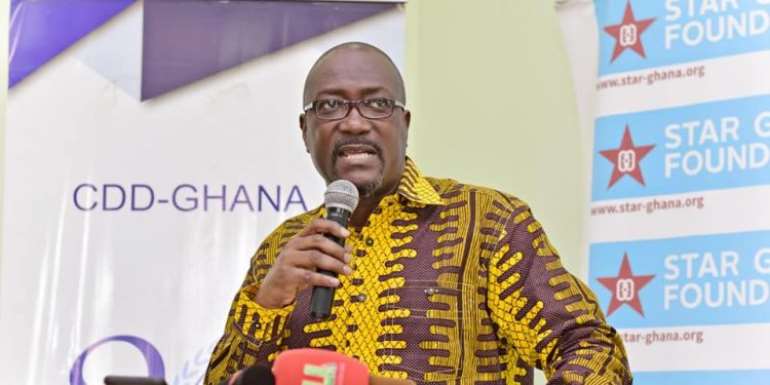
In comparison with the country’s second constitution developed in 1969, Prof. Prempeh simply makes the point that “frankly, other than the Constitution of the First Republic, this [1992] constitution is, from a governance and people-centered perspective, easily the worst constitution in our political history.” He also feels that, unlike previous constitutions, the 1992 version is the most profligate – a situation that has led to extremely wasteful public expenditure. Prof. Prempeh, in a social media post, made reference to Members of Parliament (MPs) who have, by virtue of the Constitution, been empowered to enjoy a lot of privileges and benefits to the detriment of the average citizen. Additionally, he said these MPs have failed to use their power to save the country from bad transactional agreements and subsequent judgment debts arising from contractual breaches of those deals. In his opinion, the surest way to reverse this and to help Ghana is to “fix the constitution in the many places where it is irredeemably broken.” Prof. Prempeh asserts that unlike in the past, MPs are now paid as full-time, salaried public officers, though they still draw allowances for committee sittings. He maintains that this has brought a sense of dysfunctionality in parliament. “The 1992 Constitution is also the most profligate, in the sense that it invites wasteful growth in the size of government and in public expenditures. No wonder it has both attracted and spawned a political class in its own image. It has lasted longer than all the rest only because We the People are tired of and reject coups and the disruption and retrogression they bring and entail.” “The longevity of this constitution is not because there is something intrinsically superior or great about the constitution itself; there isn’t at all. But this should not mean we must continue to put up with whatever is served us in the name of the constitution”, Prof. Premeph’s post stated. Below is the full statement Under the (1969) 2nd Republican Constitution, Ghana had a fixed number of MPs (constituencies) and the job of an MP was not treated as a full-time position; MPs received a sitting allowance for attendance, but not a salary. And, of course, there was nothing like “end-of-service benefits” (ESBs)! Today, the Constitution of the 4th Republic places no limit on the number of MPs (constituencies); we started with 200 in 1993, we are now at 275. (Expect the EC to jack up the numbers once the census is completed and Election 2024 is around the corner.) And, unlike what we had under the 69 Constitution, our MPs are now paid as full-time, salaried public officers, though they still draw allowances for committee sittings, which activity is, of course, an intrinsic part of an MP’s job description the world over. By a little-known amendment to the Constitution adopted by a supermajority vote of Parliament in 1996 (a Rawlings gift to the MPs as the term of the 1st Parliament was coming to an end), MPs are also entitled to a ”gratuity”, otherwise known as ESBs–and to a so-called car “loan”–ONCE EVERY FOUR YEARS, even if they win re-election to Parliament multiple times. On top of all this, our full-time MPs remain free, with the nominal permission of the Speaker, to carry on with their private professional and other pecuniary pursuits, including running or owning businesses that win contracts from and do business with the Government. And those among them who find favour with the President but do not get chosen as Ministers, can–and often do–get appointed to state corporate boards, from which they draw sweet allowances and perks. Some of the lawyers among our MPs also continue with their private legal practice, appearing in court in some instances to represent their private clients, even in cases against the same State they presumably work for full-time. So, how exactly are our MPs working for us full-time as MPs? And what have they done for us lately? Note that, every single international commercial transaction or agreement we have entered into in the 4th Republic, including those that have led to breaches and judgement debts, was once approved by our MPs in Parliament! How many bad deals have our Parliament saved us from since 1993? How many scandals have they unearthed through oversight? How many findings and recommendations contained in Auditor-General’s Reports have our MPs caused to be implemented? How many billions of cedis or dollars have our MPs saved us since 1993? Indeed, is our Parliament, as currently designed and operating, capable of saving us much at all? I doubt it. Well, this is the kind of Parliament and MP the 4th Republican (1992) Constitution has wrought. And this is only a small slice of it. It does not get better. Frankly, other than the Constitution of the First Republic, this constitution is, from a governance and People-centered perspective, easily the worst constitution in our political history. It is also the most profligate, in the sense that it invites wasteful growth in the size of government and in public expenditures. No wonder it has both attracted and spawned a political class in its own image. The 1992 Constitution has lasted longer than all the rest only because We the People are tired of and reject coups and the disruption and retrogression they bring and entail. The longevity of this constitution is not because there is something intrinsically superior or great about the constitution itself; there isn’t at all. But this should not mean we must continue to put up with whatever is served us in the name of the constitution. Time to fix the constitution in the many places where it is irredeemably broken. —citinewsroom Please contact Apexnewsgh.com on email apexnewsgh@gmail.com for your credible news publications. Contact: 05555568093