






WHAT DID JESUS WRITE ON THE GROUND? BY GREG ODOGWU

(John 8:3 – 20) The Bible tells us the story of scribes and Pharisees tempting Jesus Christ with the case of the woman caught red-handed in adultery. The story made it clear that these Jews wanted to set up Jesus and destroy him and his ministry. While they talked to Jesus, he ignored them, bent down, and used his finger to write something on the ground. By the time he lifted up his head to reply them, Jesus had the perfect words of condemnation for his accusers. “He that has no sin should cast the first stone!” They all fled. Following up on his historic repartee, Jesus went ahead and accused the Pharisees of not knowing God whom they claimed to represent. The interesting thing is that the Bible clearly states, in John 8:20, that Jesus survived his verbal attacks on the Pharisees because his time (of dying) had not come. In other words, if it was his time to die, they would have grabbed him and crucified him instantly for speaking such “blasphemy” right inside the Temple. The question now is what really happened? Another question is what did Jesus scribble on the ground before replying the Pharisees and setting the adulterous woman free? The answer was revealed by The Almighty. What happened was that Jesus Christ faced a serious Spiritual Warfare that day at the Temple. His ministry was targeted for destruction by the powers that be. The Jewish religious and political cabal, represented by the Pharisees and the scribes, respectively; were set to terminate what they saw as a threat to the status quo. They rallied all the political thugs and religious extremists. If Jesus had uttered a careless word, he would have been stoned that evening. That was the law. It was their weapon. But Jesus had his own Astral weapon. That day his Spirit Guide told him what to do. Children of God, fellow Peace Keepers, Jesus’ weapon was a number! 21 As those people questioned him, he scribbled the number 21 on the floor. And immediately the Spirits that controlled the thugs and extremists saw it, they flew away! They were disarmed. They were mowed down as if a nuclear bomb fell in their midst. After the bomb fell, Jesus looked up, and the enemies were nowhere to be found! Now, as Peace Keepers, we must understand the significance of the number 21. This number is the earthly timeline given to any Human being who is on a Messianic mission. It starts counting the day your spirit guide Speaks to you in very clear terms concerning your earthly mission. It terminates the day you accomplish that mission. This is because Angels and Humans in the other non-material dimensions can see everyone on Earth. They know those who have been contacted, and those with Messianic mandate. Jesus wrote 21 because he was trying to tell the demons and spirits gathered to murder him, that his Messianic timetable had yet to expire. That is why the Bible was explicit in verse 20: “his time has not come”. Now, let us do the maths. Jesus announced himself at the Temple at age 12. That was when he was contacted by the Holy Spirit. Twelve plus twenty one is 33. Jesus died at age thirty three. What about Prophet Mohammed? He received Angel Jibril’s revelation exactly at age 40. He died at age 61. Forty plus twenty one is sixty one. There is no miracle or magic in Spirituality. It’s scientific. When you know and abide by the science, it becomes like magic. The Almighty Movement has ONE particular mandate and power: To release every Human who is on a Messianic mission from his/her 21-year limit. This is because the founder of this Mission broke that ceiling on the day the Ceasefire was signed on December 25, 2018! Peace for power! Peace Supreme! Apexnewsgh.com/Ghana/Ngamegbulam Chidozie Stephen Please contact Apexnewsgh.com on email apexnewsgh@gmail.com for your credible news publications. Contact: 05555568093
Talensi: Concerned residents announce appeal plans after defamation judgment
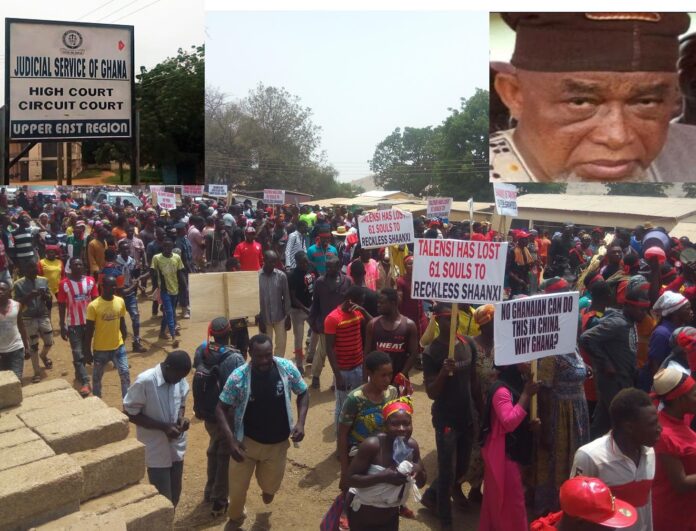
A judgment entered Friday in a defamation case at a circuit court in Bolgatanga against some natives of Talensi, a district in the Upper East Region, is heading for an appeals court. The defendants― Albert Naa, Augustine Mmi-Oni Guure, Bismarck Zumah, Charles Boazor and Samuel Sapark― announced the impending action in a post-judgment engagement with the press. They look determined and unworried in the face of the judgment. They insist strongly that they did no wrong in the course of executing their duty as citizens to protect the public interest. The five men are members of the Concerned Citizens of Talensi (CCT). The CCT has been involved in a long struggle against some human-rights abuses and violations that have sustained Talensi in the headlines since the arrival of the Shaanxi Mining Company Limited (a wealthy Chinese mining firm) in the mineral-rich-but-deprived district in 2008. Families, including members of the CCT, have lost relations as a result of the abuses and violations. The roads in the district are in states of disrepair. Inhabitants of the district’s mining hub, Gbane, struggle to find clean water to drink― with women and children often seen, particularly in the dry season, scooping littered sand from dry riverbeds in search of water. The presiding judge, Malcolm Bedzrah, directed the CCT members to pay Gh¢40,000 in damages to the plaintiff― the Paramount Chief of Talensi, Tongraan Kugbilsong Nanlebegtang, who claimed a statement made by the civil rights activists defamed him. The judge also ordered them to retract the said statement with an apology. A demonstration in Talensi against powerful figures over human rights abuses and violations. At present, the chief is also in different courts against some other natives of the region over related claims. Some local and foreign observers have shared their opinions about the multiple litigations, describing the “unprecedented” trend as “a suing spree” and “a growing threat to free speech” in the area. He has never attended any of the court sessions in person; he is being represented in all of the cases all the time by his Secretary, Richard Yinbil Sunday, by the Power of Attorney (a written authorisation to represent someone in a business or legal matter). Some international bodies and prominent media houses overseas, following Friday’s judgment, have offered to back the social justice promoters in moral and legal terms as they seek a review of the judgment at an appellate court. It is the first time the outcome of a civil lawsuit is drawing such attention to the region. The already-existing local support for the CCT members has seen a further boost since Friday from more traditional authorities and youths who believe the activists are standing for a cause that is humanitarian and just. The Root of the Court Case The court case between the paramount chief and the CCT members is rooted in an investigation that led to the resignation of a Minister of State at the Presidency, Rockson Ayine Bukari, in 2019. Some officials of the Shaanxi Mining Company Limited (now known as Earl International Group) were caught having secret meetings with a senior High Court judge, Justice Jacob Bawine Boon, in 2018 during an EIB Network investigation on the judicial system. The Chinese company was involved in a civil case before Justice Boon against the Cassius Mining Company (a multinational establishment of Australian origin) at the time. The meetings were held on separate days (late in November and early in December, 2018) at the judge’s residence in the Upper East regional capital, Bolgatanga. Inhabitants of the mining hub struggle to find clean water to drink The Minister of State at the Presidency (Rockson Bukari) sought to kill the investigative story by giving Gh¢5,000 in bribe to the investigator (Edward Adeti) and begged him to not expose the High Court judge and the Chinese company. A brand new motorbike was also presented to the investigator to influence him to hide the findings from the public. An investigative tape has the Minister of State saying he (the minister) took the cash from the Chinese company’s CEO. He is also heard on another investigative tape saying: “… the Shaanxi people, the Tongo Rana (the Paramount Chief of Talensi) and myself, we’ve supported them all along… the Cassius people are not reliable…the Tongo Rana said I should try to tell you (Edward Adeti) not to do it (publish the story) because it would affect them (Justice Boon and the Shaanxi Mining Company Ltd)…” The story was published and the items given in bribes were sent to state security services― the National Intelligence Bureau (known as the Bureau of National Investigations at the time) and the Ghana Police Service― as evidence. Later, the investigative tapes were released and heard in many public places. Justice Boon was disqualified from sitting on the ‘Cassius versus Shaanxi’ case and subsequently was transferred from the region to a remote area in the country, losing his position as the Upper East Regional Supervising High Court Judge. Rockson Bukari resigned his position as a Minister of State at the Presidency for his evident involvement in the bribery scandal. Ghana’s President, Nana Addo Dankwa Akufo-Addo, accepted the resignation letter but the Republic did not prosecute the minister despite calls for him and those he cited on the tapes to be investigated and prosecuted. The Republic prosecuted only three private individuals who were involved or cited in the bribery scandal at the Circuit Court in Bolgatanga. The three individuals― Maxwell Wooma, Charles Taleog Ndanbon and Suwaid Abdul-Mumin― were acquitted and discharged on the basis that the three accused persons and the witness in that Republic trial (Edward Adeti) were not public servants (which the excluded Minister of State and the other big names he mentioned on the tapes were). The CCT members, who had been opining publicly that Shaanxi had been violating human rights with impunity in the area because it was enjoying support from powerful figures at several levels, asked that the Paramount Chief also resign his position as a member of the Council of State and