

Dr. Nawaane cut-sod for transformative projects in Nabdam
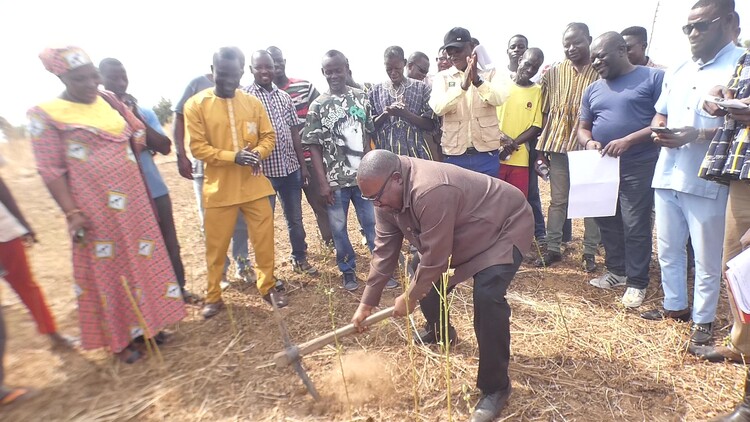
On a bright Monday morning, the Nabdam Constituency in Ghana’s Upper East Region buzzed with unusual excitement. The air was thick with anticipation and hope as community members from far and near gathered in several towns to witness an event that would mark a turning point in their lives. Chiefs in regal attire, elders with wisdom etched on their faces, women carrying children on their backs, and youth eager to see change, all converged for a historic occasion: the sod-cutting ceremonies led by their Member of Parliament, Dr. Mark Kurt Nawaane. The sod-cutting started at Soliga, a community that, for years, had grappled with limited access to basic amenities. As the sun climbed higher, the crowd swelled, filling the open grounds where the ceremony would take place. The chiefs, resplendent in traditional robes, sat at the center, flanked by elders and surrounded by an enthusiastic assembly of townsfolk. Dr. Nawaane arrived to a spirited welcome. There was singing, drumming, and dancing, a celebration that was both a show of gratitude and a rallying call for unity. As he took the stage, the noise faded, replaced by the eager silence of expectation. With humility, Dr. Nawaane began his address. He called it “a great day,” not just for himself, but for the entire district. He explained that this moment was a direct result of a visionary promise made by the President of the Republic, John Dramani Mahama. The President, Dr. Nawaane recalled, had pledged that 80 percent of the District Assembly Common Fund would be allocated to the Assembly, with 10 percent dedicated specifically to health infrastructure and health activities. This policy, he emphasized, was not mere rhetoric; it was bearing fruit in the form of tangible projects that would uplift lives. The crowd listened intently as Dr. Nawaane spoke of the longstanding needs of Soliga. For years, the community had yearned for a health post, a place where mothers could deliver their children safely, where the sick could receive care without traveling miles, and where the elderly would have a measure of comfort in their twilight years. The people had even taken matters into their own hands, constructing a modest building with limited resources, a testament to their determination and resilience. “But today,” Dr. Nawaane declared, “we are here to begin the construction of an official Community-based Health Planning and Services (CHPS) Compound, a health facility worthy of Soliga’s aspirations.” Applause erupted as he spoke, the relief and joy on the faces of the assembled evident for all to see. He paid tribute to the community’s spirit, to the elders who had kept hope alive, to the chief who had advocated tirelessly, and to the women who had borne the brunt of inadequate healthcare. “When this facility is completed, healthcare will be at your doorstep,” he promised. “No longer will you need to journey two or three miles for primary health services.” Among those in attendance was Madam Sadia Salifu, the Nabdam District Health Director. Her excitement was unmistakable. She spoke candidly to the media about the struggles the people of Soliga had endured. The existing community-built structure, she explained, was barely adequate, offering little in the way of comfort or medical safety. “This new facility is good news for more than a thousand people in Soliga,” she said. “It will change lives.” The chief, too, gave his blessings, expressing gratitude not only to the MP and the President but also to the people for their perseverance. There was a palpable sense that something momentous was unfolding, a shift from frustration to fulfillment, from hope deferred to hope realized. The day’s significance did not end in Soliga. Dr. Nawaane’s itinerary included several other communities, each with its unique needs and aspirations. In Damolga, the focus was on education. The community, like Soliga, had struggled with inadequate school infrastructure. The sod-cutting here marked the start of the construction of a modern three-unit classroom block. But this was no ordinary school building. The plans included a headteacher’s office, a storeroom, an ICT lab, a library, a staff common room, an eight-seater KVIP toilet, and two gender-friendly urinals. The design reflected a commitment to holistic education, providing not just classrooms, but the resources and facilities needed for contemporary learning. In Nangodi, two separate projects were underway. The first was the expansion of the Health Directorate Offices. The new building would feature three modern offices, a mini-conference hall, and three water closet toilets. This expansion was vital for improving healthcare administration and ensuring that health workers had a conducive environment in which to serve the people. The second project in Nangodi addressed a different, yet equally pressing need: animal husbandry. The MP cut the sod for a new pen to house stray animals. The facility would include feeding and storage areas, a mechanized borehole for water, and even a bedroom and W/C for the caretaker. This project recognized the importance of agriculture in the local economy and sought to provide humane, organized solutions for managing livestock. In Kongo, Dr. Nawaane turned his attention to food safety and sanitation. The existing slaughterhouse, crucial for the community’s butchers and meat traders, was incomplete and ill-equipped. The new project aimed to finish the construction of the slaughterhouse and fit it with a modern biodigester sanitation system. This innovation would ensure that meat processing was both safe and environmentally friendly, protecting public health and supporting local businesses. The final stop was Pelungu, where the focus was once again on sanitation—a perennial challenge in many rural communities. The planned construction included a ten-seater, four-flat water closet toilet, a five-unit bathhouse, and a mechanized borehole. These facilities would serve hundreds, providing dignity, hygiene, and a better quality of life. Through each speech, handshake, and shovel of earth, Dr. Nawaane’s message was clear: these projects were not isolated acts of charity, but part of a cohesive vision for Nabdam’s future. They were the product of thoughtful policy, community engagement, and a determination to see real, lasting change. The day’s events