

Black Stars Robbed in Vienna: Police Launch Investigation as CCTV Cameras Found Non-Operational
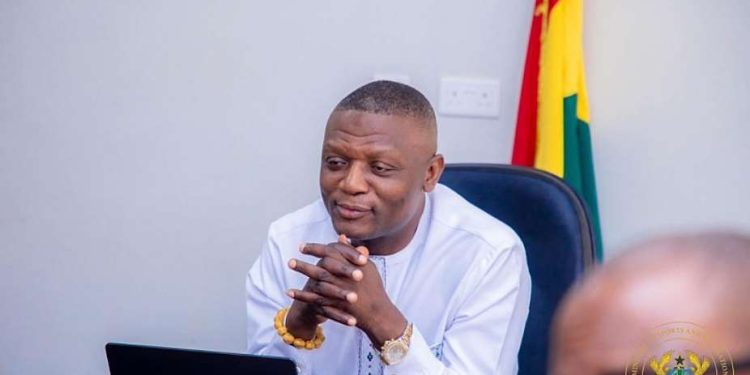
Police in Vienna, Austria, have launched a formal investigation after Ghana’s national football team, the Black Stars, fell victim to a brazen robbery on the eve of their international friendly match scheduled for Friday, March 27, 2026. The incident, which has sent shockwaves through Ghana’s football circles, saw thieves make off with $2,250 in cash and two Rolex watches belonging to players of the national team, striking at the very hotel where the squad had been lodged ahead of the highly anticipated fixture. Adding a troubling layer to the case, Minister for Sports and Recreation Kofi Adams revealed that preliminary reports point to a significant security lapse at the hotel; the CCTV cameras were not operational at the time of the robbery. The revelation has raised urgent questions about the integrity of the hotel’s surveillance system and who bore responsibility for maintaining it. “The initial report we have is that the CCTV was not functioning, and the police are checking when it stopped working and who was responsible for the hotel’s surveillance system at that time,” Adams disclosed. The minister confirmed that Viennese authorities have taken the matter seriously and are conducting a thorough review, working to establish a precise timeline of when the cameras went offline and whether any foul play was involved in their failure. With the cameras down and the robbers having apparently exploited the security blind spot, investigators now face the challenge of piecing together the events of that night without the benefit of footage. Austrian police are said to be working diligently to unravel the circumstances surrounding the theft, examining all available leads. For the Black Stars, the incident cast a shadow over their preparations for the friendly, a match meant to be a moment of national pride on the international stage. Instead, the team found itself at the centre of a criminal investigation far from home, awaiting answers as Austrian authorities race to bring those responsible to justice. Source: Apexnewsgh.com
BoG Unveils Six Pillars of Digital Defence
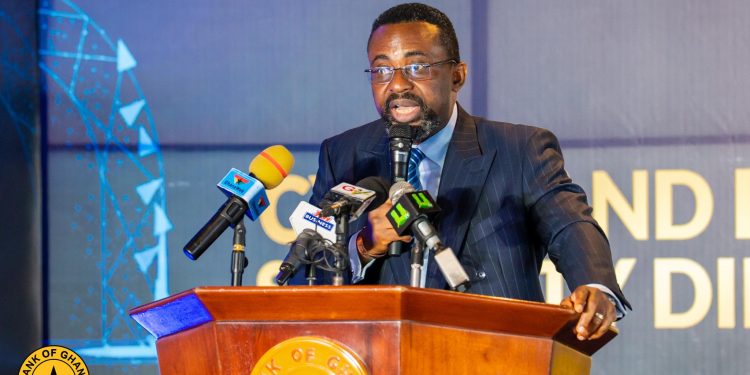
The Bank of Ghana (BoG) has drawn a bold line in the sand against the rising tide of cyber threats, introducing six strategic pillars that form the backbone of its revised Cyber and Information Security Directive (CISD 2026), a sweeping framework designed to forge a safer and more resilient digital financial sector. At the official launch of the directive, Governor Dr. Johnson Asiama made clear that the stakes go far beyond regulation. “A Safer and More Resilient Digital Financial Industry,” he declared, “is the central pillar of our regulatory philosophy.” For him, the CISD 2026 is more than a policy document; it is a solemn commitment to every individual and business that entrusts their financial data to Ghana’s financial ecosystem. The Governor did not mince words about the dangers lurking in the shadows of the digital economy. He warned that the very progress driving Ghana’s financial sector forward has also opened the door to increasingly sophisticated and persistent threats. “From ransomware attacks that can paralyse a bank for days, to systemic data breaches that can shatter public trust in an instant,” Dr. Asiama cautioned, “the threats we face are no longer just isolated IT incidents; they are national security concerns.” Acknowledging that the Bank of Ghana saw this shift coming, he pointed to the first Directive issued in 2018 as a necessary but now insufficient foundation. “We must be honest,” he said candidly, “a framework designed for the challenges of 2018 cannot adequately solve the problems of 2026.” The time had come, he stressed, to move beyond simple compliance and embrace a posture of active and collective cyber resilience. Six Pillars, One Vision To meet this moment, the CISD 2026 is built around six transformative pillars, each targeting a critical dimension of cybersecurity in the financial sector: AI and Machine Learning Governance As financial institutions lean more heavily on artificial intelligence for fraud detection, credit scoring, and customer service, the directive steps in to ensure these tools operate with transparency, fairness, and security, guarding against the risks that come with algorithmic decision-making. Cloud Computing Security Recognising the rapid shift toward cloud technologies, the directive promotes responsible, risk-based cloud adoption while firmly protecting data sovereignty over sensitive financial information. Proportionality Framework Not every institution faces the same risks or commands the same resources. This pillar tailors cybersecurity requirements to the size and risk profile of each institution, ensuring that smaller banks and fintechs are not crushed under the weight of disproportionate compliance demands. Board-Level Accountability Cybersecurity is no longer just an IT department conversation. The directive mandates that at least one board member possess verified cyber risk expertise, embedding security thinking at the very top of institutional leadership. Inclusive Oversight Ghana’s cyber defences are only as strong as their weakest link. By expanding the directive’s coverage beyond universal banks to include micro-finance institutions, savings and loans companies, fintechs, and partner regulators, the CISD 2026 creates a unified, sector-wide shield against cyber threats. Proactive Defence and Preparedness Rather than waiting for attacks to happen, this pillar pushes institutions to anticipate, prevent, and respond swiftly to evolving threats — shifting the culture from reactive damage control to proactive resilience. Building and sustaining this level of cyber defence does not come cheap. Governor Asiama acknowledged the significant investment required in infrastructure, advanced technology, and most critically, highly skilled personnel. As the Sectoral CERT, the Bank of Ghana has shouldered the initial cost of establishing the Financial Industry Cyber Security Operations Centre (FICSOC), a critical piece of national infrastructure that underpins the entire framework. With the CISD 2026 now in motion, Ghana’s financial sector stands at the threshold of a new era, one defined not by fear of cyber threats but by the confidence and capability to face them head-on. Source: Apexnewsgh.com
Black Stars Targeted in Vienna Hotel Robbery Days Before Austria Friendly

Ghana’s Black Stars arrived in Vienna with football on their minds, but an unsettling incident off the pitch has cast a shadow over their preparations ahead of Friday’s international friendly against Austria. The national football team has been hit by a robbery at their hotel in the Austrian capital, with cash and luxury watches reported stolen from the rooms of players and management committee members. A source at the Ghana Football Association confirmed the incident, which has since drawn the attention of Austrian authorities. Gabby Ofei of the Citi Sport Desk, reporting live on Citi Prime News on Friday, March 27, 2026, was first to put numbers to the loss. According to his account, thieves made off with $2,250 in cash and two Rolex watches, the cash belonging to members of the management committee, and the watches to players. “The report that came in indicates that two valuables have been stolen, a $2,250 cash and two Rolex watches,” Ofei said. “The report indicated that cash belongs to management committee members, and the watches are for the players.” What has made the investigation particularly frustrating, however, is a glaring gap in the hotel’s security infrastructure. The CCTV cameras at the facility where the Black Stars are lodged were reportedly not functioning at the time of the incident, a revelation that has significantly hampered efforts to identify those responsible. “The hotel indicated that their CCTV cameras are not functioning, which has made it difficult for the FA to furnish the Austrian police with proper evidence,” Ofei added. Without usable footage, investigators are left piecing together the incident through other means, slowing what would otherwise have been a more straightforward process of identifying the culprits. Despite the unsettling turn of events, those close to the team say the mood in camp remains composed. Officials confirmed that players and technical staff are calm and focused, determined not to let the off-field disturbance derail their preparations for the scheduled match. The Ghana Football Association, for its part, says it is working closely with the relevant authorities in Austria to support the investigation and has pledged to provide further updates as the situation develops. For now, the Black Stars are pressing on, keeping their eyes on the game, even as the search for answers continues behind the scenes. Source: Apexnewsgh.com
A Historic Moment for Africa: Mahama Hails UN Adoption of Reparations Resolution as Major Diplomatic Breakthrough
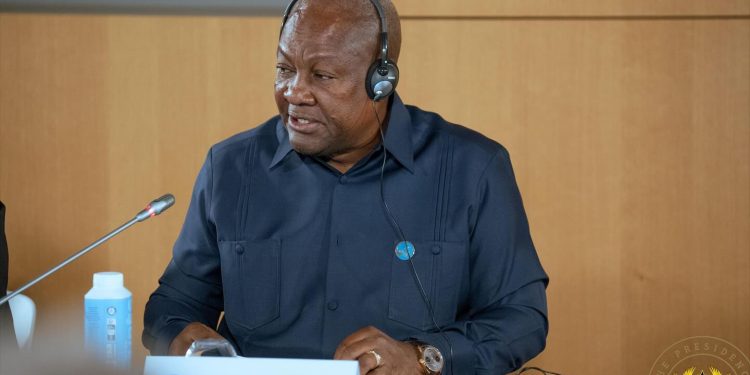
On Wednesday, March 25, 2026, the United Nations General Assembly adopted a landmark reparations resolution, one that Ghana had championed, and in doing so, opened a new chapter in the long and unfinished conversation about justice for the transatlantic slave trade. President John Dramani Mahama did not mince words about what the moment meant. Writing on X the following day, he described himself as “overjoyed”, a word that captured not just personal satisfaction, but the weight of history finally being acknowledged on the world’s most prominent multilateral stage. “I am overjoyed by the adoption by the UN General Assembly of the resolution declaring the trafficking of enslaved Africans and racialised chattel enslavement of Africans as the gravest crime against humanity,” the President wrote. The resolution, which secured 123 votes in favour, calls for renewed global commitment to reparative justice for African countries and descendants of enslaved people. It urges member states to engage in structured dialogue and take concrete, measurable steps to address the deep and lasting social, economic, and cultural wounds inflicted by slavery, wounds that, for many communities, have never fully healed. The vote was not without opposition. The United States, Argentina, and Israel voted against the resolution, while 52 countries chose to abstain. Washington, in particular, described the motion as “highly problematic,” acknowledging the historical reality of slavery but raising questions about who the intended beneficiaries of reparations should be. Fifty-two countries abstained, reflecting the complexity and sensitivity that still surrounds this conversation on the global stage. Yet the numbers told a story of their own. With 123 nations voting in favour, the resolution passed with a clear and commanding majority, a signal that the international community’s appetite for reparative justice is growing, not fading. For President Mahama, the outcome was the fruit of determined international cooperation. He credited the African Union, CARICOM, and a coalition of committed partners whose collective effort transformed what began as a proposal into a binding resolution of the world’s foremost international body. The President framed the resolution as far more than a diplomatic achievement; it is, in his view, an act of moral recognition. It honours the millions of Africans who were stolen from their homelands, stripped of their humanity, and subjected to one of history’s most brutal systems of exploitation. And it places that recognition not in the margins of history, but at the centre of international law and conscience. Drawing on the enduring words of Toussaint Louverture, the Haitian revolutionary who himself became a symbol of resistance against slavery and oppression, President Mahama underscored the principle that has driven this effort from the beginning. “The greatest weapon against oppression is unity,” he referenced — a reminder that the resolution’s passage was itself a product of that unity, and that the work ahead demands even more of it. Because for Mahama, the vote is not the destination. It is a beginning. He called on nations across the world to sustain the momentum, to stand in solidarity, and to commit to the deeper, harder work of restoration. “We must stand united in seeking the restoration of the humanity and dignity of our forebears who were enslaved and sold,” he urged. In the halls of the United Nations, history was made. But in the words of Ghana’s President, the truest measure of this moment will be what the world chooses to do next. Source: Apexnewsgh.com
Ghana’s Electronic Toll System Set for Q4 2026 Launch as Parliament Moves to Plug Revenue Gap

Ghana is on the verge of turning a significant page in its road infrastructure story. The Roads and Transport Committee of Parliament has confirmed that the country’s long-awaited electronic road toll system will be up and running by the fourth quarter of 2026, a development that promises to restore a vital stream of funding for road maintenance and development. The announcement came on Thursday, March 26, 2026, in Accra, where Isaac Adjei Mensah, Chairman of the Committee and Member of Parliament for Wassa East, addressed the Parliamentary Press Corps. His remarks came in direct response to concerns raised earlier in the week by the Minority Caucus, which had questioned the pace at which the toll system was being rolled out. “All feasibility studies and preparatory processes will soon be finalised,” Mr. Adjei Mensah said, projecting confidence that the implementation timeline was firmly on track. But the Chairman did not stop at reassurance; he went on the offensive. Pushing back sharply against the Minority’s criticism, he argued that those who abolished the toll system in the first place had little standing to question the speed of its restoration. “The Minority has no moral justification to criticise the pace of this policy,” he said pointedly. His remarks carried the weight of hard numbers. Before the tolls were scrapped under the previous administration, they were generating approximately GH¢60 million every month for the state — a substantial and consistent revenue flow that vanished overnight with their abolition. The resulting gap, Mr Adjei Mensah stressed, had left Ghana’s road maintenance infrastructure starved of funding, with deteriorating roads and stalled projects bearing the consequences. “The abolition of the tolls led to substantial revenue losses,” he said, framing the electronic system not as a new policy experiment, but as a necessary correction — one designed to close the gap and rebuild the country’s capacity to maintain and expand its road network. The electronic format, he explained, is a deliberate upgrade. It will bring efficiency and transparency to the revenue collection process, replacing the vulnerabilities of manual toll collection with a modern, accountable system. “This system will ensure efficiency in collection while restoring a reliable revenue stream for road infrastructure development,” the Chairman said. Beyond the toll system, the Committee used the occasion to address a broader range of infrastructure concerns. On the government’s “Big Push” initiative, Mr. Adjei Mensah moved to clarify questions surrounding contract awards, noting that only 44 percent of the 400 contracts under the programme were awarded through sole sourcing, with the majority going through competitive bidding processes. The session also touched on several other critical projects and policy directions, among them, progress on the Boankra Inland Port, the status of the Mpakadan Railway System, government plans to restructure the Road Fund into a Road Maintenance Trust Fund, and the partial payment of GH¢107 billion in outstanding road arrears. Taken together, the disclosures painted a picture of an administration working to untangle years of infrastructure debt while laying the groundwork for more sustainable, transparent, and efficient systems. With Q4 2026 now firmly in view, Ghana’s roads and the funds needed to keep them in shape may soon be on a more reliable footing. Source: Apexnewsgh.com
Ghana’s Gold Gets a New Story: Naana Jane Launches Heritage Village to Champion Local Jewellery Industry

Vice President Naana Jane Opoku-Agyemang stepped forward to officially launch the Heritage Village initiative, a bold platform dedicated to showcasing and promoting locally manufactured gold jewellery and breathing new life into Ghana’s value-added industry. The initiative, the brainchild of legal practitioner Gertrude Emefa Donkor under her brand Goldbod Jewellery, arrives at a time when conversations about Ghana’s economic future are louder than ever. At its core, Heritage Village is a call to action, a challenge to the nation to stop sending its gold away in its raw form and start telling a richer, more rewarding story with it. Speaking at the launch, Vice President Opoku-Agyemang made clear that the path to Ghana’s transformation runs directly through its ability to produce, not just extract. She underscored the critical importance of empowering local artisans, nurturing the country’s creative sector, and building industries that add value at home rather than abroad. For the Vice President, this is not a peripheral conversation; it is central to Ghana’s economic identity. She noted that the country’s future prosperity depends on its willingness to move beyond the mine and invest in innovation, craftsmanship, and production. The timing of the three-day event was no accident. Deliberately scheduled to coincide with Ghana Month, Heritage Village framed gold not merely as a commodity buried beneath the earth, but as a living symbol of national pride, cultural heritage, and untapped economic opportunity. It was a statement that Ghana’s gold belongs not just in the ground or in foreign markets, but in the hands of Ghanaian artisans and on the global stage as a finished, high-value product. Prof. Opoku-Agyemang took a moment to commend the organisers for their vision and courage, for contributing meaningfully to the national dialogue on industrial growth and for creating a platform where young entrepreneurs could find their footing, scale their businesses, and compete beyond Ghana’s borders. As the event drew attention from artisans, industry players, and policymakers alike, the Vice President expressed genuine optimism about what Heritage Village represents and what it could become. She envisioned it as a catalyst, an initiative capable of inspiring a new generation of innovators, uplifting local craftspeople, and playing a defining role in advancing Ghana’s industrialisation agenda. In launching Heritage Village, Vice President Naana Jane Opoku-Agyemang sent a clear and resonant message: Ghana’s gold is more than a resource; it is a legacy waiting to be shaped, polished, and proudly worn by the world. Source: Apexnewsgh.com
Mahama Champions Transparency and Accountability in Bold Governance Overhaul
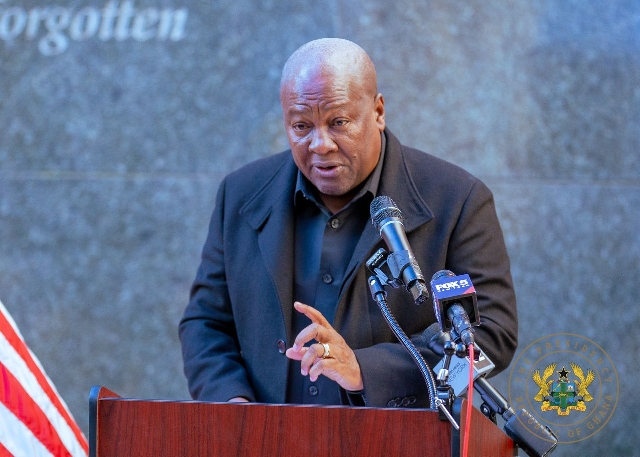
From the heart of Philadelphia, President John Dramani Mahama stood before a gathering of Ghanaians in the diaspora and delivered a message that resonated far beyond the walls of the meeting hall, a promise to transform how Ghana is governed. With conviction in his voice and urgency in his words, the President laid out a sweeping agenda of reforms designed to root out corruption, restore public trust, and redefine what it means to hold public office in Ghana. “We are committed to building a government that Ghanaians can trust — a government that is accountable, transparent, and fully responsible to the people,” President Mahama declared. At the center of this agenda are two landmark initiatives: a new national anti-corruption strategy and the Public Office Accountability Bill. Both, the President stressed, are being fast-tracked for implementation, a signal that his administration is not content with promises alone, but is moving with deliberate speed toward action. The anti-corruption strategy, as President Mahama described it, is not a routine policy document. It is a direct assault on systemic graft, a comprehensive framework built to detect, prevent, and prosecute corruption at every level of government. Beyond enforcement, it aims to cultivate a culture of ethical conduct among public officials, reinforcing the idea that integrity is not optional but foundational. Complementing this is the Public Office Accountability Bill, which will enshrine in law the standards expected of those who serve in public roles. It will create binding legal frameworks to hold officials answerable for misconduct, drawing a clear line between public service and personal impunity. “Public office is a public trust,” the President said firmly. “If you choose to serve the people, you must be prepared to be held accountable. These reforms are about ensuring that trust is never violated.” For Mahama, these are not merely regulatory measures, they are transformative tools, the bedrock upon which Ghana’s development must be built. He painted a vision of a nation where public resources are managed with care, where leadership is guided by conscience, and where institutions are strong enough to stand on their own. “Our people deserve a government that works efficiently, responsibly, and transparently,” he said. “With these initiatives, we are ensuring that the systems managing our resources are accountable, and that leadership is guided by integrity and service to the nation.” The Philadelphia engagement also carried a deeper symbolism. By taking this message to Ghanaians abroad, President Mahama acknowledged the diaspora not merely as spectators of Ghana’s story, but as active partners in writing it. He described them as vital contributors to the country’s socio-economic growth, a community whose investment, ideas, and influence are woven into the fabric of national development. As the President concluded his address, his words carried the weight of both a challenge and a commitment. “These reforms are central to Ghana’s progress,” he said. “They are about protecting our democracy, empowering our institutions, and ensuring that public service remains a noble calling, guided by the highest standards of integrity.” In Philadelphia, far from Accra, President Mahama made one thing unmistakably clear, the work of rebuilding Ghana’s public trust has already begun. Source: Apexnewsgh.com
Ghana’s Digital Fortress: How the Bank of Ghana Just Rewrote the Rules of Financial Security

In an era where the battlefield for national security has shifted from physical borders to fiber-optic cables, Ghana has just fortified its most critical asset: its financial heartbeat. The date was Wednesday, March 25, 2026. In the heart of Accra, at the storied Bank Square, a ribbon was cut, not over a road, a bridge, or a hospital, but over something far less visible and far more consequential. The commissioning of the Bank of Ghana’s Security Operations Centre (SOC) did not make the skyline any taller, but it made the nation immeasurably safer. With Chief of Staff Hon. Julius Debrah standing alongside Governor Dr. Johnson Pandit Asiama and First Deputy Governor Dr. Zakari Mumuni, Ghana quietly announced to the world that it was done waiting for a cyberattack to happen before deciding how to respond. That era was over. Ghana’s economy is digitizing at a breathtaking pace. Mobile money interoperability has woven millions of unbanked citizens into the formal financial system. Fintech startups are rewriting how businesses borrow, save, and transact. Every new digital connection, every new platform, every new line of code is a door, and for cybercriminals, every door is an opportunity. Hackers no longer need to breach a physical vault. They do not need guns, getaway cars, or inside men. All they need is a line of malicious code and a moment of vulnerability. In today’s financial landscape, billions can be siphoned in seconds, and the victims, ordinary Ghanaians, may not even know it has happened until the damage is done. The SOC is the Bank of Ghana’s direct answer to this evolving threat. Acting as a centralized nerve center for the entire financial ecosystem, the facility does not merely scan for common viruses or routine intrusions. It hunts, proactively, relentlessly, for sophisticated, state-sponsored threats and coordinated financial fraud, intercepting danger before it ever reaches the balance sheets of the people it is sworn to protect. What makes this milestone truly remarkable, however, is not the hardware. It is the philosophy behind it. First Deputy Governor Dr. Zakari Mumuni captured the spirit of the moment when he framed the SOC not simply as a new tool, but as a fundamental shift in how Ghana thinks about financial resilience. The old model, building walls and hoping they hold, is no longer sufficient. The new model is about speed, intelligence, and anticipation. “The question in modern banking is no longer if a threat will occur, but when,” a technical expert at the launch noted. “The SOC ensures that when that ‘when’ happens, the response is measured in milliseconds, not days.” At its core, the SOC operates on three powerful pillars. The first is Threat Intelligence Sharing, a real-time “neighborhood watch” for the banking sector, where a threat detected at one financial institution is immediately flagged and neutralized across the entire network, preventing a single breach from cascading into a systemic crisis. The second is round-the-clock vigilance, with a dedicated team of elite cyber-analysts working in shifts, eyes never leaving the screens, guarding the integrity of the Cedi through every hour of every day. The third, and perhaps most forward-looking, is proactive defense, the deployment of artificial intelligence and machine learning to identify and close vulnerabilities in the financial architecture before a single criminal mind can find and exploit them. For Hon. Julius Debrah and the leadership at the Bank of Ghana, this investment reaches beyond technology. It is, at its core, about trust. In a competitive global economy, capital is not loyal. Investors, businesses, and international financial institutions go where they feel safe, where the systems are strong, the oversight is credible, and the risks are managed. By establishing one of the most advanced Security Operations Centres in the sub-region, Ghana is not merely protecting its banks. It is making a bold declaration of intent: that it intends to be the most secure, the most stable, and the most trusted financial hub in West Africa. As the ribbon fell at Bank Square on that Wednesday morning, the message reverberated far beyond the walls of the ceremony. Ghana’s digital gates are now manned by a sentry that never sleeps, never blinks, and never stands down. In the high-stakes arena of global finance, where fortunes can be made or lost in the blink of a cursor, the Bank of Ghana has drawn a firm and unambiguous line, the nation’s wealth will remain exactly where it belongs: protected, stable, and secure. Source: Apexnewsgh.com