
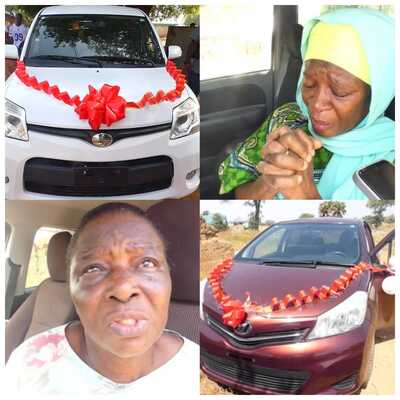



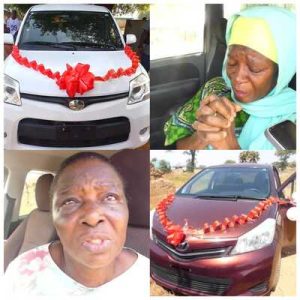
Former Upper East Regional Women’s Organiser of the National Democratic Congress (NDC) and Deputy Director-General of Warehousing at the National Disaster Management Organisation (NADMO), Hajia Charity Rahinatu Asoemah, has donated two cars to her predecessor, Madam Faustina Abagre, and a patron of the John Mahama Ladies’ Club, Hajia Zainabu Mohammed Ayariga, in recognition of their contributions to the party and the support they have offered her over the years.
The gesture, which was described as an act of appreciation and recognition, was intended to honour the two women for their dedication, guidance and sacrifices towards the growth of the NDC and their personal support for Hajia Charity’s political journey.
Speaking to the media during the presentation, Gifty Nyaaba, Regional President of the John Mahama Ladies’ Club, who represented Hajia Charity, explained that the donation was driven by a deep sense of gratitude and the desire not to forget those who had contributed to her success.
According to her, Madam Faustina Abagre, who served as the Upper East Regional Women’s Organiser before Hajia Charity, was the first beneficiary because of the remarkable relationship the two women had maintained despite competing against each other for the same position.
She recalled that after defeating Madam Abagre in the contest for the regional women’s organiser position, Hajia Charity visited her predecessor at home the very next day to apologise and assure her that the contest would not affect their relationship.
Although she had won the contest, Hajia Charity reportedly acknowledged Madam Abagre’s experience and expressed her willingness to learn from her, promising to continue seeking her guidance whenever she needed direction.
Gifty Nyaaba said Madam Abagre had remained a strong source of support and guidance to Hajia Charity, adding that the former regional organiser had never withdrawn her support despite the outcome of their political contest.
She noted that Hajia Charity had supported her predecessor in several ways over the years, some of which she could not disclose publicly, but said the presentation of the vehicle was an opportunity to make that appreciation visible.
The second beneficiary, Hajia Zainabu Mohammed Ayariga, was described as a committed patron of the John Mahama Ladies’ Club and a trusted adviser whose contribution to Hajia Charity’s political growth and the activities of the group could not be overlooked.
According to Gifty Nyaaba, Hajia Zainabu had consistently offered advice and guidance, particularly whenever she noticed that Hajia Charity was taking a wrong decision or needed direction.
She said the older woman had always been willing to pick up her phone and offer the necessary counsel, regardless of the circumstances.
Using an analogy, Gifty Nyaaba stressed that people who help others climb to positions of success should never be forgotten.
She explained that just as a ladder helps someone climb a tree, those who provide support and guidance during one’s journey to success deserve recognition when that success is eventually achieved.
She added that Hajia Charity, having established herself as a successful entrepreneur and politician, believed it was important to recognise the people who had helped her reach her current position.
The presentation, she said, was therefore not merely about giving out vehicles but about demonstrating gratitude, humility and appreciation for the people who had played significant roles in her journey.
Hajia Zainabu Mohammed Ayariga was visibly emotional when she unexpectedly received the keys to a Sienta car from Hajia Charity’s representative.
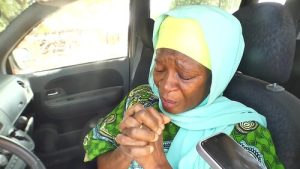
In her remarks, she used the occasion to recount her long-standing involvement in the NDC, tracing her political activism to the revolutionary period under the Provisional National Defence Council (PNDC), when she and other young people were still students.
She recalled that during the early days of the revolution, a house known as Gwanda Barracks became a meeting point for students and young political activists in the Bolgatanga Constituency.
According to her, the group gathered there before embarking on activities aimed at enforcing price controls and ensuring that traders complied with government directives against what was then described as kalabule.
She explained that their activities involved going around shops to identify traders who were allegedly selling goods above approved prices, after which the authorities would be informed to ensure compliance.
She said their commitment to the revolutionary cause was driven by the desire to see a fairer society and improve conditions for ordinary people.
Hajia Zainabu further recalled that after completing her studies, she was initially expected to undertake her national service in Accra. However, former party chairman Kofi Portuphy, impressed by her confidence, dynamism and outspoken nature, encouraged her to return to the Upper East Region to serve her own people.
Although she was initially disappointed about leaving Accra, she eventually accepted the assignment and began working with the local administration, which at the time operated under Interim Management Committees.
She later became involved in community development activities, particularly identifying gaps in education, water supply and sanitation.

She recounted how she and other officials identified communities where children had to walk more than 10 miles to attend school, with some crossing rivers to access education.
These findings were communicated to the relevant authorities to facilitate the construction and improvement of schools in deprived communities.
She also spoke about efforts to improve access to clean drinking water through the construction and lining of wells, explaining that communities were encouraged to participate while the assemblies provided materials such as cement.
On sanitation, she recalled an initiative that encouraged households to construct their own latrines, with support provided through a World Bank-related project.
According to her, although the initiative provided cement, toilet facilities and labour support, some community members were not accustomed to using household toilets, which affected its implementation.
Reflecting on those early years, Hajia Zainabu said their commitment to public service was not motivated by financial rewards, as many of them initially worked for little or no remuneration.
She described the period as one in which young people were driven by a strong sense of responsibility towards their communities.
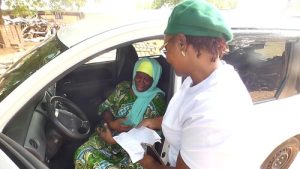
Hajia Zainabu also recounted the transition from the revolutionary period to constitutional democracy in 1992, describing the uncertainty that surrounded the future of those who had served under the revolutionary institutions.
She recalled that a delegation of young activists from across the country, led by the late Jacob Baba, travelled to Accra to engage the then Head of State, Jerry John Rawlings, over his intentions regarding the transition to multiparty democracy.
She said they were concerned about their future if Rawlings decided not to contest the presidency, given their involvement in the revolutionary administration.
According to her, Rawlings listened to their concerns and promised further consultations before taking a decision.
She further recalled that traditional authorities, opinion leaders and other influential personalities were subsequently consulted on whether Rawlings should contest the presidency under the new constitutional arrangement.
Hajia Zainabu said several prominent people in Bolgatanga, including elders and political figures, participated in the consultations and expressed support for his decision to contest.
She described Rawlings’ eventual decision to participate in the democratic process and his subsequent electoral victory as a moment of relief for those who had served under the revolutionary system.
She added that the NDC’s political journey had since gone through several phases, including periods of dominance, political challenges and the emergence of other parties.
Reflecting on the party’s future, she expressed satisfaction that younger people and women were increasingly taking up leadership roles, particularly following the political developments of the 2024 general elections.
he said the older generation had always hoped to create opportunities for younger members to take over the party’s leadership and expressed happiness that this transition was gradually taking shape.
Hajia Zainabu also used the opportunity to commend Hajia Charity for remembering those who had contributed to the party’s development and for extending such a generous gesture to them.
Meanwhile, Madam Faustina Abagre, who became the first NDC Regional Women’s Organiser in the Upper East Region in 1992, could hardly conceal her excitement after unexpectedly receiving the vehicle from Hajia Charity.

Expressing her gratitude, she thanked God for using Hajia Charity to recognise her contributions to the party, particularly at a time when she least expected such an act of kindness.
She recalled the difficult years she had spent serving the party, explaining that she had endured years of travelling under the scorching sun and rain on her motorcycle.
Madam Abagre said she never imagined that Hajia Charity, who had once contested against and defeated her for the regional women’s organiser position, would one day surprise her with such a valuable gift.
Recounting how their relationship developed after the contest, she confirmed that Hajia Charity had visited her home shortly after the election to apologise for some actions she felt had been inappropriate during the campaign.
According to her, Hajia Charity arrived with some clothes, knelt down and pleaded with her to forgive her for any wrongs committed during the contest.
She said she accepted the apology and assured her that there was no reason for them to hold grudges against each other.
Madam Abagre added that Hajia Charity had continued to maintain a cordial relationship with her, occasionally visiting her home and offering financial and other forms of assistance.
She disclosed that Hajia Charity sometimes sent her money through mobile money and supported her with provisions, including rice.
Despite these gestures, she said the presentation of the vehicle came as a complete surprise.
“I never dreamed that she would do this. I’m surprised. I’m overwhelmed,” she said emotionally.

Madam Abagre expressed profound appreciation to Hajia Charity, praying that God would continue to protect, guide and bless her for remembering her.
She added that she had nothing material to offer in return but could only pray for God’s blessings upon her benefactor.
“Everywhere she goes, her going out and coming in is in the hands of the Lord,” she said.
The donation has highlighted the importance of recognising the contributions of party faithful, particularly those whose sacrifices, guidance and commitment have helped build political organisations over the years.