



The air, once filled with the hopeful banter of students, now trembles with the aftershocks of unrest. In the corridors of academia, concern ripples among parents and educators alike.
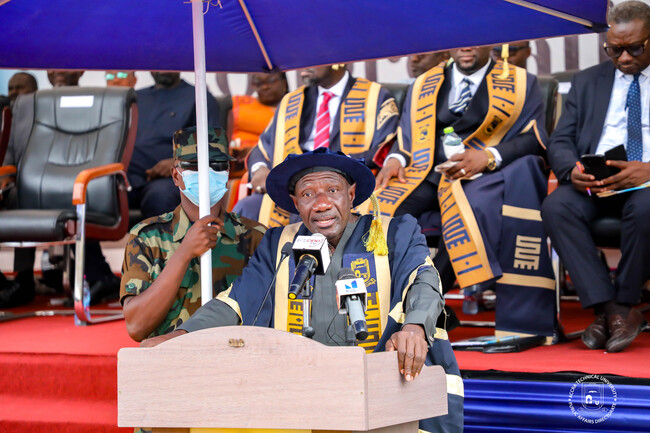
Professor David Millar, President of the Millar Institute for Transdisciplinary and Development Studies, has added his voice in the documentary “The Broken Chalkboards,” produced by Ngamegbulam Chidozie Stephen of Apexnewsgh, as he warns: if the current wave of student riots is not checked, it threatens to engulf the entire nation.
Kindly watch the full video here:
https://youtu.be/GSQR3-T6EaE.
Professor Millar’s observations are not mere conjecture. He describes, with painstaking clarity, how riots in secondary schools, once sporadic and exceptional, are becoming alarmingly routine. “It’s becoming very common and noticeable that rioting in schools, especially second-cycle institutions, is on the ascendancy. It’s beginning to increase nationwide,” he asserts. With each passing term, the risk grows that isolated incidents will ignite a conflagration, one that could destabilize the nation’s educational system and erode the social fabric.
To understand the roots of this unrest, Professor Millar embarks on a thorough diagnosis of the contemporary school environment. His analysis yields seven interlocking factors, four major and cross-cutting, and three institution-specific, that fuel the flames of student discontent.
- The Shadow of Drug Abuse
Foremost among the major factors is the specter of drug abuse and misuse. According to Prof. Millar, this problem is no longer confined to the school compound. It follows students home, forms habits, and then returns to infiltrate the school environment anew. The result is a culture where substance abuse becomes normalized, blurring the boundaries between personal recreation and institutional disruption. “We have to do something with drug abuse and drug misuse,” Prof. Millar insists, underscoring its centrality to the crisis.
- The Pressure Cooker of Peer Influence
The second factor is the relentless pressure exerted by peer groups. Within the closed ecosystem of a school, peer validation becomes a form of currency. Membership in social circles is governed by overt and covert rules, and the need to belong can drive students to conform to destructive behaviors. For girls as well as boys, these peer groups can be both a refuge and a crucible—incubating actions that undermine the school’s integrity.
- The Rise of Cults and Weaponization
Peer pressure, left unchecked, can metastasize into something even more insidious: the rise of cults within schools. These groups, often shrouded in secrecy and governed by their own codes, demand allegiance through symbolic acts, sometimes even the bearing of weapons. Inter-cult rivalries and competitions for dominance further stoke the fires of unrest. The existence of such groups, Prof. Millar warns, “weaponizes” peer relationships and transforms schools into battlegrounds.
- The Double-Edged Sword of Technology
Modern information and communication technology (ICT) is another factor reshaping the school environment. Smartphones, social media, and even artificial intelligence platforms expose students to a world far beyond the classroom. While this can be a force for good, it also creates new avenues for comparison, competition, and subversion. Students return from holidays eager to display their new digital prowess, sometimes in ways that challenge or undermine school authority. The result is a generation increasingly at odds with the structures meant to guide them.
Beyond these core issues, Prof. Millar identifies three more factors that vary from school to school.
- School Management Systems and Institutional Culture
The management style of a school can either mitigate or exacerbate unrest. Institutions with strong religious affiliations or private ownership tend to be more responsive to misconduct, swiftly meting out discipline. Public schools, by contrast, often suffer from bureaucratic inertia—disciplinary procedures are drawn out, diluted by committees, and susceptible to outside interference. This laxity, combined with unclear institutional cultures, leaves a vacuum that disruptive elements are quick to fill.
- The Disruption Subculture
A subtler, but no less significant, factor is what Prof. Millar calls the “subculture of disruption.” Weak students, fearful of looming examinations or unprepared for academic challenges, may seek to derail the school calendar altogether. By fomenting unrest, they hope to avoid failure and mask their own deficiencies. This phenomenon is often most acute as exams approach, with mass participation by those who feel threatened by strict enforcement of academic standards.
- The Parental Paradox
Finally, the role of parents is both pivotal and paradoxical. While parental engagement is essential for effective discipline, unchecked indulgence can have the opposite effect. Some parents provide their children with cars, excessive pocket money, and privileges that enable misbehavior. At home, such actions may go unchecked; at school, they find eager collaborators among peer groups. The result is a feedback loop where home and school reinforce rather than correct negative behavior.
While the destruction of property during riots is costly, Prof. Millar is more disturbed by the long-term impact on behaviors and attitudes. “It’s not so much the destruction of property… but the negative impact on behaviors and attitudes that are long-term. For me, that is the worrying part. Because these have long-term implications. We call them our future leaders. Imagine our future leaders coming out with all those vices. What sort of leadership do we get?”
Having laid bare the roots of the crisis, Prof. Millar turns to solutions. His proposals are pragmatic, grounded in both research and years of experience.
- Conscientization and Civic Education
The first step, he argues, is a renewed emphasis on civic education—what he calls “conscientization.” Many students, he notes, are simply unaware of the long-term consequences of their actions. By bringing in resource persons, former addicts, and career professionals to share their experiences, schools can equip students with the knowledge they need to avoid destructive pathways. “Educate, educate, re-educate,” Prof. Millar urges, advocating for a revival of civic education programs and the involvement of the National Commission for Civic Education in a large-scale, school-to-school campaign.
- Revitalizing School Life with Positive Engagement
Prof. Millar also calls for a renaissance in extracurricular activities. In the past, debates, drama clubs, and cultural associations provided outlets for energy and creativity. Today, these activities hold less allure, leaving students idle and susceptible to negative influences. The challenge, he suggests, is to redesign these programs to make them more relevant and engaging, drawing on the resources of national organizations and alumni to inspire and motivate students.
- Parent-Teacher Associations: Partners in Discipline
The role of Parent-Teacher Associations (PTAs) must also evolve. Rather than focusing solely on logistics and fundraising, PTAs should be fully integrated into the disciplinary process. When parents participate in disciplinary committees, students are less likely to feel victimized or singled out by staff. Decisions to suspend or expel are thus seen as collective, rather than arbitrary, reducing the likelihood of resentment and backlash.
- Revisiting Rules and Regulations
Prof. Millar advocates for a careful review and revision of school rules. Schools must reclaim the authority to punish, suspend, or even expel students when necessary. But discipline must be just and transparent, with clear guidelines to ensure fairness. The reintegration of PTAs into governance structures can provide an additional layer of accountability.
- Targeted Interventions for At-Risk Students
Recognizing that not all students are equally at risk, Prof. Millar recommends targeted interventions for those on the margins. “Not everybody has fallen victim. Those on the borderline, or those who are looking forward to crossing the carpet and joining, might hesitate. Especially if they know the consequences and the long-term effects.” Early intervention, he insists, can make all the difference.
- Engaging Alumni as Mentors
Alumni networks represent an untapped resource. By inviting “old boys” and “old girls” to share their stories, both successes and failures, schools can provide current students with role models who understand the challenges they face. These pep talks, Prof. Millar believes, can help redirect youthful energy toward productive ends.
- Restoring Trust in School Management
On the issue of school management, Prof. Millar is unambiguous: transparency and due process are essential. Disciplinary decisions should never rest with a single teacher or administrator. Instead, committees must investigate, deliberate, and present their findings to school leadership and, ultimately, the regional education authorities. The involvement of PTAs in these processes not only ensures fairness but also builds trust between students, staff, and the wider community.
The documentary touches on a particularly sensitive area: the potential for conflicts of interest among staff, especially in mixed schools. When teachers form inappropriate relationships with students or allow personal interests to color their professional judgment, the stage is set for conflict and injustice. Prof. Millar acknowledges the risk but points out that robust systems, committees, boards, and external oversight, exist precisely to prevent such abuses. “Even for dismissal or suspension, the regional director… has to endorse. And before he does that, he also consults Accra. So it shouldn’t happen like that.”
He further emphasizes the importance of PTA involvement in these processes, ensuring that decisions are not only procedurally correct but also perceived as fair by all concerned.
As the documentary draws to a close, Prof. Millar’s message is clear and urgent. The current wave of student unrest is not inevitable; it is the result of identifiable, and therefore addressable, factors. But time is of the essence. If left unchecked, today’s riots could become tomorrow’s catastrophe.
“We call them our future leaders. Imagine our future leaders coming out with all those vices. What sort of leadership do we get?” he asks, his voice carrying both the weight of experience and a hope for renewal.
The path forward will not be easy. It will demand courage from educators, engagement from parents, and commitment from students. It will require institutions to adapt, rules to be revised, and traditions to be reimagined. But it is a task that cannot be shirked.
https://youtu.be/GSQR3-T6EaE.
In the end, the story of unrest in the Upper East Region is not just a tale of broken chalkboards and shattered windows. It is a story about the kind of society we wish to build, and the leaders we hope to nurture. With vision, vigilance, and collective effort, Prof. Millar believes, the tide can be turned. And in that belief lies the promise of a brighter, more stable future for all.
Source: Apexnewsgh.com/Ngamegbulam Chidozie Stephen