


Nanlamtaaba PRO Challenges Alliance for Gban Claims, Says Company Is Legally Registered
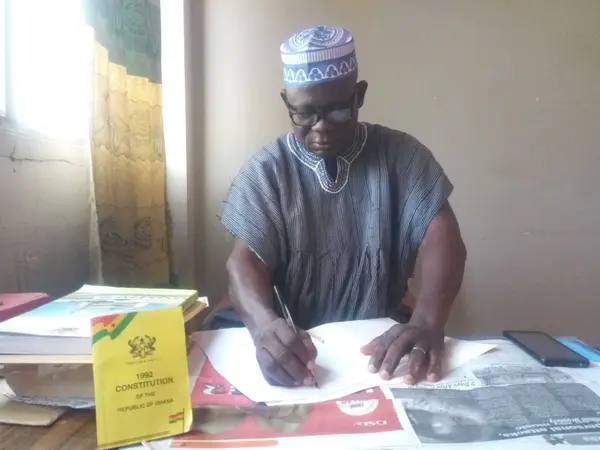
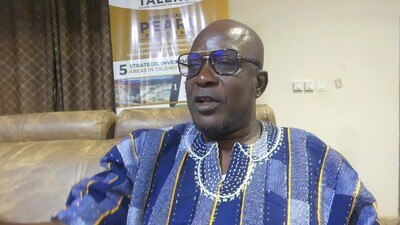
John Yaro, Public Relations Officer (PRO) for Nanlamtaaba Enterprise, has strongly rejected several claims made by the Alliance for Gban Development during its recent press conference over the ongoing mining dispute in the Gbane community of the Upper East Region. Responding to the allegations, Mr. Yaro challenged assertions concerning the mining status and legal standing Zongdaan Boyak Kolog popularly known as Poloo,” as well as claims about security protection allegedly being provided to him. According to him, contrary to claims that Boyak Kolog does not have a mining licence, he is currently operating as a small-scale miner and has been involved in a legal dispute with the Minerals Commission since 2020. He explained that the Minerals Commission had issued a licence in connection with the disputed concession, prompting Boyak Kolog to seek legal redress. “He went to court because the Minerals Commission issued a licence over his licence in 2020. He went to court and obtained an injunction against the Minerals Commission and the so-called international act,” Mr. Yaro stated. He further claimed that the High Court had issued orders restraining certain parties from undertaking activities around the concession involving Nanlamtaaba Enterprise. According to him, the court orders affected the operations of the company and also placed restrictions on certain state officials in relation to the dispute. Mr. Yaro therefore questioned claims that Puyak Kolog was operating without a valid licence. “If he has no licence, how can the Republic give him police protection?” he asked. “The man has no licence. How can police protection be applied in support of him?” He urged journalists and the public to critically examine the various claims being made by the parties rather than accepting allegations without asking questions. The Nanlamtaaba PRO also addressed the issue of security personnel allegedly protecting Boyak Kolog. He disputed suggestions that the individuals providing security were unregistered or unknown entities, insisting that they were private security companies. He also maintained that police presence around the disputed mining area was real, although the personnel might not always appear in uniform. “The police are always with us,” Mr. Yaro said, adding that he personally has police protection wherever he moves. He questioned whether critics expected police officers to be visibly present in uniform before acknowledging their presence. According to him, the security arrangements were intended to maintain peace and protect people within the area rather than demonstrate support for one side of the dispute. Mr. Yaro further said Nanlamtaaba Enterprise had decided to respect the current stop-work directive affecting the parties involved in the dispute. He indicated that the company was prepared to appear before the relevant authorities in Accra to present its case and provide clarification on the issues surrounding its operations. “We have a stop-work order within Earl-International and Nanlamtaaba. We are going by it. We will be invited to Accra, and we will go and make our case,” he stated. He dismissed the Alliance for Gban Development’s allegations as lacking substance, describing them as an attempt to divert attention from the substantive issues surrounding the dispute. “Nanlamtaaba is a registered company,” Mr. Yaro stressed. The latest development adds another layer to the ongoing tensions surrounding mining activities in Gbane, with the two sides presenting sharply different accounts of the legal status of the mining operations, security arrangements and the circumstances surrounding the disputed concession. Source: Apexnewsgh.com
Minister Samuel Nartey George to Feature in Government’s Accountability Series on September 7, 2026
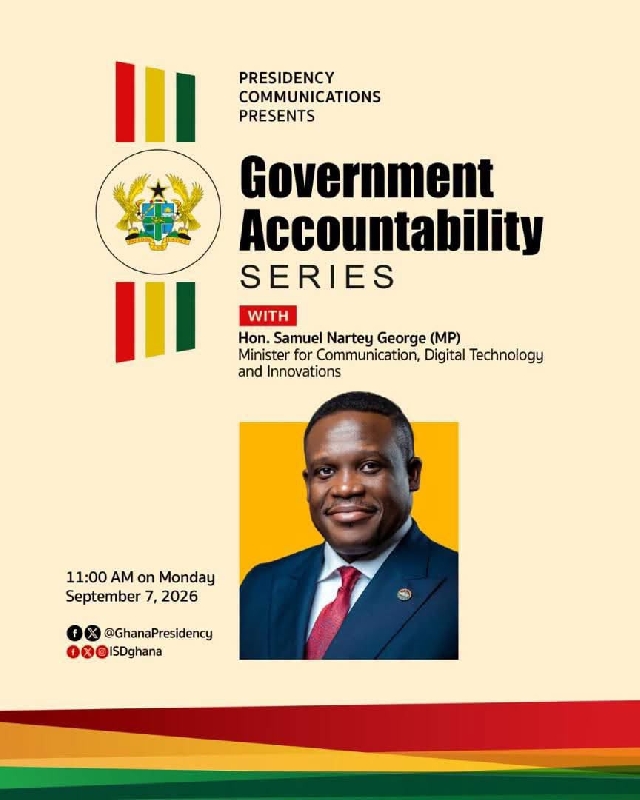
The stage is set for another edition of the government’s Accountability Series, with the spotlight this time on Samuel Nartey George, Minister for Communication, Digital Technology and Innovations. On Monday, September 7, 2026, at precisely 11 AM, Mr. George will engage the nation as part of the Presidency Communications team’s ongoing initiative to foster transparency and public dialogue. The Accountability Series, organized by the team at the Presidency, has become a cornerstone of the government’s efforts to keep citizens informed and involved. Through these sessions, ministers and high-level officials provide direct updates on policies, programmes, and achievements in their respective sectors. As anticipation builds, Mr. George is expected to address key issues and recent developments within the communications, digital technology, and innovation landscape. The session aims to shed light on the government’s progress, challenges, and future plans in these fast-evolving sectors. The Presidency Communications team emphasized the importance of the series as a vital platform, enabling government members to connect with the public, share information, and answer questions about their stewardship. Monday’s session promises to be an important opportunity for Ghanaians to gain insight into the work being undertaken to keep the nation at the forefront of digital innovation. All eyes will be on the Minister as he takes to the stage at 11 AM, continuing the tradition of open government and accountability that has become a hallmark of the current administration. Source: Apexnewsgh.com
Ghana Concludes Evacuation of 1,900 Citizens from South Africa Amid Xenophobic Attacks
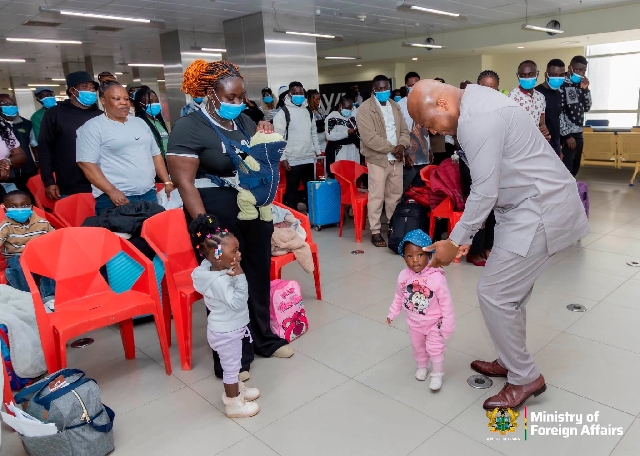
Foreign Affairs Minister Samuel Okudzeto Ablakwa stood at the airport, his face a portrait of relief and resolve, as he greeted the last group of weary, homebound Ghanaians. The day marked the conclusion of a massive national effort: the evacuation of approximately 1,900 Ghanaian citizens from South Africa, following a recent surge in xenophobic violence there. In a heartfelt Facebook post, accompanied by photos capturing the emotional reunions, Minister Ablakwa recounted the journey. “Today I warmly welcomed the final group of Ghanaians successfully evacuated from South Africa following the recent wave of xenophobic attacks,” he wrote, his words echoing the collective sigh of a nation relieved to see its people safe. The evacuation unfolded in two phases, with the second phase alone seeing 1,000 Ghanaians return. Each evacuee received support not just for their journey home, but for their new start: reintegration financial aid, transportation allowances, medical care, psychosocial support, free health insurance registration, and ongoing employment assistance. Minister Ablakwa was quick to emphasize that this was more than a government operation—it was a demonstration of national unity and compassion. “We achieved this together as Ghanaians. Our message is clear: we value the lives of Ghanaians everywhere in the world, and no Ghanaian will be abandoned in harm’s way,” he declared. He expressed deep gratitude to President John Dramani Mahama for his inspirational leadership and extended thanks to all local partners whose efforts made the mission possible. Yet, amidst the relief, the Foreign Affairs Minister did not forget those lost: he acknowledged the four Ghanaians who tragically died during the period of unrest, offering prayers and heartfelt condolences to their grieving families. Looking ahead, Minister Ablakwa assured the public that the Foreign Ministry would provide a full and transparent account of the evacuation process. “Next week the Foreign Ministry shall present a comprehensive report and account fully and transparently to the great people of Ghana,” he promised. As the final plane touched down and families embraced, the story of Ghana’s response stood as a testament to unity and the unwavering commitment to protect its citizens, no matter how far from home they may be. Source: Apexnewsgh.com
Gbane Youth Petition Mahama Over Mining Dispute, Insecurity and Alleged Assaults
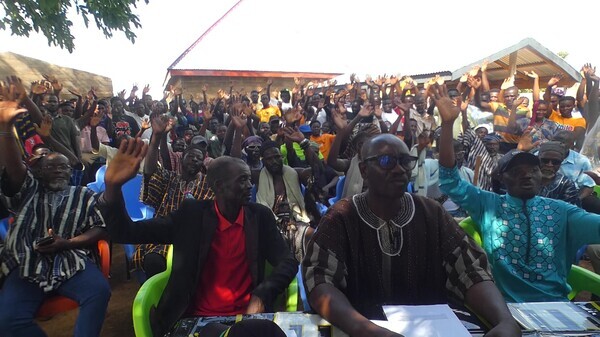
The Alliance for Gban Development, a registered youth organisation, has petitioned President John Dramani Mahama over growing tensions, insecurity and a protracted mining dispute involving Nanlamtaaba Enterprise and Earl International Group Ghana Gold Limited at Gbane in the Talensi District of the Upper East Region. This was revealed on Saturday during press conference organized by a Gban group known as Alliance for Gban Development. The group Secretary Mr. John Kpal who read out the statement, says it represents the concerns of the youth, traditional leaders and residents of Gbane. He raised concerns about what it described as a growing culture of impunity and disregard for regulatory directives amid heightened tensions in the community. At a press briefing, the group also the reveal the situation had become particularly tense over the past eight weeks following the enforcement of a High Court order directing the Ghana Police Service to provide protection for Nanlamtaaba Enterprise to undertake mining activities in the area. The Alliance stressed that while it respected the authority of the courts, it believed the enforcement of judicial decisions must also take into account community safety, peace and stability. According to the group, a Minerals Commission investigative survey conducted in the Gbane area in 2015 established that gold deposits in the area were deep-seated and recommended that the area be reserved for large-scale mining operations. The group said the government subsequently approved the recommendation and blocked out the Gbane area for large-scale mining. Following the acquisition of its mining lease, Earl International reportedly engaged affected small-scale concession holders, with the process facilitated by the Minerals Commission, the Environmental Protection Agency and the Upper East Regional Security Council. The Alliance said that in July 2021, Earl International entered into an agreement with affected small-scale concession owners, including Nanlamtaaba, under which the concessionaires were to receive two per cent of Earl’s gross production twice annually. It further alleged that goodwill payments were also made to affected concession owners. The youth group claimed that Nanlamtaaba’s Managing Director had acknowledged receiving substantial payments from Earl International, although he subsequently indicated that he believed the payments were intended for transportation and related expenses. The group said a High Court in Bolgatanga subsequently issued an interim ruling allowing Nanlamtaaba to undertake mining activities in Gbane, with the Ghana Police Service ordered to provide security. While reiterating its respect for the judiciary, the Alliance questioned the basis for allowing Nanlamtaaba to operate, claiming that records from the Minerals Commission indicate that the company’s 25-acre mining licence expired on May 14, 2025. It further argued that possessing a mining licence alone was insufficient, as mining operators are also required to obtain the necessary operating and environmental permits. The group therefore questioned why Nanlamtaaba was allegedly allowed to continue mining despite what it described as regulatory concerns. A major concern raised at the press briefing was the security arrangements surrounding the enforcement of the court order. The Alliance questioned whether the police were still providing the protection directed by the court, claiming that armed individuals who were neither police officers nor personnel of a registered security company had instead been seen providing security for Nanlamtaaba’s operations. The group alleged that some of these individuals had been involved in confrontations with residents. According to the Alliance, armed personnel carrying pump-action firearms recently entered underground workings belonging to Earl International. During the incident, it said, one of Nanlamtaaba’s armed guards accidentally shot himself in the foot and had to be carried out of the mine by Earl International security personnel. The group said it had photographs and video footage relating to the incident. The Alliance also alleged that three young men from Gbane were recently assaulted by armed security guards allegedly associated with Nanlamtaaba after they were found sitting under a tree near an area claimed by the mining company. According to the group, the incident nearly escalated into a major confrontation before the intervention of military personnel and community elders. The youth organisation said such incidents were creating fear among residents and could potentially trigger wider conflict if not addressed urgently. The group also raised concerns over directives issued by the Chief Inspector of Mines ordering the cessation of mining operations by both Earl International and Nanlamtaaba. It said Nanlamtaaba allegedly continued its activities despite an earlier directive. The Alliance further referred to a September 2, 2026 directive ordering a two-week cessation of operations. While acknowledging the regulator’s authority to suspend mining activities where necessary, the group questioned why the latest directive allegedly affected areas far beyond the disputed concession. It expressed concern about the impact of the shutdown on the estimated 2,000 workers associated with Earl International and their families. The youth group argued that if the dispute concerns a specific area, regulatory restrictions should be limited to that area rather than affecting an entire mining operation. The Alliance said it was not asking President Mahama to overturn the High Court’s decision, stressing that such a decision falls within the jurisdiction of the judiciary. Instead, it called on the government to ensure that the court’s order for state security was properly implemented. Among its demands, the group called for: The provision of professional, uniformed security personnel to enforce the court order where necessary. The removal of what it described as untrained armed guards from the area. Enforcement of directives issued by the Minerals Commission and the Chief Inspector of Mines. Investigations into the alleged assault of the three Gbane youths. Investigations into alleged seizure of property and the reported underground shooting incident. Prosecution of persons found culpable of criminal offences. An explanation from the Ghana Police Service regarding its alleged acceptance of a motorbike reportedly seized by private actors. Immediate measures to prevent the mining dispute from escalating into an inter-community conflict. “We Are Restraining Our Youth” The Alliance warned that the continued tensions could have serious consequences if the state failed to intervene. It said community elders and residents had so far exercised restraint and worked to prevent
Tony Tambil Ga-Rentome Declares Candidacy for NDC Talensi Deputy Communication Officer Position
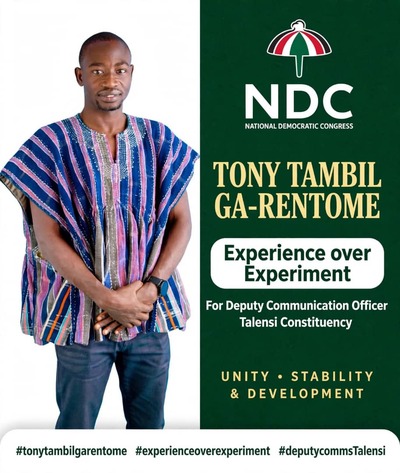
Tony Tambil Ga-Rentome has officially expressed his intention to contest the position of Deputy Communication Officer of the National Democratic Congress (NDC) in the Talensi Constituency, citing his more than a decade of active service and experience within the party. Ga-Rentome, a committed NDC grassroots activist and communicator, has been involved in the party’s activities since 2015. Over the years, he has contributed to the party’s communication efforts, grassroots mobilisation and election-related activities at various levels. As an NDC social media communicator since 2015, he has used various digital platforms to promote the party’s policies and achievements, defend its positions and engage with the youth and the wider public. His political experience also includes serving as a Branch Communication Officer from 2022 to 2026. In that capacity, he coordinated communication activities at the branch level, shared party information, organised communication engagements and represented the branch in official communication matters. During the 2024 General Elections, Ga-Rentome served as a Ward Election Collator, where he was responsible for collating results from polling stations within the ward and ensuring that the figures were accurately and promptly transmitted to the constituency collation centre. He also played an advocacy role in pushing for improved welfare and support for polling station agents ahead of the 2024 elections, stressing the importance of strengthening vigilance and protecting the integrity of the electoral process. With his background in communication, grassroots politics and election monitoring, Ga-Rentome says his experience has equipped him with skills relevant to the Deputy Communication Officer position. Academically, he holds a Bachelor of Business Administration (BBA) in Accounting and has professional experience as an Insurance Marketer, with expertise in client acquisition, financial services marketing and relationship management. His stated areas of strength include grassroots mobilisation, strategic communication, election collation and monitoring, youth advocacy and public relations. His declaration is expected to add another dimension to the contest for the NDC’s communication leadership in the Talensi Constituency as the party prepares for its internal activities. Source: Apexnewsgh.com
James Tenga Eyes Nabdam NDC Secretary Position After Years of Service
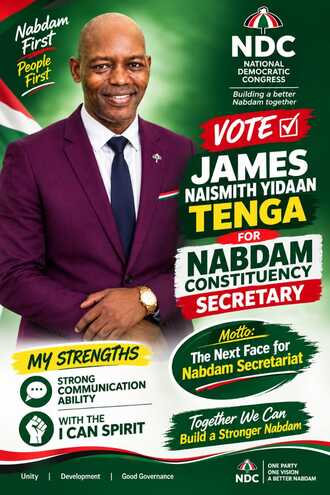
After nearly twelve years of dedicated service as the Nabdam Constituency Communications Officer of the National Democratic Congress (NDC), Hon. James Naismith Yidaan Tenga has officially announced his intention to contest for the position of Constituency Secretary. Having spent over a decade championing the party’s ideals, communicating its vision, defending its policies, and maintaining strong ties with the grassroots, James Tenga believes the time has come to take on a new challenge within the party’s leadership. His decision marks a transition from leading the party’s communication efforts to seeking a key administrative role in the Constituency Secretariat. According to him, the move is driven by a desire to contribute more directly to strengthening the party’s internal organisation, improving coordination, and enhancing the effectiveness of the Secretariat. Supporters describe his bid not as a departure from his previous responsibilities, but as a natural progression built on years of experience, commitment, and institutional knowledge. They believe his background in communication, coupled with his understanding of the party’s structures and grassroots dynamics, positions him well to serve in the Secretariat. As the contest approaches, attention is shifting from whether James Tenga possesses the necessary experience to how his expertise can help build a stronger, more responsive, and better-organised constituency administration. With his declaration, the journey to the Nabdam NDC Secretariat has officially begun, as James Tenga presents himself as the next face of the Constituency Secretariat. Source: Apexnewsgh.com
NHIA Executive Hits Back at GoldBod Critics, Says Claims of Losses and Forex Operations Are Misleading

The Deputy Chief Executive Officer (DCEO) in charge of Finance and Investment at the National Health Insurance Authority (NHIA), Anatu Anne Seidu Bogobiri Esq., has strongly rejected allegations surrounding the operations and financial performance of the Ghana Gold Board (GoldBod), describing the claims as misleading and politically motivated. In a statement dated September 4, 2026, Ms. Bogobiri argued that GoldBod’s legal mandate, financial performance and contribution to Ghana’s foreign exchange reserves do not support claims that the institution is operating like a forex bureau or making financial losses. She also cautioned the opposition New Patriotic Party (NPP) against turning the allegations into a political campaign message ahead of the 2028 general elections. GoldBod operating within its legal mandate According to Ms. Bogobiri, GoldBod’s activities are firmly backed by the Ghana Gold Board Act, 2025 (Act 1140), which received presidential assent in April 2025. She explained that the legislation gives GoldBod the responsibility of generating foreign exchange for the country while supporting the Bank of Ghana’s efforts to build up the nation’s gold reserves. She therefore dismissed comparisons between GoldBod’s foreign exchange activities and those of conventional forex bureaux, describing such comparisons as a misunderstanding of the institution’s statutory responsibilities. GoldBod generated US$1.315 billion in August Ms. Bogobiri cited GoldBod’s reported foreign exchange generation as evidence of the institution’s growing economic importance. Referring to a Ghana News Agency report published on September 2, 2026, she stated that GoldBod generated US$1.315 billion in foreign exchange in August alone. She explained that the funds came from gold exports and were subsequently made available to the Bank of Ghana and commercial banks under the Ghana Accelerated National Reserve Accumulation Policy (GANRAP). According to her, US$668.21 million was sold directly to commercial banks, while another US$646.59 million was made available to the Bank of Ghana. Ms. Bogobiri stressed that the transactions should not be mistaken for forex trading. “GoldBod does not buy forex. It only sells the forex it generates from its own gold exports,” she stated. She described the arrangement as the surrender of export proceeds rather than the operation of a forex bureau. ‘Show us the loss’ The NHIA executive also challenged assertions that GoldBod is operating at a loss. She accused critics of presenting the institution’s operational expenditure as losses without properly considering the revenue generated and the wider economic benefits of its activities. She cited GoldBod’s second-quarter 2025 figures, which, according to her, recorded GH¢381 million in revenue against expenditure of GH¢24.7 million. Ms. Bogobiri further referred to a technical assessment conducted by economists from the University of Ghana and led by Professor Festus Turkson. She said the assessment found that GoldBod had formalised 39.4 tonnes of gold that had previously been smuggled out of the formal economy, with the gold valued at about US$3.8 billion in additional foreign exchange. According to her, the assessment established a benefit-cost ratio of 18:1 when compared with the reported US$214 million Bank of Ghana trading provision. She argued that these figures demonstrate that GoldBod’s operations should be viewed in terms of their broader economic returns rather than simply through expenditure figures. “That is a national gain, not a loss,” she declared. GoldBod helping strengthen Ghana’s reserves Ms. Bogobiri further maintained that GoldBod’s importance goes beyond its immediate financial statements. She said the institution is helping Ghana generate foreign exchange, accumulate gold reserves and support efforts aimed at stabilising the cedi. She accused critics of concentrating on selected expenditure figures while overlooking the foreign exchange earnings and gold accumulation generated through GoldBod’s operations. For her, the institution’s performance must therefore be assessed against its broader contribution to Ghana’s economic and reserve position. Warning to NPP over 2028 campaign narrative Ms. Bogobiri concluded her statement with a direct warning to the NPP against what she described as an attempt to repeatedly circulate inaccurate claims about GoldBod in order to turn them into a political campaign narrative ahead of the 2028 elections. She cautioned that repeating allegations would not automatically make them credible. “If some in the NPP think repeating these falsehoods until they become a campaign slogan for 2028 will work, they should think again,” she warned. She ended with a firm declaration: “THIS PROPAGANDA IS DEAD ON ARRIVAL.” The statement was signed by Anatu Anne Seidu Bogobiri Esq., Deputy Chief Executive Officer in charge of Finance and Investment at the National Health Insurance Authority, and dated September 4, 2026. Source: Apexnewsgh.com
Anatu Bogobiri Defends Chief Justice, Says Call to Back Mahama’s Agenda Is About Ghana, Not Politics

Deputy Chief Executive Officer of the National Health Insurance Authority (NHIA), Anatu Anne Seidu Bogobiri Esq., has come to the defence of Chief Justice Paul Baffoe-Bonnie, insisting that his recent appeal for Ghanaians to support President John Dramani Mahama’s development agenda should not be viewed through a partisan political lens. Speaking in response to criticism on social media, Ms. Bogobiri argued that the Chief Justice’s remarks were a patriotic appeal aimed at promoting national development rather than endorsing the governing National Democratic Congress (NDC). She pointed to the Chief Justice’s statement that, “President Mahama’s agenda is one that will benefit Ghana. We should do everything to ensure that he succeeds,” stressing that the comments focused on the country’s progress and not on partisan politics. According to her, President Mahama serves as the Head of State for all Ghanaians, and the success or failure of his administration ultimately affects the entire nation, regardless of political affiliation. “John Dramani Mahama is not just the NDC President; he is the President of the Republic of Ghana. His failure is Ghana’s failure, and his success is Ghana’s success,” she stated. Ms. Bogobiri explained that if the government’s efforts to reset the economy, tackle corruption, create jobs and improve the living standards of citizens are successful, every Ghanaian, including supporters of the opposition New Patriotic Party (NPP), would benefit. She questioned why anyone committed to Ghana’s development would hope for the failure of a sitting President, adding that the Chief Justice never urged citizens to vote for the NDC or support President Mahama’s re-election in 2028. “He did not say ‘NDC must win 2028.’ He did not say ‘vote for NDC.’ He spoke about Ghana,” she emphasized. Addressing concerns about judicial neutrality, the NHIA Deputy CEO maintained that the Constitution allows judges, including the Chief Justice, to express views on matters of national interest, provided such comments do not interfere with their constitutional responsibilities. She argued that judicial independence should not be mistaken for silence on issues affecting national development, noting that the judicial oath primarily requires impartiality in the administration of justice. “The Chief Justice was speaking at a nation-building forum, not from the bench,” she said, describing his remarks as a responsible call for citizens to contribute to the country’s progress rather than political campaigning. Ms. Bogobiri also accused critics of applying double standards, claiming that some of those condemning the Chief Justice had remained silent when similar statements were made in support of development initiatives under previous governments. She called for consistency in public discourse involving the judiciary and political leadership, stressing that national development should never become a partisan issue. Reaffirming her support for President Mahama’s “Reset Agenda,” Ms. Bogobiri said every Ghanaian should be prepared to back policies that advance the country’s interests irrespective of political differences. She concluded by urging citizens to place Ghana first and assess public statements within their proper context instead of interpreting appeals for national development as political endorsements. Source: Apexnewsgh.com
Upper East GJA Chairman Urges Journalists to Go Beyond Headlines in WASH Reporting
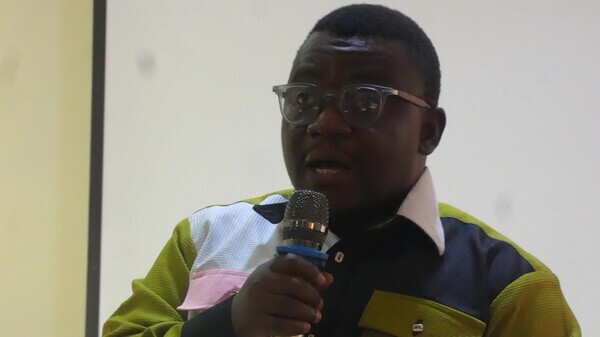
The Upper East Regional Chairman of the Ghana Journalists Association (GJA), Albert Sore, has called on journalists to deepen investigative reporting into water, sanitation and hygiene (WASH) challenges in healthcare facilities to help promote safe motherhood and improve the quality of healthcare delivery. According to him, journalists must move beyond simply reporting the lack of water, toilets and other essential sanitation facilities and probe the underlying causes of such challenges, identify responsible authorities and examine how the deficiencies affect patients and healthcare workers. Chairman Sore made the call at the launch of the 5th Upper East Regional GJA Media Awards at the Ghana Health Service In-Service Training Centre in Bolgatanga. The awards, scheduled for October 2, 2026, are being held under the theme: “Beyond the Headlines: The Media’s Role in Promoting WASH for Safe Motherhood and Quality Healthcare.” He said the choice of the theme was informed by the critical connection between WASH and healthcare, particularly for pregnant women, mothers and newborns. Chairman Sore cautioned against treating WASH as merely a routine development concern, stressing that access to clean water, adequate sanitation and proper hygiene could have direct implications for people’s health, dignity and survival. He urged journalists to pursue WASH-related stories beyond their initial publication by following up with relevant duty-bearers and demanding answers on measures being taken to address identified problems. “We must investigate. We must ask questions, follow up and find out what is being done and what more needs to be done,” he said. The GJA chairman further encouraged journalists to place greater emphasis on the human consequences of poor WASH conditions in healthcare facilities. He noted that inadequate water and sanitation services could increase the burden on already overstretched health workers while exposing mothers and newborns to avoidable health risks. He said journalists should therefore give affected communities a voice by documenting their experiences and using evidence-based reporting to push authorities towards practical and sustainable solutions. Mr. Sore explained that the theme for this year’s awards was deliberately aligned with WaterAid Ghana’s “Time to Deliver” campaign, which seeks to accelerate improvements in WASH services in healthcare facilities. He acknowledged WaterAid Ghana’s contribution to the Upper East Regional GJA Awards, noting that the organisation had supported the awards for the past three editions through its SHARE Project. He expressed appreciation for the partnership and encouraged journalists to use the awards theme as an opportunity to produce impactful journalism capable of influencing policy, shaping public discourse and triggering action. Beyond the focus on WASH, Mr. Sore said the regional awards were designed to celebrate journalists whose work had made meaningful contributions to development in the Upper East Region and Ghana. He identified MyTurn Limited and Lesken Enterprise Limited as lead sponsors for this year’s event, while Kacstone Records and the Paga Youth Movement are supporting the ceremony as main sponsors. The Regional GJA Chairman appealed to corporate organisations, Metropolitan, Municipal and District Assemblies (MMDAs), Members of Parliament, development organisations, traditional authorities and individuals to support the awards. He said additional support would enable the Association to provide more meaningful prizes, including cash and equipment, to journalists whose work demonstrates excellence, professionalism and measurable public impact. Mr. Sore stressed that supporting the GJA Awards should be viewed not simply as sponsorship of an event but as an investment in professional journalism, accountability and sustainable development in the Upper East Region. He urged journalists to use the awards as an opportunity to renew their commitment to journalism that informs the public, investigates societal challenges, amplifies the voices of affected communities and holds duty-bearers accountable for delivering solutions. Source: Apexnewsgh.com
Nabdam MP Donates 15 Sewing Machines to Centre for National Culture
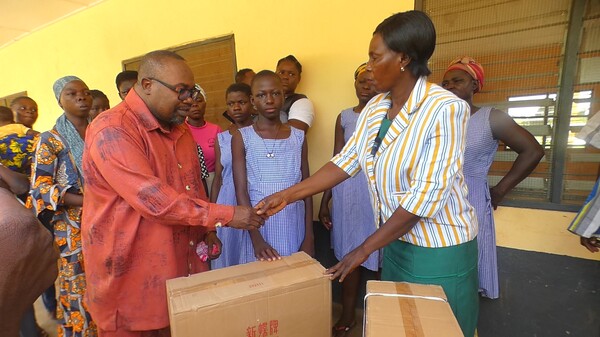
The Member of Parliament for the Nabdam Constituency, Dr Mark Kurt Nawaane, has donated 15 sewing machines to the Centre for National Culture in the Nabdam District to support vocational training for young people, particularly young women. The donation follows an inspection of the centre by the MP, during which he observed the challenges confronting the facility and the lack of equipment needed to effectively train the youth in various vocational skills. Speaking at the presentation ceremony, Dr Nawaane said the initiative was largely community-driven and had been championed by the Nabdam District Director of the Centre for National Culture, Madam Gladys Ayamga. According to him, Madam Ayamga had been working over the past six months to organise young women to acquire vocational skills but faced difficulties securing the necessary equipment. He said after visiting the centre and witnessing the situation firsthand, he decided to seek support to provide the needed sewing machines. “When I went back to Accra, I tried to look around and, thanks to God, today I am donating 15 sewing machines to the centre. This is a community-initiated activity.” Dr Nawaane stressed the importance of vocational and technical education, noting that not every young person must necessarily pursue university education. He said Ghana needed more people with practical and technical skills to meet the demands of the economy. “Not everybody is supposed to learn and go to university and go and do academic work. Currently, what we lack in Ghana is technical skills. What we lack in Ghana is vocational skills,” he said. In addition to the sewing machines, Dr Nawaane announced a financial support of GH¢5,000 to assist the centre in its training activities and enable the beneficiaries to explore additional vocational areas, including weaving. He also encouraged the centre to introduce other practical skills such as hairdressing and promised to support efforts to expand vocational training opportunities across the district. The MP expressed hope that within the next two to four years, the centre would have a larger number of students acquiring different vocational skills. He further urged the beneficiaries to take proper care of the sewing machines and use them strictly for their intended purpose. “These machines are set up for you to use them to learn. Take good care of them. Make sure that you learn and learn and learn. That is just what we expect from you,” he said. The Nabdam District Director of the Centre for National Culture, Madam Gladys Ayamga, expressed gratitude to Dr Nawaane for responding to the centre’s appeal for assistance. She said efforts to secure sewing machines for the trainees had previously proved unsuccessful despite repeated attempts to obtain support. “I am so grateful to him in the sense that he is able to come out to assist these youth. In fact, it’s not easy. I’ve been with them, struggling to get sewing machines to even equip them for the training,” she said. Madam Ayamga explained that the centre plans to expand its training programmes beyond dressmaking to include beading, hand-tassel weaving and other vocational skills. She, however, appealed for further support to enable the centre to extend its programmes to more communities in the district. According to her, distance remains a major challenge for young people from communities such as Sakote who wish to benefit from the training. She therefore called for support to establish or expand training opportunities in other parts of Nabdam so that young people would not have to travel long distances to access vocational education. Genesis of the Vocational Training Madam Ayamga explained that the vocational training initiative dates back to her time working with the Centre for National Culture in Bolgatanga, where she was involved in the hand-weaving and sewing departments. She said the experience enabled her to train several young people, some of whom later joined the Centre for National Culture as workers. She disclosed that in 2024, the centre trained 15 young women in dressmaking and five others in hand-tassel weaving. After completing their training, some beneficiaries received sewing machines and continued practising their trades within their respective communities. Others subsequently followed her to Nabdam, where they continued their training and graduated in 2025. Madam Ayamga said following the graduation, she appealed to the MP and the Nabdam District Assembly for support to recruit and train more young people. She also said the programme had opened its doors to persons with disabilities and other young people seeking opportunities for self-employment. She cited the example of a trainee who had previously learned dressmaking but returned to the centre to acquire additional skills in hand-tassel weaving. Madam Ayamga said the ultimate goal was to equip young people with practical skills that could enable them to become self-reliant and improve their livelihoods. The centre is expected to continue expanding its vocational programmes as it mobilises additional support and equipment for trainees across the Nabdam District. Source: Apexnewsgh.com