

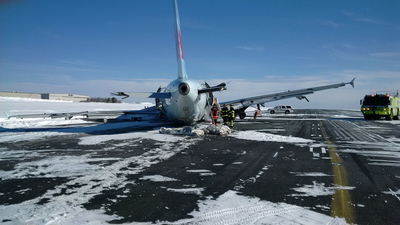
A harrowing incident unfolded at Halifax Airport in Canada when a PAL Airlines aircraft, operating as Air Canada flight AC2259, executed an emergency landing due to a landing gear malfunction. The dramatic event, which occurred around 9:30 PM AT, sent shockwaves among passengers and sparked widespread concern on social media. As the plane touched down, it skidded along the pavement, triggering panic among those on board. Passenger Nikki Valentine recounted the terrifying experience, describing how the aircraft tilted approximately 20 degrees to the left, accompanied by a loud crash-like noise. “The plane started to sit at about a 20-degree angle to the left, and as that happened, we heard a pretty loud—what almost sounded like a crash sound—as the wing of the plane started to skid along the pavement,” Valentine told CBC News. Viral footage captured the aircraft’s wings scraping the runway, causing a fire during the landing. Fortunately, no casualties were reported among passengers or crew. The emergency landing ignited discussions on social media, with users drawing comparisons to a deadly incident in South Korea. The incident has raised concerns over aviation safety, with many calling for answers. “Two catastrophic landing gear failures in a matter of hours? What’s happening in aviation right now? Mechanical issues or something more sinister? Questions need answers—fast,” one user expressed. In a statement, the airport confirmed the incident and stated that all passengers were evacuated and examined by paramedics. The airport was temporarily closed on Saturday night, though one runway was reopened shortly after. An investigation into the incident is currently underway. Source: Apexnewsgh.com
Man Arrested for Raping 13-Year-Old Girl
A shocking incident has led to the arrest of 34-year-old Oluwabunmi Anifowose, accused of raping a 13-year-old girl at Efon Alaaye in Ekiti State. According to Ekiti Amotekun Corps Commander, Brigadier General Olu Adewa, the suspect was apprehended on Saturday at a hideout in Ijebu-Ijesha, Osun State, where he had fled to evade capture. The victim, a minor, was reportedly sent on an errand to buy fufu when she was accosted and raped by the suspect. Anifowose was found hiding among suspected cult members, and Amotekun officers handed him over to the police at Efon Ekiti Division for further investigation and necessary action. In a separate incident, Amotekun operatives arrested two men, 30-year-old Usman Sheidu and 32-year-old Olalekan Aluko, for allegedly stealing an iron door at Oke-ljebu Agege area in Ikole Local Government Area. Source: Apexnewsgh.com
Russia Accuses US of Biological Warfare Activities in Africa
Russia has made a startling accusation against the United States, claiming that the US is engaging in increased biological warfare activities in several African countries, including Ghana. This accusation was posted on DW Africa’s Facebook Wall on Tuesday, December 24, 2024. According to the post, Russia alleges that the US is conducting research in Ghana and Djibouti on natural disease outbreaks, pathogen isolation, and sequencing. Additionally, the US has established a military medical center in Kenya to monitor infectious disease spread in Central Africa. In Nigeria, a joint medical research center and military medical laboratory were established in 2024, staffed by 10 specialists from the US Department of Defence. Deputy Secretary of the Russian Security Council, Alexey Shevtsov, had earlier claimed that the US is developing biological weapons, including some aimed at certain ethnic groups. These accusations are particularly concerning, given the US’s history of conducting biological research in Africa.¹ The US has been involved in various biological research projects in Africa, including a program in West Africa that aimed to detect and prevent the use of fever-viruses as bioweapons.² However, some have raised concerns that these projects may be used as a cover for more sinister activities, such as the development of biological weapons. The relationship between the US and Russia has been strained since Russia’s invasion of Ukraine in February 2022. Despite their shared interests in areas such as nuclear safety and security, non-proliferation, and counterterrorism, the two nations have been at odds over various issues. The accusations made by Russia against the US are serious and warrant further investigation. As the world watches, it remains to be seen how this situation will unfold and what implications it may have for global relations.
Japan and China Seek to Improve Ties Amid US-China Tensions
As US President-elect Donald Trump prepares to return to the White House, Japan and China are making efforts to improve their relations, which have been strained due to Beijing’s aggressive military activities in the Indo-Pacific region. Despite these efforts, analysts believe that longstanding tensions between the two nations will be difficult to overcome. According to Ian Chong, a political scientist at the National University of Singapore, “Tokyo does want to have smoother ties with Beijing, given the likely tumultuousness of the US-China relationship and also the global situation more broadly once Trump comes into office.” However, Chong notes that the basic positions of both countries are too far apart, making it challenging for them to pursue a fundamental reset in bilateral relations. Recently, Japanese Foreign Minister Takeshi Iwaya met with Chinese Foreign Minister Wang Yi and Chinese Premier Li Qiang in Beijing. The two sides agreed to facilitate a visit by Wang to Japan in 2025 and improve relations on a basic societal level. Wang emphasized the importance of strengthening people-to-people exchanges and consolidating public support for China-Japan friendship. However, Iwaya also expressed Japan’s serious concerns about the increased Chinese military activities in areas near Japan and Japanese citizens’ safety in China. Despite these concerns, the two sides agreed to hold a high-level economic dialogue and organize the Japan-China Security Dialogue to improve communication over security issues. Experts believe that Japan is seeking to extract “some positive goods” from China due to Beijing’s increasing concern about the incoming Trump administration. Stephen Nagy, a professor of politics and international studies at Tokyo’s International Christian University, notes that Japan is focusing on securing short-term gains in improving ties rather than resetting the relationship. One of the main disputes between China and Japan is Tokyo’s discharge of treated radioactive wastewater from the damaged Fukushima nuclear power plant. Beijing has repeatedly opposed Tokyo’s move and imposed bans on the import of Japanese seafood. Despite agreements to allow independent sampling of the treated waters, China’s import ban remains in place. While Japan seeks to improve ties with China, its relationship with the US remains a priority. Japanese Prime Minister Shigeru Ishiba has emphasized the importance of strengthening the US-Japan alliance, and Tokyo is expected to align itself with Washington as much as possible. However, Japan will also try to influence how US-China competition develops under the second Trump administration, conveying that its relationship with China is complex and cannot be simply cut off.
Mozambique Prison Riot Claims 33 Lives Amid Post-Election Unrest
A deadly prison riot erupted in Mozambique’s capital, Maputo, leaving 33 people dead and 15 injured. The violence occurred amidst ongoing civil unrest sparked by the disputed election results, which confirmed the long-ruling party Frelimo’s victory. Apexnewsgh reports The riot led to a massive prison break, with approximately 1,534 inmates escaping, although 150 have since been recaptured. Police General Commander Bernardino Rafael attributed the riot to protests outside the prison, but Justice Minister Helena Kida countered that the unrest originated within the prison itself. The incident has heightened concerns about public safety, with Rafael warning of a potential rise in crime over the next 48 hours. Mozambique’s interior minister reported that at least 21 people were killed in unrest following the top court’s decision, bringing the total death toll to over 150, according to civil society monitoring group Plataforma Decide. The disputed election results have sparked nationwide protests, with opposition groups and supporters claiming the vote was rigged. The situation remains volatile, with tensions expected to persist in the coming days. Source: Apexnewsgh.com
Trump Confidant Richard Grenell Sparks Diplomatic Storm in Pakistan
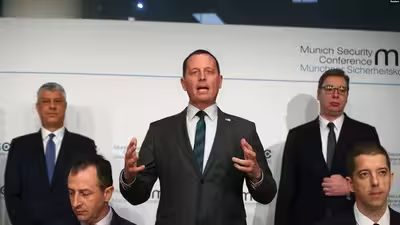
Richard Grenell, a close confidant of U.S. President-elect Donald Trump, has sent shockwaves through Pakistan’s political landscape with his persistent calls for the release of former Prime Minister Imran Khan. Apexnewsgh reports Grenell’s advocacy on social media platform X, where he tweeted “Free Imran Khan!”, has garnered significant attention in Pakistan, with many interpreting it as a sign of Trump’s support for Khan. The situation escalated on November 26 when Pakistani authorities violently dispersed opposition protesters demanding Khan’s release in Islamabad. Grenell’s initial tweet received limited attention, but it gained traction on December 15 when Trump appointed him as special envoy for global missions. Khan’s party, Pakistan Tehreek-e-Insaf (PTI), and its supporters amplified Grenell’s message, prompting a response from Pakistan’s Geo News channel, which described Grenell as “homosexual” in a headline. Undeterred, Grenell reiterated his call to free Khan, noting that his previous tweet had garnered 10 million views. Grenell’s pro-Khan stance has sparked speculation about its implications for Pakistan’s political landscape. Some Pakistani commentators have dismissed his tweets as publicity-seeking, while others believe they could influence the new U.S. administration’s interactions with Islamabad. Grenell’s credentials are impressive, having served as U.S. ambassador to Germany, special presidential envoy for Serbia and Kosovo peace negotiations, and acting director of national intelligence during Trump’s first administration. His latest tweet was in response to concerns expressed by Congresswoman Elissa Slotkin about the deadly opposition protests in Islamabad last month. With Grenell’s appointment as special envoy, many are watching to see how his advocacy for Khan will shape U.S.-Pakistan relations.
Record Deportations Pose Challenge for Trump’s Mass Deportation Pledge
The U.S. Immigration and Customs Enforcement (ICE) has reported a record-breaking 271,484 deportations to 192 countries over the past 12 months, the highest annual tally in a decade. This surge, nearly double the previous year’s count, poses significant financial and operational challenges for President-elect Donald Trump’s promise of mass deportations. ICE’s increased deportation flights, including weekend flights, and streamlined travel procedures for individuals being sent to Guatemala, Honduras, and El Salvador, contributed to the rise. Notably, ICE had its first large flight to China in six years and made stops in various countries, including Albania, Angola, and India. Meanwhile, U.S. Customs and Border Protection reported 46,612 arrests for illegal border crossings from Mexico in November, an 18% decrease from the previous month. This decline is attributed to increased enforcement by Mexican authorities and stricter asylum restrictions introduced by President Joe Biden in June. Mexico, Guatemala, and Honduras were the top destinations for deportees, with Mexico receiving the largest number (87,298). These countries are expected to continue bearing the brunt of deportations due to their governments’ willingness to accept their citizens and the relatively easier logistics. However, ICE faces significant challenges in carrying out mass deportations, including limited detention space and staff. The agency’s enforcement and removals unit has remained steady at around 6,000 officers over the past decade, while its caseload has quadrupled to 7.6 million. To address detention space constraints, the state of Texas has offered rural land as a staging area.
Israeli Settlers Vandalize Mosque in West Bank, Sparking Outrage
Israeli settlers set fire to and vandalized a mosque in the West Bank city of Marda, leaving behind a trail of hate-filled graffiti. The attackers, caught on security cameras, spray-painted slurs and threatening slogans on the mosque’s walls, including “Death to Arabs” and a quote from the Hebrew Bible’s book of Psalms. The mosque’s imam and local residents were left reeling from the attack, which they described as a “systematic terror attack” carried out by settler groups. The Israeli police and security agency Shin Bet have condemned the incident, vowing to bring the perpetrators to justice. Meanwhile, tensions in the region continue to escalate, with the Israel Defense Forces (IDF) launching airstrikes against Houthi militant targets in Yemen. The IDF reported that it hit fuel and oil tanks, two power plants, and eight tugboats, severely harming the military operations of the Houthi forces. In another development, Sweden announced that it would be ending its funding for the U.N. Relief and Works Agency for Palestinian Refugees (UNRWA), citing Israeli lawmakers’ ban on the agency’s operations in Gaza. The decision has been met with disappointment from UNRWA chief Philippe Lazzarini, who warned that it would double the suffering of Palestine refugees. The ongoing conflict in Gaza has resulted in the deaths of at least 45,000 Palestinians, with more than half of them being women and children. The war was triggered by a Hamas terror attack on Israel in October 2023, which killed 1,200 people and led to the capture of 250 hostages.
Trump Vows to End Gaza War, Issues Stern Warning to Hamas
President-elect Donald Trump has expressed his eagerness to bring a swift end to the war in Gaza, even as the outgoing Biden administration scrambles to secure a ceasefire deal. Trump’s warning to Hamas has sent shockwaves throughout the region, with many analysts interpreting it as a signal of a more aggressive approach to resolving the conflict. Speaking earlier this week, Trump issued a stern ultimatum to Hamas, stating that if the hostages held by the militant group are not released by January 20, 2025, his inauguration day, “all hell is going to break out.” This warning is reminiscent of a threat he made on social media earlier this month, in which he vowed that those responsible for the atrocities in the Middle East would face severe consequences. While Trump’s plans for Gaza remain unclear, analysts speculate that he may deploy military resources to pressure Hamas. Ahmed Fouad Alkhatib, a senior fellow at the Atlantic Council, suggests that Trump’s approach may not be significantly harsher than the measures already taken by Israel. However, Alkhatib notes that Trump may explore other options, such as squeezing humanitarian aid or pressuring countries that support Hamas to cut off financing. Trump’s warnings have been seen as a clear message to Hamas and its supporters that the US is committed to resolving the conflict. David Makovsky, director of the Washington Institute for Near East Policy Project on the Middle East Peace Process, believes that Trump’s statements have sent an “unmistakable message” to the region that the US is eager to bring an end to the war. As Trump prepares to take office, his stance on Gaza has already begun to shape the calculations of combatants in the region. Israeli Prime Minister Benjamin Netanyahu must now navigate the complex web of alliances and rivalries, balancing the demands of his ultraright-wing coalition partners with the expectations of Trump, who is eager to secure a breakthrough with Saudi Arabia. With Trump’s inauguration just around the corner, the world waits with bated breath to see how he will tackle the complex and deeply entrenched conflict in Gaza. One thing is certain, however: Trump’s bold warnings have set the stage for a dramatic and potentially transformative period in the region’s history.
Zelenskyy Seeks Strengthened Military Support in Critical Brussels Talks Amid Ongoing Russian Aggression
Ukrainian President Volodymyr Zelenskyy was in Brussels this past Wednesday, engaged in crucial discussions with NATO chief Mark Rutte and several European leaders as part of Ukraine’s ongoing efforts to strengthen its defenses against the escalating threat from Russian forces. The urgency of the situation was palpable. Just the day before, Zelenskyy emphasized the need for increased military support for Ukraine, particularly in terms of air defense systems. “We must do everything possible to destroy Russia’s ability to wage war from as far away as possible,” he stated, calling for more drones, modern artillery, and long-range missiles to bolster Ukraine’s military capabilities. As Zelenskyy prepared for the talks, concern loomed over the future of U.S. support, particularly with the upcoming inauguration of President Donald Trump a month away. The shifting political landscape added a layer of uncertainty to Ukraine’s already precarious situation. Among the notable figures joining Zelenskyy in Brussels were German Chancellor Olaf Scholz, Polish Prime Minister Donald Tusk, Italian Prime Minister Giorgia Meloni, Denmark’s Prime Minister Mette Frederiksen, European Council President António Costa, and European Commission President Ursula von der Leyen. They gathered at a crucial time, especially as Russia launched further aerial attacks overnight, intensifying the urgency of their discussions. In the backdrop of the meeting, Ukrainian air defenses were hard at work. Ihor Taburets, the governor of Ukraine’s Cherkasy region, reported that Ukrainian forces successfully shot down 13 drones without causing any damage to local infrastructure. Similarly, Khmelnytskyi Governor Serhii Tiurin confirmed that they too had intercepted two drones, showcasing the resilience of Ukraine’s defense efforts. On the Russian side, their Defense Ministry claimed the destruction of two Ukrainian aerial drones over the Belgorod region, along with additional interceptions over Bryansk and Kursk, highlighting the ongoing back-and-forth skirmishes in the conflict. Adding another layer of complexity to the narrative, Russia announced the detention of a suspect in the killing of Lt. Gen. Igor Kirillov, a prominent figure overseeing the military’s nuclear, biological, and chemical protection forces. Authorities identified the suspect as a citizen of Uzbekistan, allegedly recruited by Ukrainian intelligence to execute the attack in Moscow. The Ukrainian Security Service, or SBU, took responsibility for the operation, labeling Kirillov a “war criminal and an entirely legitimate target.” His actions during the nearly three-year war in Ukraine had already led to sanctions against him from several countries, including Britain and Canada. As these high-stakes meetings and military engagements unfolded, the situation remained tense, underscoring the critical importance of international support and strategic defense measures in the ongoing conflict.