

MTN Ghana Injects GH¢5 million Into COVID-19 Fight
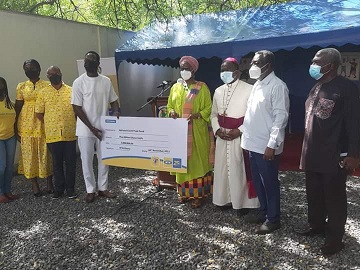
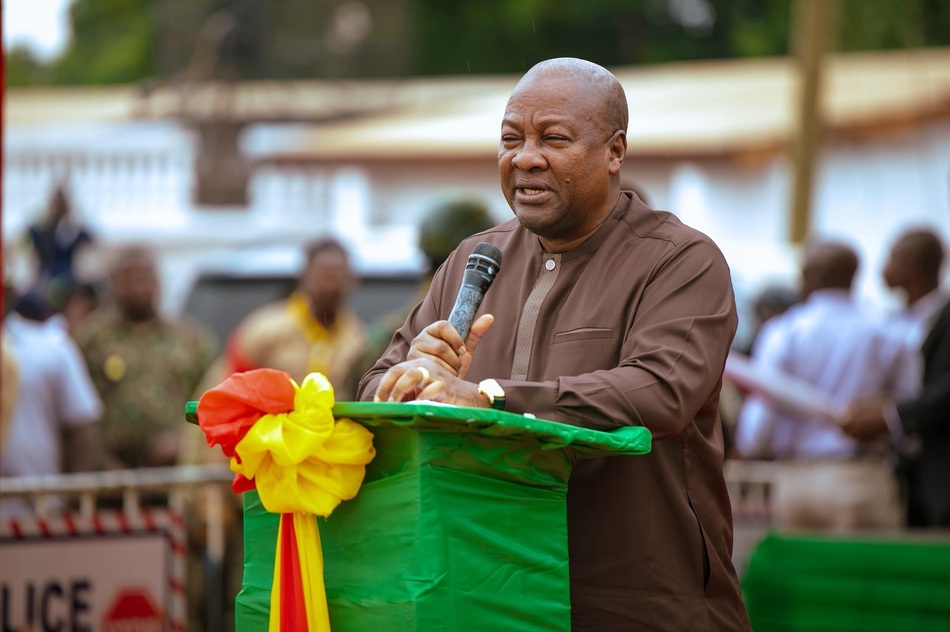
MTN Ghana has taken another giant step by donating five million Ghana Cedis (GH¢5,000,000) to the National COVID Trust Fund to help complement the government’s fight against the pandemic. This donation is in addition to an earlier donation of five million Ghana Cedis (GH¢5,000,000) worth of PPE and Testing Accessories presented to the Trust Fund last year. Speaking at the handing over ceremony in Accra, the Chief Executive Officer of MTN Ghana Mr. Selorm Adadevoh, said as a company they are committed to the socio-economic development of Ghana. “We are honored to have been able to complement the Government’s efforts in managing the pandemic through the donation of 5 million Cedis worth of PPEs and testing equipment to the country,” he stated. This he said, since the outbreak of the virus, the company has supported Ghanaians with many interventions to lessen the impact of the pandemic on the nation’s socio-economic infrastructure. One of the key things which we needed to address was to boost our Network to support work from home, online school, entertainment, and other digital activities. Our aim then and now is to help ensure continuity of life, business, and wellbeing. We are proud to have also contributed to three educational campaigns aimed at getting people to live responsibly. Our “Be Wise”, Wear it for me” and “One More Push” campaigns were to encourage people across the continent to not give up in the fight against COVID-19, and to continue to wear their masks, wash their hands and practice social distancing. According to him, on the vaccination front, MTN Group donated $25million to support AU’s vaccination rollout across 55 member states to cover 7 million vaccine doses for health workers. “Having acknowledged that we have all collectively played our roles in this fight against COVID-19, MTN Ghana and its Foundation have approved an additional GHc5m to be presented to National COVID Trust Fund. It is to ensure the Government’s strategy in combating the pandemic is fully achieved. This presentation brings MTN’s total contribution to the National COVID Trust Fund to GhS10m. We believe this will help immensely to provide the needed PPEs for the people of Ghana and most importantly brighten lives as we celebrate our 25th anniversary,” he added. He also used the occasion to congratulate the President, His Excellency Nana Addo Dankwa Akufo-Addo, and the Government for taking the needed measures in managing the spread of the disease in the Country. The Chairperson of the COVID -19 National Trust Funds, Her Ladyship Justice (RTD) Sophia A.B. Akuffo who received the cheque on behalf of the COVID -19 National Trust Funds commended MTN Ghana for embarking on such benevolence exercise; adding that the contribution has come at the right time. “Since the contribution to the Trust Fund have dwindled and almost halted. This was a result of the general perception that, the COVID-19 pandemic is either no more with us or is a pandemic for others to combat,” she disclosed. Stressing that, there is the need for collaborative efforts on the parts of all stakeholders to effectively help fight the pandemic. “We also need to support the promotion of research on the Coronavirus, its different variants the behaviour patterns, as well as the potency and efficacy of the various approved vaccines, especially the research on post-vaccination. For example the COVID-19 Specific Antibody Response in Vaccinated Persons in the Country, which has already been started by the Noguchi Memorial Institute for Medical Research (NMIMR), of the University of Ghana, Legon. This she said, the Trust Fund has also established a collaborative partnership with the National Road Safety Authority (NRSA) to jointly implement a Road Safety and Coronavirus education campaign. According to her, the campaign seeks to educate drivers, passengers, pedestrians, and other road users on the need to be careful on the roads especially during the Christmas period. “Since Christmas is also a spike period of the Coronavirus pandemic, due to the increase in trade and commerce, as well as the increase in the movement of people, goods, and services. It is therefore imperative to include COVID-19 education and information sensitization with that of the road safety education campaign. All these require substantial financial and other logistical resources,” she disclosed. She, therefore, urged the general public to continue to adhere to the prevention and safety protocols in order to avoid the spread of the virus. —newsghana Please contact Apexnewsgh.com on email apexnewsgh@gmail.com for your credible news publications. Contact: 05555568093
46th Edition Of MTN SWAG Awards Launched In Accra
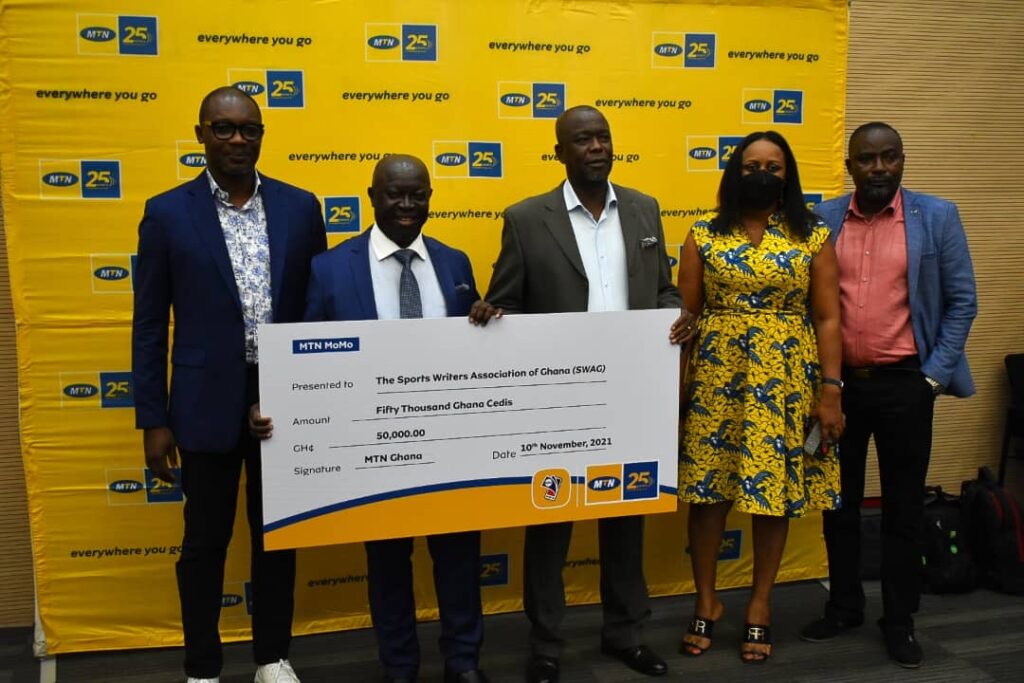
MTN Ghana in partnership with the Sports Writers Association of Ghana (SWAG) have officially launched the 46th edition of the SWAG Awards. The 2021 SWAG Awards is set to be held on the 17th of December 2021 at the Accra International Conference Center. MTN Ghana also used the occasion to announce a sponsorship package of fifty thousand Ghana Cedis (GHc 50,000) some souvenirs and airtime towards the SWAG Awards. The 46th MTN SWAG Awards was officially unveiled at a press conference held at MTN House in Accra. Speaking at the launch, the Chief Corporate Services Officer of MTN Ghana, Samuel Koranteng, said, “the decision to support the SWAG awards stems out of the MTN’s strong commitment to the development of sports men and women as well as sports in general”. “We are proud to be sponsoring a long-standing event that honours those who embody and have demonstrated extra-ordinary strength and resilience in their sporting endeavours”, he added. The President of SWAG, Mr Kwabena Yeboah, expressed gratitude to MTN Ghana for their unflinching support for the past decade. He said, “The partnership has gone a long way to strengthen the SWAG Awards and enhance its sustainability”. MTN Ghana remains committed to the development of sports in Ghana. The company has over the years committed resource towards sponsorship of different sporting disciplines. MTN’s support to sports development is not restricted only to sporting activities but also to sports journalists as well. MTN Ghana has been a major sponsor of the annual SWAG Awards for over 10 years and the headline sponsor of the awards for 2021. Apexnewsgh.com/Ghana/Ngamegbulam Chidozie Stephen Please contact Apexnewsgh.com on email apexnewsgh@gmail.com for your credible news publications. Contact: 05555568093
MTN’s Selorm Adadevoh Adjudged CIMG Marketing Man Of The Year 2020
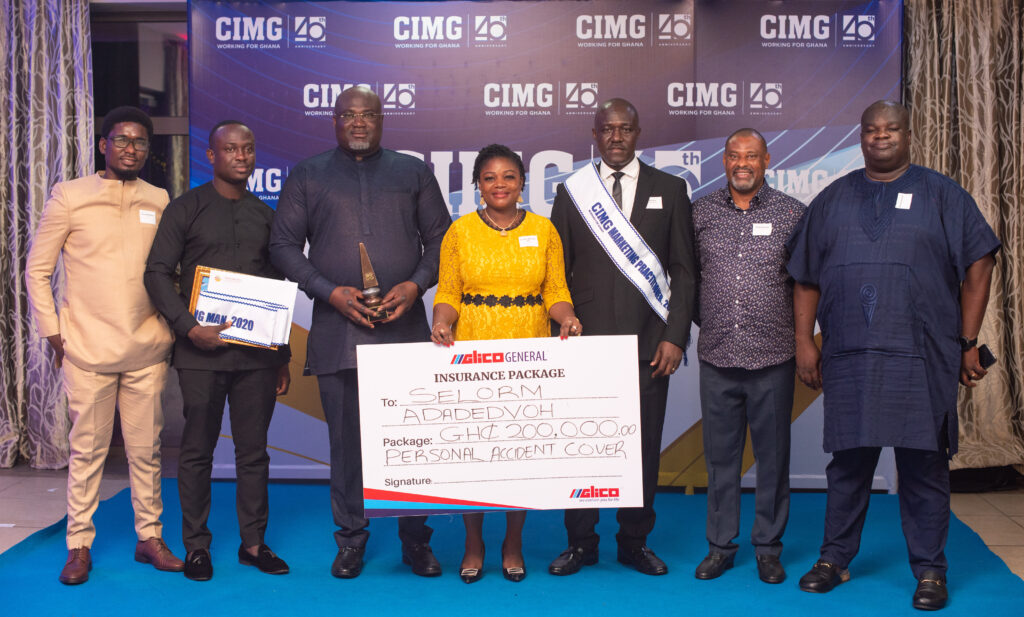
The CEO of MTN Ghana Mr. Selorm Adadevoh has been adjudged the Marketing Man of the Year 2020 at the 32nd Annual National Marketing Performance Awards organised by the Chartered Institute of Marketing. The award is in recognition of his excellence in strategic marketing in the areas of Market Insights, People Management, Corporate Reputation Management, CSR, and Sound Marketing Management. The citation to Mr. Adadevoh for being Marketing Man of the Year reads in part as follows: “A marketing corporate executive, an astute administrator and an achiever are what many see you to be; and these accolades were not lost on our team of assessors who could not agree more, thus this crowning moment. You led a company that is dedicated to lead in the delivery of a bold new digital experience for your customers, and you have succeeded in wowing them by making their lives a whole lot better.” At the same event MTN Ghana won three other awards including: Marketing Practitioner of the Year 2020 – Mr. Eli Hini, CEO of Mobile Money Limited, a subsidiary of MTN Ghana New Media Campaign – MTN “Wear it for me” MTN Ghana retained its CIMG Hall of Fame Award for the second consecutive year The awards add to the several other awards bestowed on the business and its executive officers across many platforms in recognition of its performance in a difficult year – 2020, a year that saw the outbreak of the global pandemic COVID-19, transforming businesses and their operations. MTN Ghana demonstrated resilience in its operations and invested heavily in corporate social investments helping the government of Ghana in its fight to stem the pandemic. Receiving the Marketing Man of the Year award via video, Mr. Adadevoh expressed his gratitude to MTN staff, partners and stakeholders for their support and contribution to the company’s achievement. He said, “a big thank you to all staff of MTN and partners for their contribution and to CIMG for the recognition”. “CIMG Awards is a very important award for us at MTN. Adjudged Marketing Man of the year, places a responsibility on me and MTN as a whole to continue the excellent work we do in meaningful ways not only to MTN but to Ghana”, he added. The CIMG Awards was instituted to deepen the interest of the marketing profession and that of its members and to ensure that the Institute impacts positively in the performance of its legitimate role in society, the economy of Ghana and the world at large. The 32nd edition of the Awards also coincided with the 40th Anniversary of CIMG and the 25th Anniversary of MTN and was organized under the theme “Repositioning Ghana to leverage AfCFTA for economic development.” Apexnewsgh.com/Ghana/Ngamegbulam Chidozie Stephen Please contact Apexnewsgh.com on email apexnewsgh@gmail.com for your credible news publications. Contact: 05555568093
MTN Ghana Invites Entries For 25th Anniversary Bright Media Awards Competition
MTN Ghana has launched its 25th Anniversary Bright Media Awards Competition to reward Ghanaian journalists. The Bright Media Awards Competition will reward journalists across the country for their immense contribution to the growth of the business through storytelling. The competition is part of activities being organised to commemorate MTN’s 25th anniversary celebration. Journalists are invited to submit entries on the topic: MTN Ghana – 25 Years of Brightening Lives. The rules of the competition are as follows: The competition is open to all Ghanaian journalists working in print, online media/digital, radio and television. Use of digital multimedia approaches/presentation will be an advantage Entries must be original works not previously published or broadcasted Print and online – article of not more than 1000 words. Radio – Audio documentary or magazine programme of not more than five minutes Video submission must be a short video/ documentary or magazine programme of not more than five minutes There will be a special award for best photographic presentation on the theme. Photographers/photojournalists are encouraged to send photos with captions and contexts. There is a limit of two entries per person. Awards prizes Overall winner will receive up to 25,000 cedis worth of prizes, including cash, digital device, plaque and other gifts. Category winners will also receive up to 10,000 cedis worth of prizes including cash prize, digital device and plaque. There will be special awards/consolation prizes as well. All entries are to be submitted digitally via brightmediaawards@mtn.com and the deadline for submission of entries is 5pm on November 25, 2021. Speaking on behalf of the Chief Corporate Services Officer of MTN Ghana, Nana Kofi Asare, Senior Manager, Commercial Legal said, “the media have been key to the success of the business; they have shared our stories with Ghanaians for the past 25 years. Through them we have kept our stakeholders and customers updated and informed on our operations and plans, and as we celebrate 25 years, it is only right that we include them in the celebrations and reward them for their good work”, he added. MTN launched its 25th anniversary in June 2021 to commemorate the company’s operations in Ghana. Several activities have been organized to celebrate customers, partners for their support and loyalty over the past 25 years. Apexnewsgh.com/Ghana/Ngamegbulam Chidozie Stephen Please contact Apexnewsgh.com on email apexnewsgh@gmail.com for your credible news publications. Contact: 05555568093
MTN Ghana focused on ambition 2025 strategy

MTN Ghana has stated that it will continue to support employees, customers and communities as it delivers against its ambition 2025 strategy in order to capture long-term growth opportunities and create sustainable value for all stakeholders. This was contained in the businesses Q3 performance report. MTN Ghana has witnessed a sustained growth in data, MoMo and digital offerings/solutions resulting in service revenue growth of 25.4% year-on-year. This shows that the significant investment made by the business is yielding results. MTN Ghana over the period has invested total CAPEX of GH¢1,060 million, which includes the rollout of 959 4G sites and the modernization of 1,543 existing 4G sites, resulting in an increase in 4G population coverage by 4.7 to 84.7%. “Our active subscriber base recovered from the previous quarter to record an increase of 0.4 million to 25.2 million. This was supported by our network investments, digital offerings and an improvement in quality of service. On the contrary, the contribution of voice to revenue decreased by 7.9% growing at 2% year-on-year. This phenomenon is impacted by shifts in customer behavior. “The sustained growth we have seen in a difficult year is a clear testament that our investments into the business and infrastructure is paying off and we will have remained focused on delivering our ambition 2025 strategy to ensure we give everyone the benefits of a modern connected life everywhere we go,” Selorm Adadevoh, CEO of MTN Ghana said. MTN’s Ambition 2025 strategy is anchored on building the largest and most valuable platform business with a clear focus on Africa. This will rest on a scale connectivity and infrastructure business, making use of both mobile and fixed access networks across the consumer, enterprise and wholesale segments. On the regulatory front, MTN Ghana continues to make progress in fulfilling by the end of 2021, all agreed localization requirements of 25% for Scancom PLC and 30% for MobileMoney Limited. Looking forward, MTN Ghana will remain focused on executing its strategy and unlocking value for all its stakeholders. The Ambition 2025 strategy is underpinned by five (5) growth platforms – MoMo (FinTech Solutions), Ayoba (Digital Solutions), Enterprise Services, Network (Network as a Service) and Chenosis (API Market Place). Please contact Apexnewsgh.com on email apexnewsgh@gmail.com for your credible news publications. Contact: 05555568093
MTN Ghana Implements Onnet/Offnet Parity Measures From November 1, 2021 In Compliance With SMP Directives

MTN Ghana today announced onnet/offnet parity measures on its network to ensure on-net/off-net parity for Voice and SMS special plans, promotions and bundle offers to enable customers enjoy the same rate for calls on MTN and calls to other local networks. In June 2020, MTN Ghana was declared a Dominant/Significant Market Power (SMP) in the Voice, Data and SMS markets. MTN has complied with all the defined directives to date by the Regulator. The objective is to increase competitiveness in the telecommunications industry. This initiative is one of the remedies imposed under MTN Ghana’s declaration as a Significant Market Power (SMP). Full details of the onnet/offnet parity are available on the company’s website www.mtn.com.gh, our social media platforms and will be published in print media. MTN Customers can also dial *550# for details. T& Cs apply. We continue to engage the Regulator to explore ways of promoting competitiveness in the industry while ensuring value for all our Customers through continued innovations in our products and services. MTN Ghana remains committed to pursuing its Ambition 2025 strategy which is anchored on building the largest and most valuable platform business to support Ghana’s digitalization agenda Apexnewsgh.com/Ghana/Ngamegbulam Chidozie Stephen Please contact Apexnewsgh.com on email apexnewsgh@gmail.com for your credible news publications. Contact: 05555568093
Winners of MTN@ 25 Mega Promo Receive Prizes: 20 More Brand New Hyundai Sonata Vehicles Up For Grabs

MTN Ghana has presented the first five (5) brand new Eighth Generation Hyundai Sonata Vehicles to the first set of winners of the MTN @ 25 Mega Promo. The winners drawn from data collated from the first month of the promotion consist of 3 national winners and 2 regional winners selected from the Ashanti and Ahafo regions. The first five winners are Mr Kofi Anane, Mr Boakye-Yiadom Osei Owusu, Miss Grace Amoah, Mr Eric Osei Agyeman and Miss Angela Dodzi Bakah. About 200 customers also received cash prizes up to GHC5,000 while 8,000 customers received airtime which were transferred to them digitally. MTN Ghana expressed its commitment to continue to brighten the lives of Customers beyond the provision of distinct Customer Experience and telecommunication services. Noel Ganson, the Chief Marketing Officer of MTN Ghana said, “the Silver Jubilee celebration could not be complete without recognizing the significant contribution of our numerous Customers to the success of the company. “With you, our Customers, we have been able to build a formidable business that provides value.” “The journey of rewarding 25 customers with the Hyundai Sonata, cash and airtime has just begun, therefore, all customers should take the MTN @25 Mega promotion seriously to benefit”, he added. Rehina Adams, Showroom Manager of Hyundai Motors and Investments Ghana Limited mentioned that the 8th Generation Sonata’s features include Push To Start, Remote Start Ignition, Voice Command Control and Shift By Wire Button. Other features include Reverse Camera and Reverse Sensors, Touch Screen with Internal Memory and Leather Seats. Angela Dodzi Bakah, one of the winners from the Ashanti region, expressed her delight in emerging as one of the winners and urged other users of MTN to be optimistic about winning. “I am very delighted. I joined the promo by doing more with MTN. I did more transactions and bought a lot of airtime and bundle. Initially, I thought it wasn’t real but winning this car has increased my confidence in MTN promotions. I encourage all Customers to subscribe to the promo and win big,” she said. MTN launched its 25th anniversary mega consumer promotion in August to reward Customers for their loyalty to the brand. The points–based promotion is designed to reward all Prepaid and eligible Post paid Subscribers (existing and new) based on their usage of products and services across MTN platforms. To participate in the promo, customers are required to dial *156# and select option 5 to opt-in. Alternatively, customers can enter the promo by downloading myMTN App and proceed to opt in digitally at https://tinyurl.com/25th-Promo. The mega promotion is expected to end on October 31st 2021. Winner Selection and Promo Rewards Customers who exceed their monthly target points by the highest percentage margin (by ranking) will be rewarded. In all, 25 Customers will be rewarded with 25 brand new Hyundai Sonata cars. Over 24,000 customers will be rewarded with cash prizes up to Ghc5, 000 and loads of free Airtime. As the 25th anniversary promotions run, MTN customers are advised to be wary of the activities of fraudsters who employ various tactics to defraud Customers. MTN Ghana will only call Customers via 0244300000. Winners of MTN promotions are not informed via any links or promo codes. MTN will not request for any money or airtime before customers redeem their prizes. Customers are advised to call the Toll-Free number 100 or interact with customer service agents on its social media handles as follows: Twitter @MTNGhana/@AskMTNGhana; Facebook: MTN Ghana WhatsApp:0554300000 and 0555300000. Customers also have the choice of using MyMTN App or Email via customercare.GH@mtn.com. Visit www.mtn.com.gh for more details on the promotion. Apexnewsgh.com/Ghana/Ngamegbulam Chidozie Stephen Please contact Apexnewsgh.com on email apexnewsgh@gmail.com for your credible news publications. Contact: 05555568093
MTN’s customer service practices have evolved; Mrs Jemima Kotei Walsh

Twenty-Five years ago when MTN Ghana, then known as Spacefon launched its Global System for Mobile communication (GSM) mobile cellular services with initial coverage in Accra and Tema, they only had a hotline of just about four employees to attend to customer needs and enquiries. Today, the mobile telecommunications company in Ghana attends to millions of customers across the country. Customer Service Week is celebrated annually during the first week in October — October 4 – 8 but in recent years, the company dedicates the whole month to celebrating and expressing gratitude to its customers for their loyalty. Earlier this week, our reporter, Efia Akese (EA), interacted with the Chief Customer Relations Officer of MTN Ghana, Mrs Jemima Kotei Walsh (JKW), to find out how the journey has been throughout the 25 years of operation, how the company’s customer services have evolved over the years and what customers should expect especially this year when the company marks its 25 anniversary in Ghana. Below are excerpts from the interview: EA: We know you are commemorating the 25th anniversary of MTN operations in Ghana, can you take us through the customer service journey over the years? JKW: The journey over the past 25 years has been a truly exciting and rewarding one. Mrs. Jemima Kotei Walsh presenting a prize to a customer at a Y’ello Soiree in Takoradi in the Western Region We have grown from just a handful of customers and customer service persons in the early days of the business to millions of customers and thousands of service personnel today. EA: What have been the major changes in customer service in your 25 years journey? JKW: Our customer service practices have evolved with technology and gone through significant transformations over the years. From a hotline of just about four employees to a fully-fledged contact centre and customer service team with over 600 personnel offering both self-service and agent-assisted options. Customers being attended to at the MTN Service Centre at Osu in Accra Our branch network footprint has expanded from just a few centres in Accra to regional and current national coverage. In recent years, we have also introduced digital and online channels such as our social media customer support, as well as apps to enable us to serve our customers remotely and to be present on their preferred channels. We’ve also strengthened the relationship with customers by introducing relationship managers and key account managers for managing some categories of our customer base. Customer Relationship Managers and some guests on the dance floor at a Y’ello Soiree This is in addition to the thousands of canvassers who are out there on the field providing trade services to customers. EA: What technologies have the company invested in to improve customer service delivery? JKW: Over the past 25 years, there has been a great deal of investment in all aspects of the business, including customer services, to provide the best quality experience to our customers. Technological advancements offered us the opportunity to update our customer relationship management tools to better serve our customers from queue management to intelligent routing to enhanced KYC (Know Your Customer) and customer management tools and now digital. We also have Voice of the Customer (VOC) tools to solicit feedback from customers as a follow up of their engagements with us to help us continuously improve. EA: Could you share any positive outcomes or success stories (experiences) with customers? JKW: We have many of such stories to tell. MTN Customer Relationship Managers presenting a cake to a customer on her birthday Customers’ needs vary and it’s always a delightful experience when a customer issue is resolved, no matter how simple or complex it may be because it brings smiles to their faces. Our customer experiences are too numerous to share here. EA: How has the role of the customer service personnel changed with technology? JKW: Technology has enhanced our service delivery practices such that today, a customer’s needs not come to our physical touchpoints to be supported on an issue. Some guests at a Y’ello Soiree organised to celebrate customers The more basic requests such as purchasing airtime or unblocking a PUK can be done by the customer without any support from service personnel. Our service personnel are also able to remotely support customers, as well as handle multiple customer interactions via digital channels with the help of technology. In all of this, our people have also developed and sharpened their skills to thrive in the digital world. EA: What are some of the challenges you have faced and how are you dealing with them? JKW: The customer experience landscape has greatly changed over the years and keeps evolving. Throwback: Some customer service staff posing by the prize car of the first customer promotion organised by Spacefon Increased customer traffic and the complexity of customers’ needs are some of the challenges. EA: I believe you agree with me that we cannot talk about the achievements and challenges over the 25 years period without talking about COVID-19? How has the pandemic impacted customer service delivery? JKW: It certainly put a lot of strain on our people, processes and channels, especially the online channels and our service centres amidst the COVID-19 protocols, but we rose above the challenges and delivered acceptable service standards under the circumstances. EA: Do customers understand why your customer service teams changed the way they interacted with them? JKW: Yes, I believe this is in relation to COVID 19. A customer receives a phone from MTN at a Y’ello Soiree In view of the nature of the pandemic and the awareness created, they were very understanding of the situation. EA: What were some of the high and low points during the peak of the COVID-19 pandemic? Can you share a touching story? JKW: The fear and anxiety stemming from the uncertainties of the pandemic and what the future holds were overwhelming in many ways. However, with the structures put in place and the support of the
MTN Group receives recognition on the Fortune’s Change the World list
MTN Group has received recognition on the 2021 Fortune Change the World list. The Change the World List is a global ranking of the top 53 companies that make a measurable progress addressing pressing social problems as part of their business strategy. “MTN is humbled to recognised on the Fortune Change the World list. We are committed to changing the world through meaningful contributions to the societies across the markets in which we operate,” says MTN Group President and CEO Ralph Mupita. “Our networks, products, and services are supplied with the intention of closing the digital divide by facilitating digital communications and financial inclusion.” The publishers of the Change the World list have noted that many of this year’s honourees are battling to reverse the neglect of some societal needs, as magnified by the pandemic. These companies are investing in the long-term health of their businesses by supporting those on the lower stages of the global economic ladder, including distributing COVID-19 vaccines in low- and middle-income nations. Since the start of the spread of COVID-19, MTN has remained committed to playing a part in the ongoing fight against the pandemic through our global mask wearing awareness campaign #wearitforme and #onemorepushafrica. Heeding the call for vaccinations across the African continent, MTN donated US$25 million to support the African Union’s COVID-19 vaccination programme. The donation to Africa Centres for Disease Control and Prevention (Africa CDC) will help secure up to seven million doses of the COVID-19 vaccine for health workers on the continent. Also noted during the pandemic, the urgent need to stay connected, saw data traffic soaring by 110% in 2020. MTN was able to address gaps in connectivity by improving the affordability of its services, whilst providing digital and financial solutions to consumers and businesses, whilst helping to drive digital inclusion to the most vulnerable and marginalised communities on the African continent. For MTN, better connectivity doesn’t mean less eco-responsibility. MTN works with its partners to make sure we limit our environmental impact and safeguards biodiversity around every cell tower we build. MTN has also set science-based targets of reducing greenhouse gas emissions by 47% by 2030 and achieving net-zero emissions by 2040. For us, this is about being part of the long-term solution, harnessing the power of partnerships to act swiftly to address the challenges brought on by the pandemic, whilst prioritising our people, customers, and communities, as well as looking after our businesses and the environment. It is for this reason, we continue to believe in the power of collective action to make a meaningful difference, focusing our efforts where needs are greatest. Read more: These companies are changing the world How a pan-African company is connecting the world—responsibly Apexnewsgh.com/Ghana/Ngamegbulam Chidozie Stephen Please contact Apexnewsgh.com on email apexnewsgh@gmail.com for your credible news publications. Contact: 05555568093
Cybersecurity month: MTN educates public on securing home, office and devices

Nothing is more important in this year’s cybersecurity month, than a focus on ways to cyber secure one’s home and office as working, learning and connecting virtually has become the new normal amid the Covid-19 pandemic. Indeed, Covid-19 has made working from home the order of the day, and that has given rise to the need for businesses to establish digital links between the office and homes of individual workers via cyberspace for work to go on, while ensuring employer safety. This gives no business comfort, because in doing so, they risk exposing trade secrets and classified information to the outside world through transfer of information between the office and the home. Whereas working from home was initially viewed as something that was going to impact productivity negatively, it has proven rather beneficial to many businesses, in that, when people work from home, they tend to work even beyond normal working hours, while attending to other home responsibilities. But it still does not take away the security risk that could pose to businesses. There are however very simple ways to secure homes and office, as well as the cyberspace that facilitate communication between the two locations to prevent hacks and interception of classified information. Beside the compelling reason for the working from home to remain amid Covid-19, the new normal now is digital and virtual; so many businesses and individual continue to do many hitherto offline financial transactions, not online. This obviously comes with its own risks of individuals and businesses having their bank and or mobile money wallets details exposed to cyberfraudsters if not well protected. Telecoms market leader, MTN Ghana has therefore put forward a number of ways Ghanaians could effectively secure their homes and offices and prevent any digital exposure and a compromise of the cyberspace between the office and the home. Passwords Firstly, MTN emphasizes the need for one to secure their wireless networks by changing the default administrator password to one’s internet router or any wireless access point, and also give each device and online account its own unique password. “Use a strong and unique password for each device and online account to make it difficult for outsiders to hack you device and or online account and access your vital information,” it said. Connected devices It also urges Ghanaian to ensure that they know all the devices connected to their wireless home network and be sure all those devices are trust. This is important because with a wireless home network like the MTN TurboNet for instance, several individual devices like phones, tablets, laptops and even smart televisions could be connected to it. Sometimes even visitors are given the access to the wireless network and any of the devices could be doing any activity that can pose a risk to others. Indeed, a visitor’s device connected to the TurboNet of this writer once did an online transaction payable with airtime and the system charged the fee, not the airtime of the person who did the transaction, but on the airtime on the TurboNet without the knowledge of yours truly. So it is important to know what each connected device is doing at any time. Regular backup It is also important, according to MTN, to ensure regular backup of important information so that one can always have access to missing information incase of a hack or any challenges. A number of ways to back include saving information on Google Drive. iCloud and or other online channels like in one’s email. The way to do this back ups can be found in phone settings, depending on the phone one uses. What to do is to do a Google Search on “how to backup information online” and follow the lead to do so. You are the shield It is important to remember that fraudster often capitalize on social engineering rather than technical know-how to commit their fraudster. In other words, the attack is mostly targeted at the individual, rather than the networks complex technical platform. In many experiences today, mobile money fraud, WhatsApp account hacks and many others are targeted at individuals and the fraudsters only succeed when the individual display naivity, gullibility and or greed. So the best shield or protection for each person online is the person himself. Each person needs to be vigilant and highly alert to hack and fraud attempts, which come hard on daily basis and in different forms. MTN therefore proposes a few simple tips to enable Ghanaians be on the alert regularly and avoid becoming victims of cyber fraud. No one is off limits The first thing to do is to avoid the wrong mindset that says “it can’t happen to me”. No one is off limits. In less than one week, yours truly had three attempts by fraudsters seeking to hijack my WhatsApp account. A former telecoms executive recently made a post of Facebook telling of how her mobile money wallet and WhatsApp accounts were hacked by a clever fraudster pretending to be a staff of a telco. The fraudster capitalized solely on her gullibility by making her trust him. She only realized it after they had done some damage to her. No one is off limits! Two-step verification Secondly, use two-step verification on all your online accounts – WhatsApp, Facebook, Twitter and others. What this does is that whenever someone tries to hack your account, the service provide would always send you a secret code (often six digits) and inform you that your account is being re-set. The fraudster would call you and pretend to be helping you by asking you to mention the code to to them. But NEVER-repeat-NEVER mention the secret code to them or anyone for that matter. If you do, your account is gone for good. Bot links Some people are fond of clicking every link they see online – whether on WhatsApp, Facebook, email, Twitter and what-have-you. It is important to be circumspect on what links to click because several of those link can