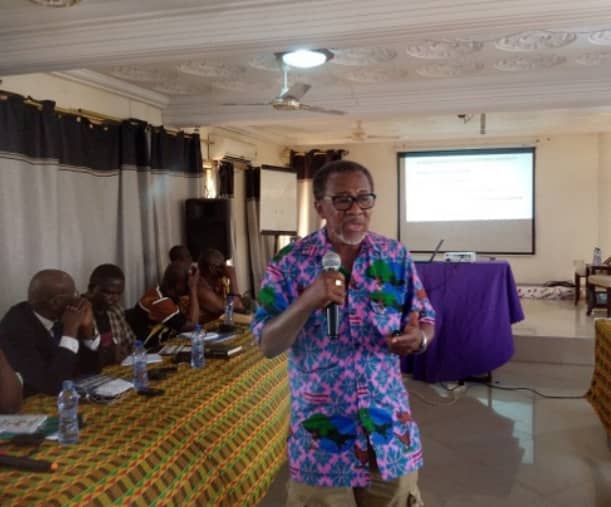
Prof. David Millar presents draft concept paper for PBL in NAVASCO as part of his Birthday Anniversary
Education, Opinion

Prof. David Millar presents draft concept paper for PBL in NAVASCO as part of his Birthday Anniversary

As part of his birthday Anniversary, President of the Millar Institute for Transdisciplinary and Development Studies Professor David Millar who also doubled as an old student of Navrongo Senior High School have put up a ‘draft concept paper’ for what he called a Novel Approach to Teaching and Learning in Secondary Institutions in Ghana Problem-Based Learning (PBL) in Navrongo Senior High School (NAVASCO). According to Professor Millar, “The records show that University for Development Studies, Tamale was first to introduce PBL in her Medical Programs in Ghana, and University of Cape Coast, Cape Coast, was first to do likewise in a Social Science Programs. The same records show that PBL is alien to Secondary Institutions”. “The public have bemoaned the education standards in the country and the general perception is that they are following along with the fact that they are not relevant for purpose. A clarion call from stakeholders but especially from the Education Minister during his recent visit to the UN Submit (September 2022) added to the need for proactive strategies to salvage Ghana’s Education”. He said: “In sharing with these concerns the Old Students Association of Navrongo Senior High School (NABIA), is attempting at heeding the call by all a sundry to come out with innovations to help salve her Alma Mata”. Meanwhile, as part of his birthday anniversary, Profession David Millar presented the concept paper to the school management and staff of her Alma Mata NAVSACO. Apexnewsgh.com can confidently report that the management of the school was extremely excited when the draft concept paper was presented to them by astute Professor Millar, as they immediately requested for urgent implementation of the concept. Kindly read the full concept below PROBLEM-BASED LEARNING (PBL) IN NAVRONGO SENIOR HIGH SCHOOL (NASVASCO)(DRAFT CONCEPT PAPER) PUT TOGETHER BY PROF. DAVID MILLAR OCTOBER, 2022 PROBLEM-BASED LEARNING (PBL) INTRODUCED IN NASVASCO: A NOVEL APPROACH TO SECONDARY TEACHING AND LEARNING IN GHANA 1.0 Prelude Problem-Based Learning (PBL) at the Second Cycle Institutions Level is not new in the Advanced Countries but it is relative new in Africa; and in Ghana not known to be practice anywhere at the Secondary Levels. This approach to teaching and learning is very prominent at various Medical Schools the world over. The records show that University for Development Studies, Tamale was first to introduce PBL in her Medical Programs in Ghana, and University of Cape Coast, Cape Coast, was first to do likewise in a Social Science Programs. The same records show that PBL is alien to Secondary Institutions. Recent events in the Education Programs in Ghana has given rise to a need for major reforms towards emphasis on TVET and Hands-on Education for various educational offerings. The public have bemoaned the education standards in the country and the general perception is that they are following along with the fact that they are not relevant for purpose. A clarion call from stakeholders but especially from the Education Minister during his recent visit to the UN Submit (September, 2022) added to the need for proactive strategies to salvage Ghana’s Education. In sharing with these concerns the Old Students Association of Navrongo Senior High School (NABIA), is attempting at heeding the call by all a sundry to come out with innovations to help salve her Alma Mata. Hence, the Old Students Association, with her own voluntary contributions, mobilized from Old Students Local and International have offered to launch the PBL program at NAVASCO, in collaboration with GES, the School Authorities, PTAs, and the Student Body. This will be organised first as an ICT-Science Club for PBL (starting with Biology, Chemistry, and Physics as pioneer courses). The experiences from this experiment, if impactful, will then be expanded to other programs of learning. 2.0 What is Problem-Based Learning (PBL)?(This is sub-chapter is extensively from literature)The term “Problem-Based Learning” (PBL) was originally developed by Barrows and Tamblyn (1980) for Medical Education. It is based on the Constructivist Theory of Learning.PBL is a pedagogical strategy that uses open ended / ill-structured problems that mirror real-world problems. The authenticity of the problems helps students to transfer their knowledge and skills beyond the classroom, preparing them for the workplace and life in a rapidly changing world. The open ended nature of problems gives students the flexibility to approach it from different angles, to take different thematic sidelines according to their personal interests. This gives them control of the learning process, capturing their interest and motivating them to learn.Lewis et al. (1998) emphasises that the act of posing problems is integral to the process of solving problems. Finding or posing problems is a creative endeavour that can occur prior to, during, or after the act of problem solving. By keeping the problem definition open, the students can “frame and reframe” their perspective on a problem so they reach “goal clarity”. Educational psychologists have discovered that solving a problem is a back-and-forth (recursive) process, not a linear one (Pea, 1985). In this way the student takes ownership of the problem thus enhancing their engagement and responsibility for the learning process. Suggested principles of PBL (Slavery and Duffy, 1995)• Anchor all learning activities to a larger task or problem.• Support the learner in developing ownership for the overall problem or task.• Design an authentic task.• Design the task and the learning environment to reflect the complexity of the environment they should be able to function in at the end of learning.• Give the learner ownership of the process used to develop a solution.• Design the learning environment to support and challenge the learner’s thinking.• Encourage testing ideas against alternative views and alternative contexts.• Provide opportunity and support for reflection on both the content learned and the learning process.• Gudzial et al. (1997) consider the two most important aspects of Problem-Based Learning to be the authentic real world problems and students reflection on their experiences. • The teacher’s role changes from the provider of content to the facilitator of the learning process. Teachers present students with authentic problems and provide an

Read More
A Professor should at least profess some local innovation in their local communities—Prof. Millar Professor David Miller
Opinion

A Professor should at least profess some local innovation in their local communities—Prof. Millar

President of the Millar Institute for Transdisciplinary and Development Studies Professor David Millar is advocating for those with the title ‘Professor’ to redirect their effort by way of professing some local innovation in their local communities. Speaking in an exclusive interview with Apexnewsgh.com, Prof. Millar said, that is the only way the community people will recognize those rooming and calling themselves Professors in Africa. “Academia in Africa as a whole especially the Professors should redirect their effort by way of professing local innovation in our local communities. Once you start professing that, your people will appreciate the school you have gone to. For now, they don’t know you are a professor, they only know you have gone to school and you have come to solve this problem for them”. Meanwhile, Pro. Millar through his innovation in Ghana has started changing the narrative, especially for the people in the rural communities in the northern part of Ghana by way of using what is mostly described as nuisance grass to produce charcoal and brown paper. The grass initiative alone is expected to create jobs for the community people and as well reduced bush fires which in the past have affected some innocent farmers after losing their hard earn effort throughout the farming season. However, another interesting part of the grass innovation by Prof. Millar proves that the grass conversion into brown paper will massively address the issue of plastic and environmental pollution in Ghana. Apexnewsgh.com/Ghana/Ngamegbulam Chidozie Stephen Please contact Apexnewsgh.com on email apexnewsgh@gmail.com for your credible news publications. Contact: 05555568093

Read More
There is a need for the word ‘INNOVATION’ to be added to your institution name–Prof Millar told
Education, Opinion

There is a need for the word ‘INNOVATION’ to be added to your institution name–Prof Millar told

Director of Academic Planning and Quality Assurance of UDS Prof. Shamsu-Deen Ziblim has made an interesting suggestion to the President of the Millar Institute for Transdisciplinary and Development Studies Prof. David Millar for consideration. According to the Director of Academic Planning and Quality Assurance of UDS, there is a need for the word ‘INNOVATION’ to be added to your institution name such as Millar Institute for Transdisciplinary Innovation and Development Studies. “When I came here for the graduation this morning, the question I asked myself is, what is the name of the institution? Millar Institute for Transdisciplinary Innovation and Development Studies and I say wow, is it not better we add ‘innovation’? Because of the novelty, we have here. The innovation will be important. Stressed According to the UDS Professor, “even the first technical University Kwame Nkrumah University Science and Technology, we are yet to hear and touch the indigenous development using local resources to develop things that will help in environmental management and in less than two decades MITDS is able to produce grass charcoal and grass brown paper”. Apexnewsgh.com/Ghana/ Ngamegbulam Chidozie Stephen Please contact Apexnewsgh.com on email apexnewsgh@gmail.com for your credible news publications. Contact: 05555568093

Read More
COVID: The timing for the reopening of schools is a problem–Prof. David Millar Prof David Millar
Education

COVID: The timing for the reopening of schools is a problem–Prof. David Millar

Government and Ghana Education Service (GES) should have waited a little to observe this new strain of COVID before the reopening of schools for our kids on Tuesday. In a press statement released by Ghana Education Service on January 15, 2021, sighted by Apexnewsgh.com it says, “Management of Ghana Education Service (GES) wishes to inform students, teachers parents, and the general public that schools officially reopen on Mondays 18th January 2021 for the academic year”. “Management of GES, therefore, directs that all schools should use Monday to tidy up their classrooms and compound. Academic work will therefore begin on Tuesday 19th January 2021”. “In the light of that, Management wishes to inform all stakeholders that the annual event dubbed ‘MY FIRST DAT AT SCHOOL’ observed to welcome children entering school for the first time, will be held across all District and Regional Education Directorate on Tuesday 19th January 2021”.   However, Professor David Millar, the President of the Millar Institute for Transdisciplinary and Development Studies holds a different view following the directive of reopening of schools by the Ghana Education Service. According, to Prof. Millar who spoke to Ngamegbulam Chidozie Stephen of Apexnewsgh.com in an exclusive interview on Sunday, January 17, 2021, looking at the current experience and the dimension of the new COVID, government and Ghana Education Service (GES) should have waited a little to observe this new strain of COVID before reopening schools for our kids on Tuesday. “Basically, we now need to learn how to leave with COVID like we are living with other diseases, so I think it natural coming that in one way or the other we have to start the school system. But, the timing for me is the problem. They are saying there is a new strain of COVID and therefore the coronavirus incident is sparkling so that makes the timing a bit worry. Because, if it would have been the good old COVID that knew since the beginning of last year that one will see we live with it but, with his new strain that, they don’t know what it is, they say is worst than the first strain we got, is now very disturbing. So, we should hold on a bit, see how that pounds out then we send the kids to school. Because if, is really as devastating as they say it is, then we are subjecting all the kids to danger. This is a new COVID, we don’t know how it is but, we know is very deadly and colleagues and friend elsewhere have told me how deadly this particular one could be, and this new one, unlike the first COVID, doesn’t discriminate between the young and elderly and is even appearing to be more dangerous to the young than the elderly”. He told Apexnewsgh.com Apexnewsgh.com/Ghana/Ngamegbulam Chidozie Stephen Please contact Apexnewsgh.com on email apexnewsgh@gmail.com for your credible news publications. Contact: 0555568093.

Read More