


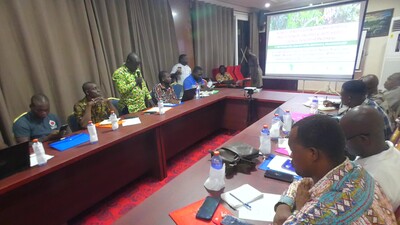


In the acclaimed documentary “Swallowed by Drugs,” produced by Ngamegbulam Chidozie Stephen of Apexnewsgh, Mr. Francis Adingo, President of the Upper East Youth Association, delivers a passionate and urgent call to action on the growing crisis of drug and alcohol abuse among the youth in the Upper East Region. His words echo the anguish of parents, the frustration of community leaders, and the deep concern of citizens witnessing a generation on the brink.
Mr. Adingo likens the menace of substance abuse to that of illegal mining, commonly known as GALAMSEY, drawing a parallel between the fight to save Ghana’s rivers and the need to save its youth. “Substance abuse is actually a major, major social canker,” he insists. “Just as we are fighting to protect our land and water bodies from GALAMSEY, we must put the same energy into protecting our youth from drugs and alcohol. What good is it to save the rivers if there is no one left to drink from them?”
He paints a poignant picture of parental heartbreak: mothers and fathers who have sacrificed to raise their children, only to see their dreams dashed by addiction. “It pierces the heart of parents to see you give birth, carry a baby for nine months, raise a child up, send a child to school, and then watch helplessly as they drop out or succumb to drugs,” Adingo says. “Parents are crying day in and day out for a solution.”
Highlighting the centrality of the youth to Ghana’s future, Adingo underscores that both male and female youth are the backbone of national productivity and promise. “The strength of every nation, the productivity of every nation depends on the youth,” he declares. “If we don’t address this, we are mortgaging the future of our country.”
Mr. Adingo does not shy away from assigning blame or demanding accountability. He commends the National Police Special Task Force for their efforts nationwide, but asks, “What is the duty of the Narcotic Control Board? What is the duty of the local assemblies?” He argues that local authorities know where substance abusers gather, yet enforcement is often lax. “Assemblymen know these people. Law enforcement agencies have the intelligence, but why can’t they crack down?” he asks. The lack of action, he believes, allows the problem to fester, even among professionals. “Some are even uniformed men and women, nurses. My own brother was a nurse but lost his way to substance abuse. Today, he is no more.”
Adingo is also critical of traditional authorities, lamenting the decline of discipline and community responsibility. “In the past, when you committed a crime, the chief would discipline you. Today, discipline has been abandoned. Chiefs, elders, opinion leaders, many have left us, the youth, to our fate.” This abdication, he observes, has weakened community bonds and accountability.
He points to another serious obstacle: the erosion of trust in law enforcement. “You tell a police officer about drug dealers, and suddenly your name is out in the community. People are afraid to provide information because their safety is at risk.” Adingo argues that for the fight against substance abuse to succeed, whistleblowers must be protected, and communities must feel safe to cooperate with authorities.
Adingo’s analysis is multidimensional, recognizing that substance abuse does not exist in a vacuum. He links it to poverty, regional disparities in education, and the lack of meaningful employment. “The poverty nature of our region is compounded by drug abuse and the wide gap between the South and North in terms of education,” he notes. “Until we sit down as youth, elders, opinion leaders, and chiefs, until we take collective responsibility, the Upper East is not going anywhere.”
He calls for increased investment in youth development: “When more factories are built, when more incentives are given to agriculture and youth employment, the youth will be engaged. When you get yourself so engaged, you won’t have time for these things.” Adingo urges the government, civil society organizations, and all stakeholders to join forces. “We need civil society organizations, we need volunteers… it’s a canker. What do we do to come together to make sure we solve these issues?”
A particularly haunting aspect of the substance abuse crisis, Adingo says, is its ripple effect. Addiction tears apart families, fuels domestic abuse, and erodes community values. “Some parents have lost hope in their children. Rehabilitation homes exist, but the fees are often too high for struggling families. We need to make rehabilitation more accessible.” He shares stories of young people who have turned their lives around through such centers, emphasizing that with discipline and support, recovery is possible.
Adingo is also troubled by the normalization of substance abuse. “You see women, men, even parents, spending time in drinking spots as if it’s normal. Some die quietly in their sleep, the substances having replaced food and family.” He describes a tragic scene: “A young man demands money from his aging father for drugs; when refused, he chases him with a cutlass.”
The problem, he warns, is not isolated. “If you think it is only your neighbor’s family afflicted today, tomorrow it will come to yours. When they finish destroying one community, they move to the next, recruiting more peers into addiction.”
Adingo’s call to action is resolute and inclusive. “All of us, pastors, imams, assemblymen, youth groups, civil society organizations, politicians, chiefs, we all have a role to play. We must bring back discipline, support our communities, and not be afraid to speak hard truths.”
He concludes on a note of hope, sharing the story of Atinbila, a young man who overcame addiction with community support and rehabilitation. “When we put in the effort, when communities rally around their youth, when we support those fighting addiction, there is hope. We can build a respectable, productive society so that tomorrow, our sons and daughters can live in peace.”
Mr. Francis Adingo’s voice in “Swallowed by Drugs” is a clarion call. It is a call for unity, courage, and decisive action, a reminder that the future of the Upper East Region, and of Ghana itself, lies in the hands of a generation that must be saved, not swallowed, by drugs.
Source: Apexnewsgh.com