

Former Defence Minister Nitiwul Accuses Mahama Administration of Abandoning Galamsey Fight
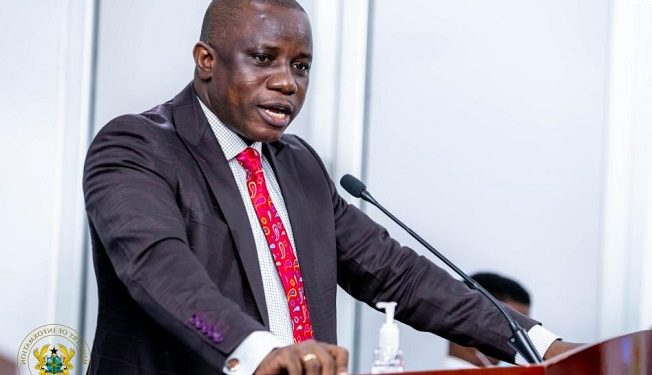
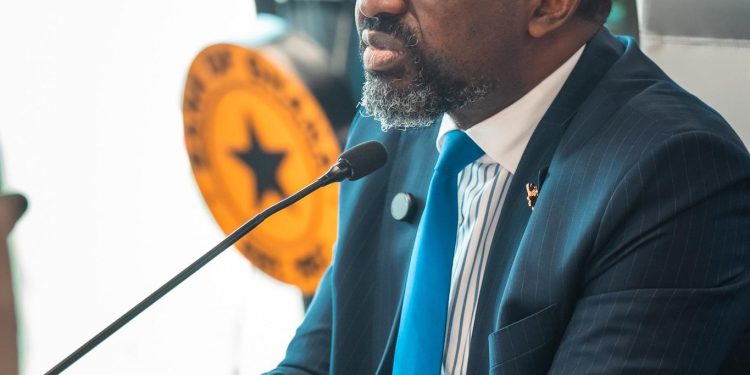
Former Minister for Defence, Dominic Nitiwul, has sharply criticized the administration of John Dramani Mahama, accusing it of abandoning the fight against illegal mining, known locally as galamsey. Speaking in an interview with Citi News on Wednesday, February 18, 2026, Nitiwul expressed alarm over the worsening depletion of forest reserves and the increasing pollution of major water bodies under the current government. Nitiwul noted that illegal mining has long been a source of grave environmental problems in Ghana, destroying forests and contaminating rivers that serve as vital sources of drinking water. Despite recent efforts by the government to clamp down on galamsey, he argued that the situation has only deteriorated. “No, no, that is worse off. Completely worse off. Everybody knows it’s worse off,” Nitiwul asserted. “We’ve depleted a lot of our team. Last year, what happened on the field was bad. It’s worse off.” He further alleged that the government has essentially abandoned its efforts to curb illegal mining. “I think the government has given up. That’s why nobody’s talking about it any longer. They’ve just given up. That’s basically what it is,” he said. Nitiwul’s comments highlight growing concerns about the government’s commitment to tackling galamsey and the environmental toll the practice continues to exact on Ghana’s natural resources. Source: Apexnewsgh.com
NAIMOS Foils Bribery Attempt After Seizing Illegal Mining Equipment in Bekwai
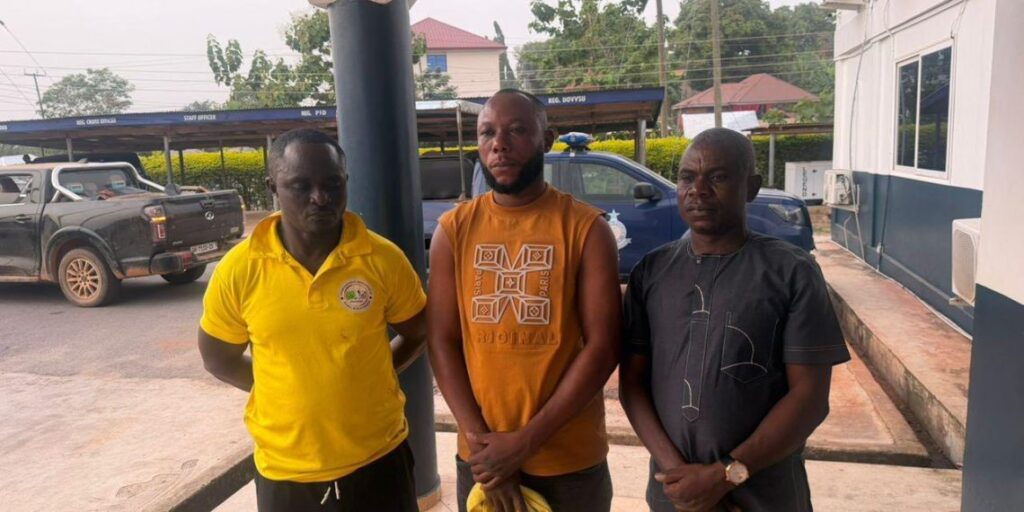
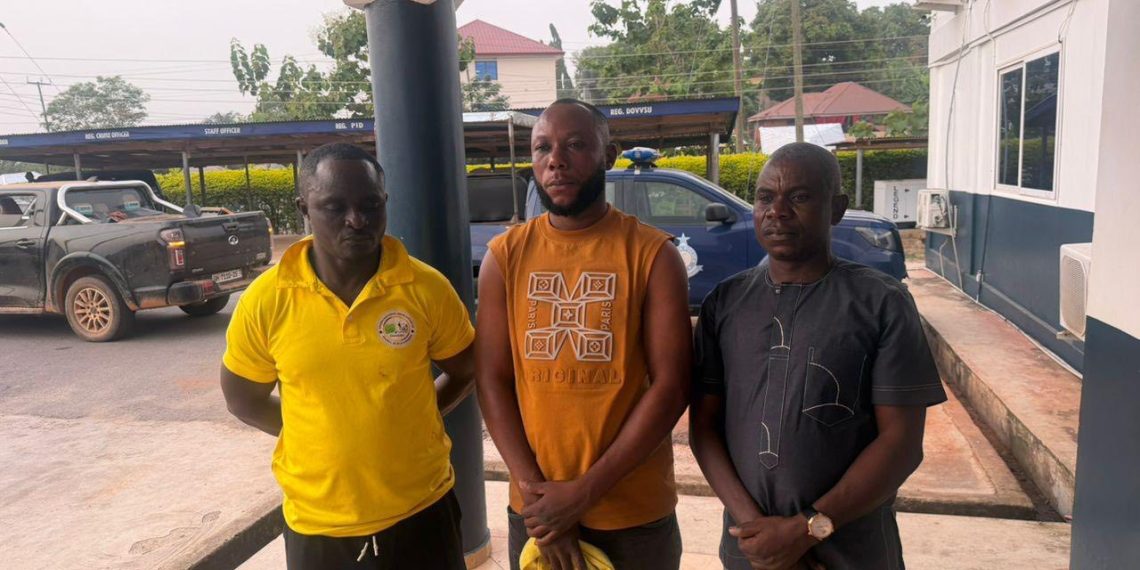
The fight against illegal mining in the Ashanti Region took a dramatic turn on Wednesday, February 18, 2026, when the National Anti-Illegal Mining Operations Secretariat (NAIMOS) foiled a bribery attempt by three suspected galamsey operators in the Bekwai Municipality. The NAIMOS task force, continuing its crackdown on galamsey, returned to the Edwinase and Kokotro sites, locations previously targeted for illegal mining. At Kokotro, the team uncovered an active galamsey operation perilously close to the town, raising concerns for public safety, property, and the environment. During the operation, the task force dismantled makeshift structures and destroyed industrial pumping machines and other illegal mining equipment. They also seized a Liugong excavator, two Liugong monitors, and an unregistered motorcycle as evidence. As the team made their way back to base, three men, Emmanuel Koblah, Samuel Addai, and Kofi Frimpong, approached them in a Black Tundra F150 with registration GR 4743–16. Claiming to own the Kokotro site, the men attempted to bribe the task force with GHC 119,825.00 in a bid to reclaim their seized equipment. The task force immediately rejected the offer, arresting the trio on the spot and handing them over to the Bekwai Police Station for further investigation and prosecution. The attempted bribe, the excavator monitors, and the vehicle have all been secured at NAIMOS headquarters as evidence. NAIMOS issued a stern warning to all illegal miners and their associates: any attempt to bribe officers will result in swift arrest and prosecution. The Secretariat also called on local authorities and security agencies to intensify surveillance of previously raided sites to prevent a resurgence of illegal mining activities. Source: Apexnewsgh.com
Major Illegal Mining Network on River Pra Dismantled in Covert Operation
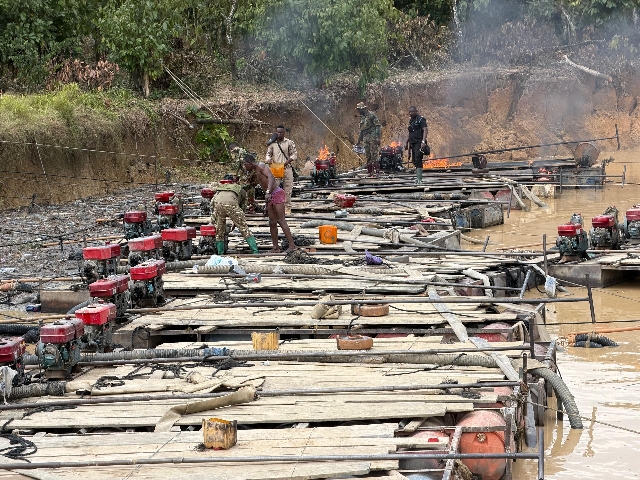
In a daring intelligence-led operation on Tuesday, the National Anti-Illegal Mining Operations Secretariat (NAIMOS) uncovered and dismantled a sprawling illegal mining network operating directly on the River Pra in Ghana’s Eastern Region. The raid, executed with the support of the Akyem-Oda Blue Water Guards, targeted the river corridor between the Ofoase Awona and Nsese communities in the Akyemansa District. This operation forms part of Ghana’s ongoing national campaign to protect vital water bodies and enforce environmental regulations. Acting on verified intelligence and shrouded in secrecy, the joint task force set out with a clear mission: to disrupt illegal mining activities, verify reports of environmental violations, and destroy equipment polluting the river. The River Pra, a lifeline for many communities, has faced severe degradation from illegal mining, so much so that several water treatment plants were recently forced to shut down. To reach the site, the team trekked nearly 14 kilometres through dense cocoa plantations, finally arriving at the riverbank where they discovered about 50 illegal miners actively working on the water. Sensing the imminent raid, the miners abandoned their operations and dove into the river, swimming across to Nsese to evade arrest. Undeterred, the task force pressed on, dismantling and destroying all illegal mining infrastructure left behind. The scale of the operation was significant; 75 dredging Changfang platforms and 50 gold washing platforms were destroyed, along with 150 Changfang machines that were found on the riverbed and subsequently burnt. Several pipelines and water hoses drawing water directly from the Pra were also destroyed. After the dust settled, NAIMOS officials engaged with local residents, educating them about the dire environmental, health, and livelihood risks posed by illegal mining. Community members expressed gratitude for the intervention and called for continued vigilance to restore the Pra River and safeguard their way of life. NAIMOS highlighted the troubling persistence of well-organised illegal mining networks in remote areas, which often operate with impunity despite local security and administrative structures. The Secretariat is now calling for stronger, better-coordinated efforts among security and administrative agencies to effectively dismantle these entrenched operations and protect Ghana’s natural resources. Source: Apexnewsgh.com
Perseus Mining Awards Scholarships to 172 Youths, Deepening Commitment to Community Education

Excitement and hope filled the air as 172 young men and women from Perseus Mining Ghana Limited’s (PMGL) operational communities were awarded scholarships totaling GH¢278,279 under the company’s Edikan Trust Fund. The ceremony, which drew together traditional authorities, community leaders, parents, students, and company officials, marked another milestone in PMGL’s ongoing investment in the future of its host communities. This year’s bursary allocation not only supports the educational pursuits of beneficiaries in various tertiary institutions across Ghana, but also represents a significant increase—GH¢68,279 more than last year’s expenditure. The boost underscores Perseus Mining’s growing commitment to education as a driver of local development. In his address, Alexander Oduro, General Manager of Perseus Mining, emphasized the transformative power of education. “Education equips individuals with the tools to improve their lives and contribute meaningfully to society,” he said. Oduro assured the gathering that PMGL would continue to empower host communities by investing in young people’s academic journeys. Board Chairman of PMGL, Ehunabobrim Prah Agyensaim VI, echoed these sentiments, describing education as a catalyst for social transformation. “Education gives young people the opportunity and skills to dream beyond their circumstances and strengthens the pillars of society by nurturing thinkers, innovators, and responsible citizens,” he remarked. He credited this belief as the guiding principle behind the company’s unwavering support for the Edikan Scholarship Scheme over the past five years. Nana Agyensaim, Paramount Chief of the Owirenkyi Traditional Area, highlighted the broader impact of Perseus Mining’s contributions. Since the inception of the Edikan Trust Fund, the company has invested over GH¢28 million in development projects, including scholarships, that have uplifted communities throughout the region. Akwasi Gyima Botah, Chairman of the Edikan Trust Fund, explained that the fund was established as a development vehicle to improve the socio-economic well-being of communities within PMGL’s operational areas. Its flagship initiative, the Edikan Scholarship Scheme, provides financial assistance to deserving but needy students at the tertiary level. “Hundreds of youths have benefited over the years. Many have completed their education and are now giving back to their communities,” he noted. For the beneficiaries, the scholarship is more than financial support; it’s a vote of confidence in their potential. Many expressed their gratitude, pledging to make the most of the opportunity and to honor the investment by striving for academic excellence. With each scholarship awarded, Perseus Mining reinforces its vision: to position education as a cornerstone for sustainable development in Ghana’s mining communities, ensuring that the next generation is equipped to build a brighter, more prosperous future. Source: Apexnewsgh.com
Government Revokes Law Permitting Mining in Forest Reserves Amid Galamsey Concerns

The government has officially revoked Legislative Instrument (L.I.) 2462, which previously granted the President authority to approve mining in the nation’s forest reserves. The revocation follows the maturation of the Environmental Protection (Mining in Forest Reserves) Revocation Instrument, 2025, which became law on Wednesday, December 10, 2025, after being laid before Parliament by the Minister for Lands and Natural Resources, Emmanuel Armah-Kofi Buah. This decisive move forms part of the government’s renewed efforts to combat illegal mining, commonly known as galamsey, which has wreaked havoc on the country’s environment and forest resources. L.I. 2462 had long faced fierce criticism from environmental activists and the general public, who argued that it enabled industrial mining in protected forest areas, undermining conservation efforts and fueling the destructive effects of galamsey. Environmental and civil society groups have welcomed the revocation, viewing it as a significant step toward restoring and safeguarding Ghana’s forest reserves. Source: Apexnewsgh.com
Chamber of Mines CEO Urges Caution and Dialogue on Mining Royalty Reforms

The Chief Executive Officer of the Ghana Chamber of Mines, Dr Ing. Kenneth Ashigbey, has urged the government to slow down ongoing reforms to mining royalties and intensify engagement with industry stakeholders to safeguard the sector’s long-term sustainability. Speaking at a media soiree on Tuesday, Dr Ashigbey addressed concerns over proposed changes to Ghana’s mining fiscal regime, including adjustments to royalty structures and taxation. He revealed that the Chamber has already initiated discussions with the Minister for Lands and Natural Resources regarding the proposed review of royalties. Dr Ashigbey clarified that the mining industry is not opposed to the introduction of a sliding royalty scale, but emphasized that the timing, thresholds, and broader fiscal context must be carefully considered. “We are not averse to the sliding scale. The challenge is at what point you are putting the sliding scale and the context in which you are putting us,” he explained. While referencing ongoing debates over lithium royalties, the Chamber CEO noted that the gold sector faces more immediate and far-reaching challenges. He cautioned that the government’s proposal to set royalties as high as 11 percent comes at a time when the industry is already contending with high effective tax rates and uncertainties in Ghana’s growth and stabilisation framework. Dr Ashigbey warned that pushing through the reforms too quickly could threaten the sector’s competitiveness and long-term viability. “What we believe should happen is that the government should wait and have more engagement. We should find a sweet spot that ensures the government gets its revenue, while the industry remains sustainable,” he said. He also cautioned that the swift legislative process, including a bill currently before Parliament, could undermine investor confidence if not handled with broader consultation. Dr Ashigbey stressed the need for a balanced outcome that would allow mining companies to grow and hire workers, while also supporting government revenue and job creation across the economy. He called on the government to temporarily slow the legislative process, urging broader dialogue with policymakers, industry players, and other stakeholders. “We need to put a brake on the process, bring all sides around the table, understand the government’s policy rationale and find the best way forward so we don’t jeopardise the sustainable development of the industry,” he concluded. Source: Apexnewsgh.com
Withdrawal of Lithium Agreement Sparks Debate Over Mineral Royalties in Parliament
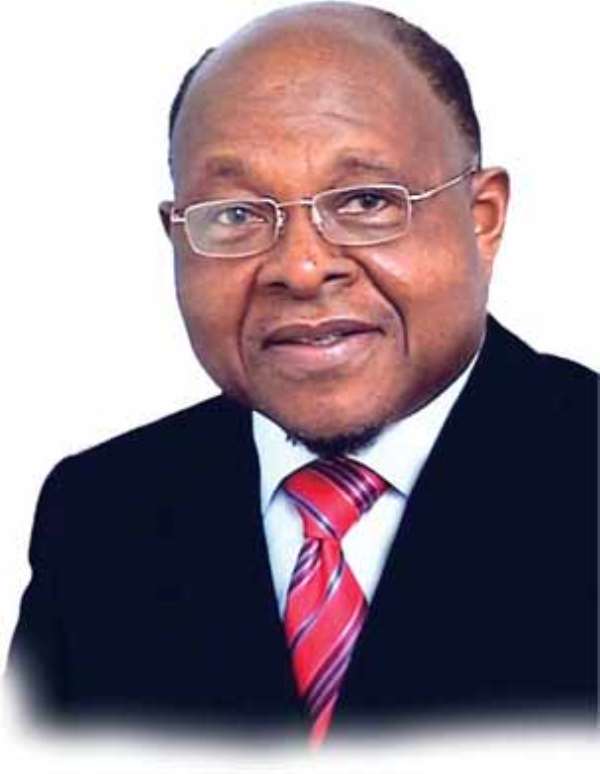
The recent withdrawal of a lithium mining agreement from Parliament has reignited debate over the country’s mineral royalty policies, following objections from the Majority caucus. The Majority argued that the 10 percent royalty rate negotiated by the Akufo-Addo administration contravened the Minerals and Mining (Amendment) Act, 2010, which caps royalties for such concessions at 5 percent. The former Speaker of Parliament Prof. Mike Oquaye emphasized that the controversy should extend beyond the debate over whether the royalty rate is set at 10 or 5 percent. He argued that Ghana has long disadvantaged itself by accepting a maximum royalty cap of 5 percent for valuable resources like lithium, gold, diamonds, and bauxite. “It’s very painful to envisage that we have something that has got value. Then we say, when you take this commodity, which has got value, don’t give me more than 5%. But give me anything 5% downwards. That is what the cap means, and who does that? Honestly, we have not been fair to our nation at all,” Prof. Oquaye asserted, adding that Ghana should negotiate for significantly higher royalties, suggesting rates of at least 20 percent, to ensure fair returns from its mineral wealth. The lithium agreement, initially presented to Parliament by Minister for Lands and Natural Resources Emmanuel Armah-Kofi Buah, concerns the mining of lithium and other minerals in Mankessim, Central Region. The agreement was later revised after Barari DV Ghana Limited, the mining firm involved, requested changes to the lease terms in light of a sharp downturn in global lithium prices, which affected the project’s commercial viability. Prof. Oquaye’s comments have sparked renewed calls for Ghana to re-examine its approach to negotiating mining royalties, with many stakeholders insisting that the nation’s interests must be better protected in future agreements. Source: Apexnewsgh.com
Galamsey: Atiwa East DCE denies jail reports, appeals contempt ruling

The Atiwa East District Chief Executive (DCE), Ernest Ntim, has filed an appeal against a contempt ruling by the Koforidua High Court 2, following his conviction over alleged involvement in illegal mining activities on protected land in the Eastern Region. Speaking on Citi Eyewitness News on Monday, December 15, Mr Ntim confirmed that his legal team has formally applied for an appeal, describing the court’s decision as one he intends to challenge until all evidence is publicly examined. According to the DCE, the court did not impose a custodial sentence but fined him and three others, a cost he said was shared among the four individuals. He dismissed media reports suggesting he had been jailed, insisting such claims misrepresented the outcome of the case. Mr Ntim said the appeal would focus on evidence allegedly linking him directly to the illegal mining site, particularly a video he claims has not been publicly played or subjected to proper scrutiny. He maintained that he was unfairly implicated and accused unnamed individuals of orchestrating the case against him. The Atiwa East DCE further stated that he has, since his swearing-in, briefed senior government officials on what he described as coordinated attempts to undermine him, expressing confidence that President John Dramani Mahama would not take any administrative action without hearing his side of the story. “I was asked to pay a fine, and we immediately applied for an appeal. I will follow up on this case until the video they claim shows me on the land is played for everyone to see. I was only fined. The GTV station that published the jail story was not in court. I do not think the President will act on calls for my removal without first listening to my side,” he said. The Koforidua High Court 2 fined Ernest Ntim after finding him 15,000ghs in contempt of court for allegedly continuing illegal mining operations despite an injunction application pending before the court. The court held that Mr Ntim and members of his team were responsible for environmental destruction, including damage to farmlands and pollution of the Koben River, a key water source for several communities. Source: Citinewsroom
Galamsey Crackdown: Forestry Commission Nabs 11 Suspects in Pra Anum Forest Reserve
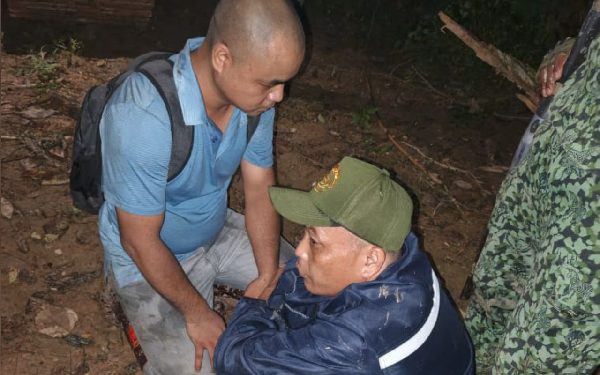
The Forestry Commission (FC) has arrested 11 suspected illegal miners, comprising eight Ghanaians and three Chinese nationals, in a joint anti-galamsey operation conducted at dawn on Sunday, December 14, 2025. The operation was carried out by a 28-member team drawn from three Rapid Response Teams, with support from officers of the Oda Forest District of the Forest Services Division. The Commission said the arrests were made in Compartment 70 of the Pra Anum Forest Reserve at Banka, within the Oda Forest District of the Eastern Region. The eight Ghanaian suspects were identified as Mohammed Mustapha, 25; Aminu Moro, 48; Owusu Emmanuel, 28; Raymond Opoku Agyemang, 32; Teye Joseph, 32; Oduro Emmanuel, 29; Aaron Oppong Gyebi, 36; and Isaac Apana, 32.Ghana sports merchandise The three Chinese nationals arrested are Jun Hunay, 42; Wen Yong Feng, 49; and Lu Zheng Zhan, 37. According to the Forestry Commission, all 11 suspects have been handed over to the Asante Akim Juaso District Police Command to assist with investigations and possible prosecution. The operation also led to the seizure of two pickup vehicles, a Toyota with registration number GW 4974-23 and a Great Wall vehicle with registration number GT 4189-25, as well as eight excavators and one automatic pump-action gun. The Commission said the seized vehicles have been sent to the Oda Forest District Office for safekeeping, while it reaffirmed its commitment to intensifying efforts to curb illegal mining activities in forest reserves across the country. Source: Apexnewsgh.com
Former Bogoso–Prestea Gold Mine Workers Demand Urgent Intervention Over Unpaid Benefits

A wave of frustration and hardship is sweeping through the homes of former employees of the Bogoso–Prestea Gold Mine, as they call on the Minister of Lands and Natural Resources, Emmanuel Armah-Kofi Buah, to step in and compel Heath Goldfields Limited (HGL) to fulfill its obligations and pay long-overdue statutory and contractual benefits. In a heartfelt petition dated December 10, 2025, the ex-workers detailed their ongoing struggle. Despite a clear directive from the Minister in May 2025, which gave HGL 120 days to clear all outstanding payments, the majority of separated employees are still waiting for their lawful entitlements. Only partial payments have been made, leaving hundreds in limbo. The petition paints a grim picture: months without income have pushed many ex-workers and their families into severe financial distress. The situation, they say, is “dire.” Some former employees have tragically passed away without ever receiving what was owed to them, leaving their dependents vulnerable and unsupported. Others, particularly the elderly and those medically unfit—now live in poverty and indignity, their dignity eroded by prolonged neglect. “Hundreds of affected workers have been without income for months, unable to provide food, education, and healthcare for their families,” the petition reveals, underscoring the human cost behind the unpaid benefits. The group criticizes HGL for repeatedly shifting payment timelines, making promises that remain unmet. HGL’s assurances that all arrears would be settled in December 2025 have yet to materialize, and the absence of clear, official communication has only heightened the anxiety and confusion among those affected. Beyond the immediate crisis of unpaid entitlements, the petitioners are also raising important questions about the process that allowed HGL to take over operations at the mine. They draw a parallel to the fate of the previous operator, Future Global Resources (FGR), and demand answers about the financial vetting and commitments that were supposedly evaluated by the government. “These signs of financial strain mirror the very problems that led to the removal of FGR,” the petitioners warn, expressing concern about the effectiveness of government oversight in protecting workers’ rights. Despite written assurances from HGL in late August and early October, key payments, including Provident Fund contributions and arrears, end-of-service benefits, severance packages, accrued leave, annual bonuses, and other statutory obligations, remain unpaid. The group also laments the lack of accessible communication channels, which has left them in the dark and compounded their distress. Many feel neglected, with no way to seek updates or clarity on when they might finally receive what is rightfully theirs. In a final plea, the former employees urge the Minister to enforce immediate payment of all outstanding entitlements, protect the benefits of those re-engaged, and establish strict timelines with penalties for any further default. Warning that their patience is wearing thin, they signal that public demonstrations may soon follow if urgent action is not taken. “Our families are suffering, our dignity is fading, and our lawful entitlements remain unpaid,” the petition reads—a powerful call for justice and relief for the hundreds of households who have long relied on the mining sector for their livelihoods. The ex-workers hope that with swift government intervention, their long ordeal will finally come to an end. Source: Apexnewsgh.com