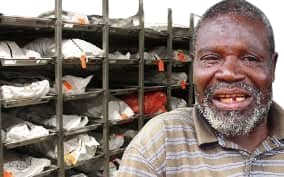




In many African societies, there’s an unspoken truth about mortuary attendants. They’re often shunned and stigmatized, their work viewed as taboo or unpleasant. This is the reality faced by Mr. Alhassan Azaah, a retired mortuary attendant who dedicated 20 years of his life to serving his community, region, and country. Despite his tireless efforts and genuine love for his work, Mr. Alhassan faced societal stigma. People perceived him as being exposed to something “unclean” or “unpleasant” simply because he worked with deceased individuals. This perception overshadowed his dedication and the invaluable service he provided to those in need. One would expect a man with Mr. Alhassan’s gift and strength to be celebrated and appreciated. However, his love and sacrifice for the people he served ultimately led to his stigmatization. His story highlights the challenges faced by mortuary attendants in many African societies, where their work is often misunderstood and underappreciated. Mr. Alhassan’s career as a mortuary attendant was marked by his compassion, strength, and dedication. He worked tirelessly to ensure that deceased individuals were handled with dignity and respect. His work was not just a job, but a calling that he answered with love and commitment. Despite the challenges he faced, Mr. Alhassan remained steadfast in his commitment to his work. He understood the importance of his role in supporting families and communities during difficult times. His story serves as a reminder of the need to appreciate and recognize the contributions of mortuary attendants, who often work behind the scenes to ensure that deceased individuals are treated with dignity and respect. A recent engagement between multiple award-winning journalists, Mr. Ngamegbulam Chidozie Stephen of Apexnewsgh and retired mortuary attendant Mr. Alhassan Zaah has shed light on the mysterious and often misunderstood world of mortuary work. Through their conversation, Mr. Alhassan shared some of his most profound experiences, revealing the good, the bad, and the ugly aspects of his profession. One of the most striking aspects of Mr. Alhassan’s story was his claim that he would often receive mysterious knocks on his door, signaling that someone in the hospital was nearing their end. These knocks were not just ordinary knocks; they were a harbinger of death, a sign that a life was about to slip away. “I’d get these knocks on my door in the middle of the night,” Mr. Alhassan recounted, his voice low and measured. “I’d open the door, and there would be no one there. But within minutes, the hospital would call, summoning me to the OPD or maternity ward.” Mr. Alhassan’s experiences were both fascinating and terrifying. He would often find himself drawn into a world beyond the living, a world where death was a constant presence. His story is a testament to the unseen forces that shape our lives and the mysterious ways in which we experience the world around us. This phenomenon has sparked debates about the supernatural and its connection to the spiritual realm. Some believe that knocking sounds can be a sign from the universe, a message from departed loved ones, or even a warning of impending danger. For Mr. Alhassan, the knock in the dead of night wasn’t a mystery; it was a grim omen, a fleeting visit from a soul moments from its end, delivering a silent summons only he could understand. Despite the initial shock, Mr. Alhassan had grown accustomed to this strange occurrence, and his experiences had become a topic of discussion among those who knew him. Mr. Alhassan’s tenure as a mortuary attendant at the Upper East Regional Hospital was a testament to his unwavering dedication and hard work. Despite the challenges he faced, he consistently demonstrated a remarkable commitment to his duties. Without any means of transportation to convey dead bodies, Mr. Alhassan had to rely on his own stretcher to often transport the deceased from the hospital to the mortuary. He would frequently manage up to 20 dead bodies per night, single-handedly, without any assistance. His resourcefulness and determination enabled him to develop creative ways to handle the bodies, including using a gauze to tie the legs of larger individuals. Mr. Alhassan’s experiences were not without challenges. He often had to use his hands and a supporter to carry the stretchers, and at times, people would even sit on top of the stretcher. Despite the difficulties, he persevered, driven by his commitment to his work. “I worked like a donkey, because i can work on 20 bodies alone without anyone assisting me,” He stressed As Mr. Alhassan reflected on his experiences, he noted that people’s reactions to him varied. Some appreciated his work and showed him kindness, offering him drinks and other gestures of goodwill. However, others didn’t take kindly to him, perhaps due to the nature of his work. Mr. Alhassan’s compassion and dedication to helping others were evident in his work. He had a special place in his heart for families dealing with death or sickness, and he approached these situations with the utmost care and respect. For him, assisting the deceased was not just a task, but a sacred duty. He believed that when God calls someone home, it’s his responsibility to serve that person well, ensuring they receive the dignity and care they deserve. This conviction drove him to treat dead bodies with the utmost respect, handling them with care and compassion. Similarly, when it came to the sick, Mr. Alhassan couldn’t bear the thought of turning a blind eye. He felt an overwhelming urge to help those in need, whether it was offering support, providing comfort, or simply being present. His kindness and empathy knew no bounds, and he poured his heart into every interaction. Mr. revealed that in 2019, despite his dedication and hard work, he faced sabotage from hospital officials who, he said, unexpectedly removed him from his position and replaced him with someone else. Mr. Alhassan was then assigned to a new role – sweeping the hospital floors. Though this new task was far removed from his previous