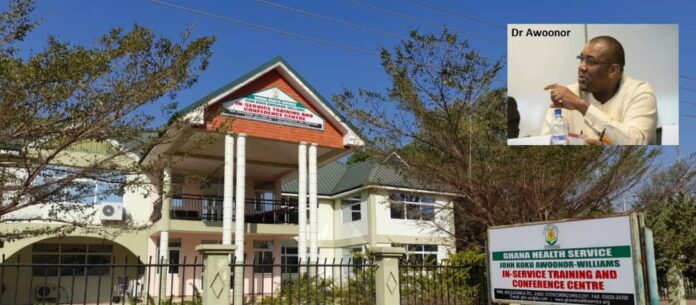
The Ghana Health Service (GHS) has renamed its in-service training complex in the Upper East regional capital, Bolgatanga, after a former Upper East Regional Director of Health Services, Dr John Koku Awoonor-Williams. The honour comes two years after the Commission on Human Rights and Administrative Justice (CHRAJ) had cleared him of a thievery allegation levelled against him in a petition lodged with some entities by BONABOTO, an ethnic association coined from the central part of the Upper East Region. The association— led by Vitus Azeem, Francis Atintono and Stanley Abopaam at the time— had accused Dr Awoonor-Williams of unlawfully taking five official vehicles from the Upper East Regional Health Directorate along with him upon his transfer from the region in 2015. The allegation was rooted in a claim made in August, 2016, by Dr Awoonor-Williams’ successor, Dr Kofi Issah, at a public event and during a media interview that five official vehicles could not be accounted for at the directorate after Dr Awoonor-Williams’ departure from the region. But a four-month-long investigation undertaken by Starr News (a subsidiary of the EIB Network) exonerated Dr Awoonor-Williams. Subsequently, an investigation conducted for 18 months by the CHRAJ—Ghana’s main anti-corruption organ— also affirmed in a 71-page report that BONABOTO’s imputation against Dr Awoonor-Williams and Dr Ebenezer Appiah-Denkyira (a former Director-General of the GHS who was similarly accused by BONABOTO) was not true. Dr Awoonor-Williams stands out among the 11 regional directors of health services the Upper East Region has had from 1972 up to the present time. Whilst he was in charge as the Upper East Regional Director of Health Services, he supported poor widows and orphans and gave scholarship assistance to a number of second-cycle and tertiary students in the region. He refurbished the 3-storey office block of the Upper East Regional Health Directorate and assisted many GHS staff to acquire their own vehicles under the Ministry of Health’s “Staff Vehicle Hire Purchase Scheme” as motivation to accept posting to hard-to-reach areas in the deprived parts of the region. Caption: Dr Awoonor-Williams transformed the Upper East Regional Health Directorate among his numerous achievements. He offered personal incentives to health professionals to accept posting to the Bawku Traditional Area and the rural corners of the region, renovated residential quarters for nurses, midwives and doctors in the region and constructed a 2-storey in-service training centre for the GHS. He introduced motorised tricycle ambulances to bridge ambulance gap in difficult-to-reach areas of the region, established a satellite campus for a “Degree in Public Health Nursing Programme” at Navrongo. He constructed an ultramodern walk-in cold room in the regional capital for storage of vaccines for the region, introduced the Mobile Technology for Community Health (MoTech) Initiative to help the region and Ghana attain the United Nations’ goals on infant fitness and maternal health. Dr Awoonor-Williams introduced the Ghana Essential Health Intervention Project (GEHIP) in the region through a proposal he wrote to the Doris Duke Charitable Foundation (DDCF) to help address maternal deaths and infant morbidity in three districts in the region. After that, he wrote another proposal that won a 9-million-US-dollar funding from the Korean International Cooperation Agency (KOICA) to achieve the same objectives of GEHIP across the region under what is known today in the region as the CHPS-Plus Project. He offered continuous support to the Ghana Red Cross Society, the Ghana Coalition of NGOs in Health, the Red Cross Mothers and several other local GHS partners to promote health in rural communities. Dr Awoonor-Williams also inspired and facilitated the expansion of the Upper East Regional Hospital (an ongoing project) in Bolgatanga and acquired a van for delivery of medicines and other non-consumables to health facilities across the region. He established a laboratory at the Regional Medical Stores at Zuarungu (capital of the Bolgatanga East District) for the preparation of mixtures and syrups. Even as a Regional Director of Health Services, he was also providing surgical services and clinical consultations at the Navrongo War Memorial Hospital, the Bongo District Hospital and the Upper East Regional Hospital as the region was plagued by an acute shortage of medical doctors. “Dr Awoonor has a passion for constructive change”— GHS Director In addition to these rare feats, he also undertook important research work that informed some national policies as well as staff development and capacity building programmes during the seven years he served as the Upper East Regional Director of Health Services. Dr Awoonor-Williams also supported poor patients financially and assisted several sick persons in the region to receive tertiary care at higher-level health facilities outside the region. Besides, he provided a fully furnished office and a restroom for drivers at the Regional Health Directorate and constructed a restaurant for the Regional Health Administration. He also facilitated construction of CHPS compounds in areas including the Builsa North Municipality, the Builsa South District, the Kassena-Nankana Municipality, the Kassena-Nankana West District, the Bawku Municipality, the Binduri District, the Bolgatanga Municipality and the Bongo District. “Dr Awoonor has championed a lot of programmes in Public Health, especially the CHPS. He has a passion of making constructive change or impact wherever he finds himself and he has strong collaboration with development partners in the area of health. He mobilised resources to build the in-service training centre some years ago as a training unit for healthcare staff among other good reasons. Management thought it wise during Dr Winfred Ofosu’s time to name the facility after him to inspire and to motivate people everywhere,” the new Upper East Regional Director of Health Services, Dr Emmanuel Kofi Dzotsi, said in a Starr News interview. Dr Awoonor-Williams was chased out of the region by an incited mob in October, 2015— a situation that reportedly made it impossible for him to hand over to his successor as properly as he should. He held a handkerchief to a tearful eye as he drove out of the deprived region (to which he had devoted everything for 7 years) immediately after he had handed over on a Monday morning.




 BILLY
BILLY