


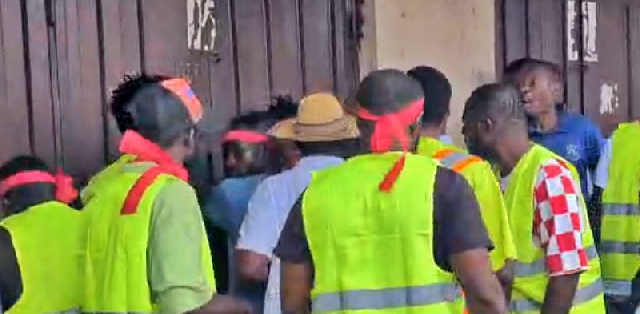




It was a tense morning at the Suame Magazine industrial hub in Kumasi, Ashanti Region, as members of the Ghana Union of Traders’ Associations (GUTA) prepared to continue their protest by keeping dozens of foreign-owned shops shuttered. But just as the day threatened to escalate, an emergency intervention by regional national security officials brought a dramatic turn of events.
Earlier that morning, the Ashanti Regional Coordinating Council (RCC) had summoned GUTA executives, Suame artisans, as well as representatives from the Bureau of National Investigations (BNI) and the Ghana Police Service for a crisis meeting. The goal was clear: to restore calm and address the underlying grievances fueling the shop closures.
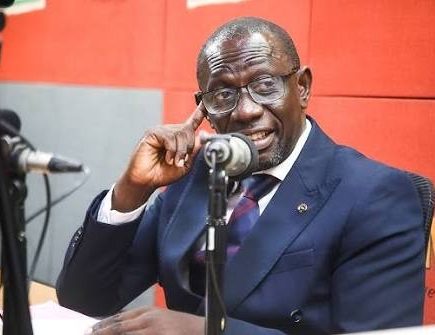
After intense discussions, the parties emerged from the meeting with a breakthrough. Speaking to the press, the Ashanti Regional Coordinator for National Security, Rtd. Captain Kwame Jabari, announced that GUTA had agreed to reopen all the locked shops before noon. “GUTA have decided on their own to open up the shops that they locked up yesterday before 12 o’clock today so that dialogue and communication can go on, and we can settle the issues without needing any conflict,” Capt. Jabari stated.
He commended the willingness of the union to pursue peaceful dialogue but issued a firm reminder: local trade associations do not have the legal authority to shut down businesses. “Such decisions should not be taken by the local counterparts because they are not law enforcement agencies, and they have no authority to go out closing up shops over there. That’s supposed to be left for the security agencies to do,” Capt. Jabari cautioned.
As part of the resolution, national security officials would visit Suame Magazine to directly brief local spare parts dealers on the outcome, followed by a separate engagement with Nigerian traders operating in the enclave. Capt. Jabari further urged GUTA’s national leadership to escalate their grievances to the Ministry of Trade and Industry for a lasting nationwide solution, while recommending that the Ashanti Regional Minister establish a stakeholder committee to tackle the issue locally.
“The regional minister has also been briefed on what transpired in the meeting, and we hope that the regional minister can set up a committee comprised of the various stakeholders so that this issue can be settled locally,” he said. “We also urge the national GUTA to take up the issue at a national level so that we can have stakeholder engagement with the Ministry of Trade, National Security, and the Police Service, so that this issue can be solved once and for all.”
For GUTA’s part, Ashanti Regional Chairman Anthony Oppong confirmed the group’s agreement, revealing that about 80 percent of the targeted shops at Suame Magazine had been closed during Monday’s action. He explained that requesting a direct address from National Security was necessary to dispel suspicions among members that GUTA leaders had been bribed to reopen the stores. “Most of the time, when these shops are closed, and they are reopened like this, the notion is that the leadership have betrayed the boys and has collected money from the Nigerians and their authorities,” Mr. Oppong said. “So we wanted them to come and let them know the reason why the shops are being opened.”
Mr. Oppong voiced frustration over what he described as a 20-year failure by successive governments to enforce the Ghana Investment Promotion Centre (GIPC) Act, which reserves local retail trading for Ghanaians. He recalled that after a similar incident at the Acheamfuo market two months earlier, GUTA had supplied data on foreign traders to the Regional Minister but received no response. “The law says that you shouldn’t stay in the market. So if you are not supposed to stay in the market and you are there, it means the right thing is to move out of the market,” he lamented. “We are very, very disappointed because this thing has been lingering on for the past 20 years and we’ve been fighting back and forth.”
Rejecting any suggestion that the agitation was politically motivated, Mr. Oppong attributed the unrest to intense economic pressures facing local businesses. He alleged that foreign traders exploit regional trade protocols to bring in imported Asian goods without paying Ghana’s standard port duties, undermining local traders who face steep import costs and high bank interest rates. “There is nothing political about this. It is our business; it is because our businesses are collapsing,” he stressed. “You cannot compete with somebody who is not paying those duties, so definitely they can undersell us.”
Addressing a viral video from Monday’s incident that showed a man in a smock being assaulted, Mr. Oppong clarified that the individual was Ghanaian, not Nigerian, and that no arrests had been made. According to him, the altercation began when a Nigerian shop owner allegedly hired local “machomen” to prevent his shop from being locked, which led to the scuffle. GUTA executives quickly intervened and arranged for the injured man to be taken to the hospital, where he is reportedly recovering well. “It wasn’t any violent, planned activity to intimidate or hurt anybody,” Mr. Oppong said.
He concluded by affirming that GUTA’s concerns about foreign retail operations in other Kumasi commercial centers, such as Acheamfuo and Alaba, were also part of ongoing discussions with National Security. The union expects decisive action from the government to protect local livelihoods.
With the shops at Suame Magazine set to reopen and new channels for dialogue established, the day ended with cautious optimism, but also a clear demand for lasting solutions to the long-standing tensions between local traders and their foreign counterparts.
Source: Apexnewsgh.com