







In the early hours of Monday, Cyclone Chido unleashed its devastating fury on northern Mozambique, leaving a trail of destruction that would haunt the region for months to come. As the storm made landfall in the district of Mecufi, it brought with it relentless winds and torrential rains, resulting in catastrophic damage, particularly in Cabo Delgado province. The chair of Mozambique’s National Institute for Disaster Risk Management and Reduction, Luisa Meque, surveyed the aftermath firsthand, revealing that at least 34 lives had been lost and 43 more injured. With rescue teams desperately combing through the rubble, she noted that these figures were only preliminary. The effects of the cyclone were far-reaching, with reports indicating that around 2.5 million people had been impacted. Among those who felt the cyclone’s wrath was Canjar Amade, who recounted his harrowing experience through a WhatsApp message. The cyclone tore apart his house overnight, with the winds wrenching the roof sheets away and ultimately collapsing the structure by morning. His story echoed the accounts of many others in the capital, Pemba, and surrounding districts, where destruction was near-total and few homes remained intact. As the nation grappled with the immediate aftermath, meteorologist Acacio Tembe warned that the remnants of Cyclone Chido still lingered, causing ongoing rains and strong winds across Niassa, Cabo Delgado, and other areas. The storm’s impact extended beyond Mozambique, as it also battered parts of Malawi and the island of Mayotte. Experts anticipated that the system would eventually dissipate near Zimbabwe by late Tuesday, but the damage had already etched itself into the lives of countless individuals. Mozambique, a country frequently besieged by the forces of nature, faces the harsh realities of climate change. The annual rainy season, spanning from October to April, often brings severe flooding and tropical cyclones. With predictions of a potential La Nina effect in southern Africa in early 2025, experts warned that the frequency and intensity of severe weather, including heavy rains and storms, were likely to increase. This prediction looms Source: Apexnewsgh.com
Iranian-American Journalist Sentenced to 10 Years in Prison Amid Ongoing Crackdown on Dissent
Iranian-American journalist Reza Valizadeh has been sentenced to ten years in prison by a court in Tehran. His conviction comes on the grounds of alleged collaboration with the United States government, a charge his lawyer, Mohammad Hossein Aghasi, condemned as politically motivated. Valizadeh, who previously worked for Radio Farda—an outlet associated with the U.S. Agency for Global Media—was found guilty on charges of working with what Iranian authorities deem a “hostile” government. Aghasi revealed that the verdict was issued by the Tehran Revolutionary Court and indicated that an appeal could be filed within 20 days. Despite this legal recourse, Aghasi lamented the fact that he has yet to meet with his client since the ruling. Compounding concerns about Valizadeh’s case is the context of his return to Iran. In a troubling message posted in August, he indicated that he had returned to the country on March 6, 2024, after a long absence of 13 years. He described his return as fraught with uncertainty, mentioning a lack of guarantees for his safety: “Eventually I came back to my country after 13 years without any security guarantee, even a verbal one,” he noted. According to Aghasi, Valizadeh experienced six months of freedom before being detained. The plight of journalists in Iran remains dire, highlighted by the recent tragic death of Kianoosh Sanjari, a former journalist with VOA’s Farsi Service. Sanjari reportedly took his own life in protest against the country’s oppressive regime, emphasizing the bleak reality for those who challenge the government. Just before his death, he had called for the release of imprisoned colleagues and threatened self-harm if his demands were unmet. This pressure on journalists is not unprecedented; a similar fate befell Parnaz Azima, a former Radio Farda broadcaster, who faced harassment and was barred from leaving Iran after a brief visit to see her ill mother in 2007. As Iran continues to grapple with societal unrest, particularly in the wake of the protests following Mahsa Amini’s death in 2022, the country’s economic struggles worsen. The rial’s continued devaluation against the U.S. dollar and persistent unemployment contribute to the rising tension among the Iranian populace, leaving many to question the future of freedom and expression within the nation.
U.S. Administration Condemns Iran for Imprisonment of Dual National Journalist
In a significant diplomatic concern, the Biden administration has publicly condemned Iran for sentencing Reza Valizadeh, an Iranian American dual national, to ten years in prison. This case stands out as the only known instance of a U.S. citizen being jailed in Iran since the rare prisoner swap that occurred in September 2023. The State Department confirmed the troubling news in an email, prompted by inquiries from Voice of America (VOA). “We are aware of reports that dual Iranian-U.S. citizen journalist Reza Valizadeh has been sentenced to ten years in prison in Iran,” a spokesperson stated. “We strongly condemn this sentencing and call for his immediate release and the release of all political prisoners in Iran.” Valizadeh’s situation came to light in October when reports surfaced regarding his detention in Iran shortly after the September prisoner exchange between the two nations. A former journalist for Radio Farda, a sister network of VOA, Valizadeh had left the Persian-language service in 2022. His sentencing not only highlights concerns regarding the treatment of dual nationals in Iran but also reflects the ongoing tensions and complexities surrounding U.S.-Iran relations.
North Korean Troops Engaged in Combat Alongside Russian Forces in Ukraine War
In a startling development, North Korean soldiers have been reported to be fighting alongside Russian troops in the ongoing conflict in Ukraine. According to a recent assessment from the Pentagon, the engagement of North Korean forces has been confirmed specifically in the Kursk region of Russia. Pentagon press secretary Major General Pat Ryder disclosed that these troops have actively participated in combat operations in Kursk, where they have already suffered casualties, both killed and wounded. He emphasized that the involvement of North Korean soldiers has been limited to this particular region for the time being. However, the Pentagon refrained from providing further details regarding the extent of the casualties faced by these troops. The news comes amidst escalating tensions in Eastern Europe, with the United States previously estimating that North Korea had dispatched approximately 12,000 soldiers to Russia for training in preparation for potential combat in support of Moscow’s military objectives in Ukraine. It appears that North Korean forces have only recently begun to join Russian military operations, marking a significant shift in the dynamics of the conflict. Just hours before the Pentagon’s announcement, Ukraine’s intelligence agency reported that at least 30 North Korean soldiers had been killed or injured during combat across various villages in the Kursk region. Ukrainian President Volodymyr Zelenskyy has publicly accused Russia of deploying a “significant number” of North Korean soldiers in its assaults, characterizing the losses among North Korean troops as “noticeable.” The international response to these developments remains cautious, with inquiries directed to both the Russian Embassy in Washington and the Russian Ministry of Defense going unanswered. As the situation unfolds, the implications of North Korean involvement in the war could reverberate throughout the region and beyond. Source: Apexnewsgh.com
Tragic Toll of Conflict: Gaza Health Ministry Reports Over 45,000 Dead Amid Ongoing Strikes
In a heartbreaking update released on Monday, Gaza’s health ministry announced that the relentless offensive by Israel against Hamas militants has resulted in the deaths of more than 45,000 people since the conflict began. Apexnewsgh reports The ministry noted that nearly 107,000 individuals have been injured, illustrating the magnitude of the humanitarian crisis unfolding in the region. Alarmingly, it has been stated that more than half of those killed are believed to be women and children, although the ministry does not differentiate between civilians and fighters in its casualty count. The past day marked yet another brutal chapter in this ongoing tragedy, as airstrikes claimed the lives of 52 additional people. Local civil defense and hospital officials reported that Israeli airstrikes targeted multiple locations, including Gaza City in the north, Khan Younis in the south, and the Nuseirat refugee camp in central Gaza. The Israeli military revealed that its operations aimed to strike key Hamas command and control centers within these areas. Israel has repeatedly asserted that Hamas militants operate within civilian-populated zones, complicating the military operations. In contrast, Palestinians and various human rights organizations have called attention to the Israeli military’s failure to adequately protect civilian lives during these assaults, raising urgent concerns about the mounting civilian casualties. The current conflict erupted in October 2023, ignited by a sudden and deadly attack from Hamas on southern Israel, during which approximately 1,200 Israelis were killed and 250 hostages taken. As of now, about 100 hostages remain in Gaza, with fears that at least one-third of them may be deceased. Amidst this turmoil, Hamas continues to be designated as a terror organization by the United States, the United Kingdom, the European Union, and various other nations, highlighting the complex and dire circumstances that have engulfed the region in suffering and loss. Source: Apexnewsgh.com
U.S. Air Strikes Target ISIS in Syria Amid Ongoing Conflict
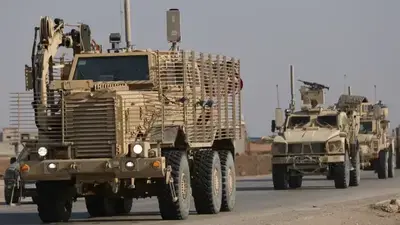
In a decisive move to undermine the Islamic State group’s influence in Syria, American forces conducted air strikes on Monday, successfully eliminating a dozen ISIS fighters, according to a statement from the U.S. military. The operation was part of an ongoing mission aimed at disrupting and degrading the capabilities of the notorious jihadist organization. U.S. Central Command (CENTCOM) revealed through social media that the air strikes targeted key ISIS leaders, operatives, and camps. This strategic initiative is designed to prevent the group from launching external operations and to thwart any attempts to re-establish a foothold in central Syria. CENTCOM further emphasized the significance of these strikes, which were carried out in areas previously controlled by the Syrian regime and Russia. The intent is to maintain sustained pressure on ISIS at a critical juncture in the volatile region. The backdrop of these operations is the recent upheaval following the downfall of Bashar al-Assad’s government, which was overthrown by an Islamist-led rebel alliance that seized the capital, Damascus, on December 8. In response to the evolving dynamics on the ground, U.S. forces targeted over 75 locations associated with ISIS, employing a fleet of warplanes, including B-52s, F-15s, and A-10s. Currently, around 900 U.S. troops remain deployed in Syria, with an additional 2,500 in Iraq, as part of an international coalition formed in 2014 to combat the persistent threats posed by the Islamic State group. The coalition’s ongoing efforts underscore a commitment to thwart the resurgence of this extremist organization in the region. Source: Apexnewsgh.com
A Grief So Deep: Families Seek Justice Amidst the Shadows of Damascus
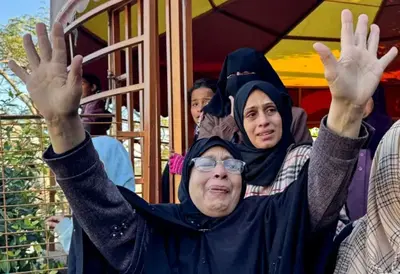
In the heart of Damascus, outside al-Mujtahid Hospital, a somber crowd gathers. The walls are plastered with grim photographs—images of bodies, victims of years of relentless torture. Apexnewsgh reports Families sift through the poignant reminders, desperately searching for missing loved ones. Yet, for many, their search ends in heartache as they leave without answers. A young woman, her black ponytail swaying as she strides away from the wall, breaks the silence with a piercing shriek. “You knew about this. You always knew!” Her voice trembles with anger as she demands accountability for the suffering. The crowd remains hushed until a man quietly offers, “God will have his justice after death.” She storms off, her disbelief echoing in the air. “What God?” she retorts. “I don’t believe in God.” According to the Syrian Network for Human Rights, an estimated 100,000 individuals are unaccounted for in Syria’s shattered prison system, although many locals suspect the true figure is much higher. Under the regime of Bashar al-Assad, arrests were often made for mere accusations of dissent against the government. As the citizens of Damascus navigate their daily lives—a struggle that includes waiting in long lines for bread or finding solace in rituals of newfound freedom—the shared anguish is palpable. A man at a bakery asserts the grim reality: “Every family in Damascus is missing someone.” Amid the sorrow, one woman, Hiba al-Sadfy, claims her family’s fortune, having not lost anyone directly. However, her husband, Anas al-Nesmeh, speaks of his time in prison, where the cries of the tortured still haunt him. “The driver was arrested, and they thought I was sending food to rebels,” Nesmeh recounts, revealing the horror of his three-year imprisonment where starvation and brutality were rampant. Marked by the scars of his past, his wife points to the lingering wounds on his wrists and back—evidence of his torment. Not far from the hospital, the community mourns the loss of Mazen al-Hamada, a young man who succumbed to the tortures of prison. Initially incarcerated for smuggling baby food to needy families, he later became an international voice advocating for Syrian torture victims after fleeing to Europe. His haunting testimony, where he described the unimaginable atrocities he witnessed, resonates deeply with those attending his funeral. As al-Hamada’s body is carried through the streets, a procession emerges, draped in a rebel flag that has now transformed into a symbol of their struggle. The mood shifts as grief morphs into a demand for justice; chants rise to the heavens, proclaiming, “The people of Syria are one!” and calling for the execution of those responsible for their suffering. The visible signs of dissent are unmistakable—posters of Assad, once symbols of his regime, are torn down and trampled underfoot as locals express their unrelenting anger. In a vivid act of defiance, one poster is placed on the ground at the entrance of the ancient market, an invitation for passersby to step on the face of the fallen dictator. In this atmosphere of grief and resistance, the people of Damascus are united, sharing a collective pain that transcends personal loss. Each search for the missing is a plea for justice, a cry that reverberates through the alleys and streets of a city scarred but not broken. Source: Apexnewsgh.com
Mysterious Drone Sightings Spark Concern Across Eastern U.S.
As the nation prepares for Donald Trump’s inauguration, questions abound regarding a series of mysterious drone sightings over the eastern United States. Apexnewsgh reports The incoming national security adviser, Republican Representative Michael Waltz of Florida, is calling for a thorough investigation into the origins and intentions behind these unidentified aerial vehicles. In recent weeks, residents from New Jersey and surrounding states have reported seeing upwards of 5,000 drones flying over their communities. U.S. officials quickly deemed this figure an exaggeration, with many conspiracy theories circulating, ranging from government surveillance to foreign threats posed by drones launched from vessels off the eastern coast. Waltz emphasized the need for clarity during a recent appearance on CBS’s “Face the Nation,” stating, “We need to get to the bottom of it.” Alongside him, Senator Amy Klobuchar of Minnesota echoed concerns about transparency, insisting that “this can’t be the future.” Despite the growing worries, officials from the White House, the Department of Homeland Security, and the FBI have sought to quell fears, indicating that most reported sightings are actually manned aircraft and do not pose a threat to national security. An FBI representative noted that, out of the thousands of claims, fewer than 100 warranted further examination. “We can’t ignore the sightings,” an official remarked, acknowledging ongoing investigations. “However, there seems to be a slight over-reaction regarding the number of claimed drone sightings.” Evidence of drone activity has been confirmed at military installations, including Picatinny Arsenal in New Jersey, yet investigators have found no indication of foreign involvement. The concern among state and local leaders continues to grow, as articulated by former Maryland Governor Larry Hogan, who reported seeing “dozens of large drones” above his home. Amid the flurry of speculation, President-elect Trump suggested that the Biden administration may be withholding critical information regarding the drone phenomena and proposed that these devices be shot down. In a similar vein, New Jersey Representative Christopher Smith criticized the government’s handling of the situation as “dismissive.” In response to these concerns, federal authorities have provided New Jersey officials with advanced radar technology equipped with an electro-optical infrared camera system to monitor the drones. However, White House National Security spokesperson John Kirby has assured the public that investigations thus far have uncovered no evidence of illicit activities related to the sightings. “Many of the reported sightings turn out to be manned aircraft operating lawfully,” Kirby confirmed, aiming to address the growing public unease about the unexplained aerial activity. As investigations continue, the origins and intentions of the mysterious drones remain a topic of widespread intrigue and concern. Source: Apexnewsgh.com
UN Forms Technical Committee to Break Libya’s Election Deadlock
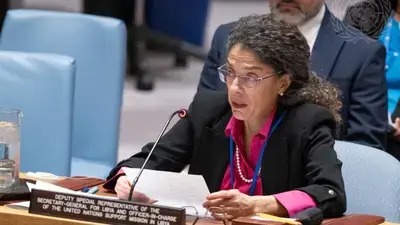
The United Nations announced the formation of a technical committee composed of experts in Libyan affairs. Apexnewsgh reports This initiative, shared by the acting head of the U.N. mission in Libya, Stephanie Koury, is intended to tackle the pressing issues that have hindered the country’s path to national elections. Libya has endured over a decade of upheaval since the NATO-supported uprising in 2011. The political landscape has been marked by conflict and division, particularly since the controversial election planned for December 2021 fell apart due to disputes over candidate eligibility. With the political process stalled, the new committee aims to address outstanding electoral law issues and develop strategies for holding elections as soon as possible. Koury emphasized the committee’s mission to explore various options, including potential guarantees and a timeline for the electoral process. The backdrop to this uncertain political climate is the presence of the Government of National Unity (GNU), led by Prime Minister Abdulhamid al-Dbeibah. Established through a U.N.-endorsed agreement in 2021, the GNU finds itself in a precarious position as the parliament no longer recognizes its authority. Despite this, Dbeibah has firmly vowed not to relinquish power without the mandate of a national vote, a statement that reflects the complex dynamics at play. As the nation grapples with the difficulties of achieving lasting peace, Libyans remain wary of the political players who, despite publicly advocating for elections, may not have their best interests at heart. Many citizens express skepticism about whether these leaders genuinely desire a democratic process that could see them removed from their positions. Koury reiterated UNSMIL’s commitment to facilitating not only the electoral process but also the unification of military and security institutions, emphasizing the importance of advancing national reconciliation. As Libya continues to navigate its turbulent political landscape, the efforts of the U.N. and the newly formed committee could be crucial in shaping the future of the country. Source: Apexnewsgh.com
Catastrophic Cyclone Chido Devastates Mayotte, Rescuers Race to Find Survivors
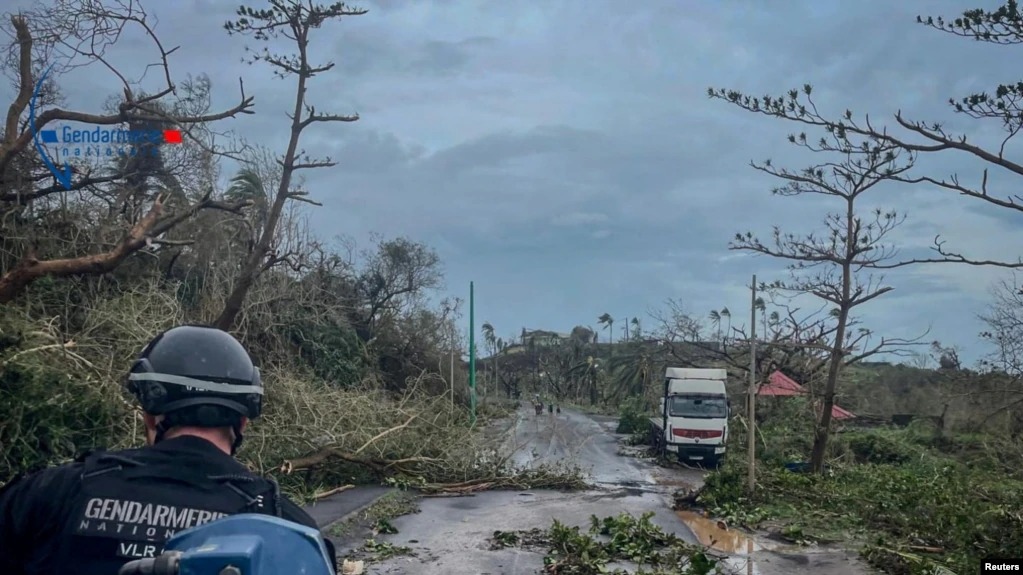
The French Indian Ocean territory of Mayotte has been left in ruins following a powerful cyclone that struck over the weekend. Cyclone Chido, packing winds of up to 226 kilometers per hour, swept across the islands, obliterating homes and disrupting vital services, with hundreds feared dead. Apexnewsgh reports Scenes of destruction have emerged from Mayotte, a region recognized as part of France but among its poorest territories. Entire neighborhoods have been flattened, leaving behind mere piles of rubble. “The storm has spared nothing. The hospital is hit. The schools are hit. Houses are totally devastated,” said Ambdilwahedou Soumaila, the mayor of Mamoudzou, the capital. The aftermath of the cyclone poses a significant challenge to the French government, which is presently operating in a caretaker capacity following President Emmanuel Macron’s last appointment of a new prime minister just days prior. As rescue efforts intensify, Health Minister Genevieve Darrieussecq revealed the grave state of healthcare on the island. “The hospital has suffered major water damage and destruction, notably in the surgical, intensive care, maternity, and emergency units,” she reported, noting that essential medical centers have become non-operational. With roads blocked and communication lines severed, officials are gravely concerned for those potentially trapped under debris in inaccessible areas. François-Xavier Bieuville, the prefect of Mayotte, warned that the death toll could reach several hundred or even thousands. In preparation for the rescue response, additional soldiers and firefighters have arrived on the island to support the initial deployments. Meanwhile, La Reunion, a nearby French island, serves as a crucial hub for relief operations. In the initial hours after the storm, a first aid plane delivered critical supplies, including medical materials and staff, to address the urgent needs of the injured and affected. As the scope of the disaster comes to light, international aid promises are flooding in. Ursula von der Leyen, president of the European Commission, assured that the bloc stands ready to support Mayotte in the coming days. Additionally, the World Health Organization has expressed its readiness to assist communities desperately in need. One local resident, Ibrahim, described the chaos unfolding on the island, referring to it as “apocalyptic scenes” as he navigated the wreckage. Many residents, particularly those living in shantytowns with flimsy roofs, faced immense peril as their homes were dismantled by the cyclone. The cyclone highlights the broader issue of climate change, with meteorologists noting that Chido was exacerbated by unusually warm waters in the Indian Ocean. Just after striking Mayotte, the storm made its way to Mozambique, where officials have reported three fatalities. As the rescue efforts continue under challenging conditions, the extent of Mayotte’s suffering remains uncertain, particularly for the estimated 100,000 individuals living clandestinely on the island, who may be hesitant to seek assistance for fear of possible repercussions. The coming days will be crucial in determining the recovery and support needed for the resilient islanders of Mayotte. Source: Apexnewsgh.com