






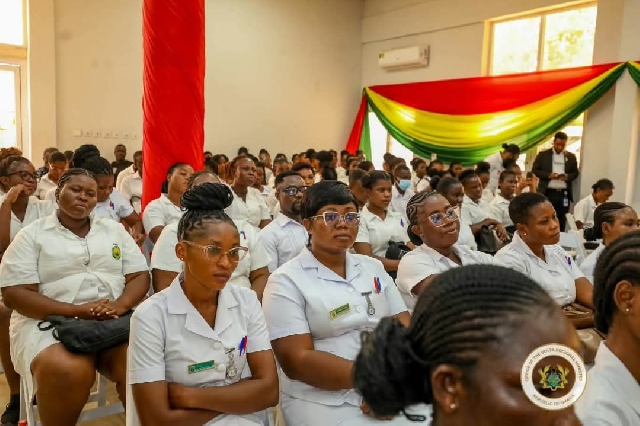

At the expanded Upper East Regional Committee of the Ghana AIDS Commission (ReCCOM) meeting held on September 29, 2026, Sulemana Majeed, Regional TB/HIV Coordinator for the Ghana Health Service/NACP, painted a sobering but hopeful picture of Ghana’s ongoing struggle with HIV.
Majeed explained that since Ghana stopped conducting the HIV Prevalence Survey in 2014/2015 due to funding cuts, national HIV data has relied heavily on statistical modeling and estimates rather than direct surveys. Using the NAOMI model, the country now estimates that about 337,435 people are living with HIV, with 10% of infections among children. “Most of our HIV cases are in adults, but the risk of mother-to-child transmission remains a concern,” Majeed noted.
He revealed a worrying trend: new infections are concentrated among people aged 20–44, Ghana’s most productive age group. In 2025 alone, the country recorded nearly 13,951 new HIV infections and 12,000 AIDS-related deaths. “New infections among young adults threaten our future workforce and demand urgent intervention,” he said.
Majeed also highlighted gender disparities: while more women live with HIV, men are more likely to die from AIDS-related complications, often because they seek care late, when the disease is advanced.
Ghana has not yet achieved the global 95-95-95 targets (95% of people living with HIV diagnosed, 95% of those on treatment, 95% virally suppressed) for epidemic control. As of 2025, only 70% knew their status, 81% were on treatment, and 92% of those on treatment had achieved viral suppression.
Projections suggest that without significant improvements, Ghana will fall short of the 2030 goal to control the epidemic. By then, the country hopes to reduce new infections to around 6,500 annually and AIDS-related deaths to about 4,000–5,000. But to get there, ART (antiretroviral therapy) coverage must rise from the current 58% of adults to 95%.
According to him, regionally, Upper East is among those with lower prevalence, but some districts have seen unexpected spikes in new cases, often linked to migratory labor patterns and mining activities. Majeed warned that 12 out of the region’s 15 districts need close monitoring.
He also identified ongoing challenges with data quality, double reporting, and incomplete records, but reported ongoing efforts to improve data accuracy and support staff.
However, he believe Ghana must ramp up efforts to find, treat, and retain people living with HIV, especially in the most affected age groups, to avert thousands of preventable deaths. “If we want to achieve epidemic control by 2030 and save lives, our response must be faster, stronger, and more focused than ever,” he concluded.
Source: Apexnewsgh.com